We have launched E-mail Alert service,subscribers can receive the latest catalogues free of charge

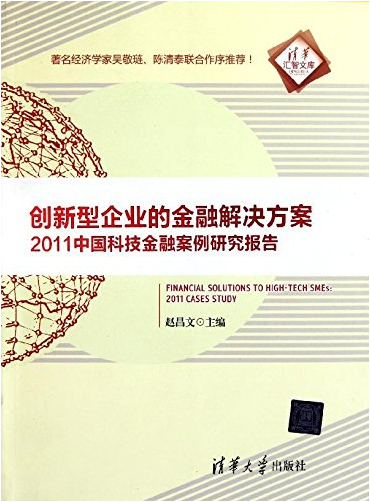
Financial Solutions for Innovation-Oriented Enterprises: Report on Case Studies of China's Science and Technology-based Finance 2011
2015-11-09


 |
|
Financial Solutions for Innovation-Oriented Enterprises: Report on Case Studies of China's Science and Technology-based Finance 2011 |
Zhao Changwen, Research Department of Industrial Economy of DRC
Science and technology-based finance (STF) innovation is a combined result of government function and market mechanism. With a strong nature of public finance, STF innovation is related to a number of fields where market failure occurs. Therefore, the government is a major participant in many STF fields. The role of government is widely manifested in the STF innovation such as scientific and technological banks, intellectual property right hypothecated loans, "uniformed borrowing and repaying" loans, guidance funds, and insurance for science and technology. Meantime, during STF innovation, the government must base its function on market mechanism and focus on cultivating, guiding and regulating such mechanism.
STF innovation displays integration and interaction between different participants. Integration is mainly reflected by the fact that participants in SFT innovation consist of relevant stakeholders across various departments and fields. For example, the "uniformed borrowing and repaying" loan mode involves not only venture capital investment but also banks as well as guarantee institutions and governments. The operation of scientific and technological sub-branches of the Hangzhou Bank even concern five entities including banks, venture capital investment, guarantee, insurance and government-backed high-tech zones. Interaction is primarily embodied in the innovative interaction among various entities relating to reducing the degree of information asymmetry and improving the risk-reward structure, such as the joint loan mode of equity investment and bank credit.
STF innovation takes on the feature of drawing on the experience of others and promoting innovation at the same time. Since China lags behind major developed nations like the US in terms of the overall development level of science, technology and finance (financial innovation in particular), China's STF innovation inevitably bears the trait of absorbing and learning experience from them. To some extent, small and medium-sized enterprise collection notes, government guidance funds, and scientific and technological banks are exotic by nature. However, in the course of fostering specific STF innovation, relevant institutions have digested, absorbed and further innovated those goods in order to highlight the Chinese characteristics.
The book comprises four parts laid out around China's STF innovation in the following four main fields and on the basis of STF innovation. Part one: Science and technology loans. As the primary channel for STF innovation, it mainly covers intellectual property right loans, scientific and technological banks, and the wholesale and guarantee mode of retail loans. Part two: Venture capital investment and private equity and investment which are the focal points of STF innovation. At present, venture capital investment and private equity and investment in China focus mainly on three aspects including government guidance funds, contract structure design, and operation with venture capital investment of other institutions. Part three: Multi-level capital market which greatly enriches the content of STF innovation. Raising the ration of capital market financing points to the general trend of the financial development of China's enterprises. Part four: Information asymmetry, unreasonable risk-reward system and problems with social funds guided by public investment, which are three major issues targeted by the former three parts for solutions. The book touches upon two bottlenecks facing China's STF innovation, namely policy constraint and poor financial ecology, and narrows down before conclusion to the major objective for China's STF innovation, that is, to propel science and technology-oriented enterprises' capacity for innovation.
The book is written by Zhao Changwen, Director-General and research fellow of the Research Department of Industrial Economy of the Development Research Center of the State Council. If there are any views inappropriate in this book, it is hoped that dear readers would not hesitate to make comments and stint their criticism.