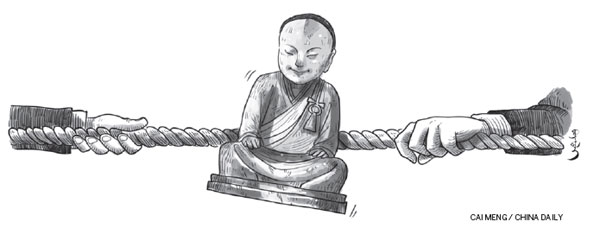
A mummified monk inside a gold-painted papier-mache Buddha statue that was exhibited in European museums (the latest being at Budapest) might have been stolen from a village in Fujian province in 1995. People in the village say the statue was the personification of Zhanggong Liuquan, who underwent the excruciating, years-long process of self-mummification to attain nirvana during the Song Dynasty (960-1279) and was worshiped as a "Buddha" for centuries.
If the claims are proven, can China bring the statue back? It can, gong by precedents. For instance, China won a lawsuit in a Copenhagen district court in 2008 and claimed back 156 antiques of the Xia (21st-16th century BC) and Shang (16th-11th century BC) dynasties. And in 2001, it won a case in a New York court to retrieve the wall paintings stolen from the tomb of Wang Chuzhi, a warlord during the Tang Dynasty (618-907).
For the restitution of stolen cultural heritages and traded abroad, three international conventions play important roles: the 1954 Convention for the Protection of Cultural Property in the Event of Armed Conflict (or the Hague Convention), the 1970 Convention on the Means of Prohibiting and Preventing the Illicit Import, Export and Transfer of Cultural Property (or the 1970 UNESCO Convention) and the 1995 UNIDROIT Convention on Stolen or Illegally Exported Cultural Objects (or the 1995 Convention).
Since China is a state party to the last two conventions, they could be applied to retrieve the statue. But since the Netherlands became a party to the 1970 Convention only in 2009, and the statue was stolen in 1995 and acquired by the anonymous collector in the Netherlands in 1996, the 1970 Convention cannot be directly applied in this case for lack of retroactive force. The 1995 Convention is not binding on the Netherlands either, because the Dutch parliament did not ratify it despite the country signing it in 1996. Ratification is necessary to bring the convention into force.
Perhaps filing a direct civil claim in a Dutch court is a possibility. But according to the Dutch Civil Code, the owner of a stolen movable object can claim it back from the present possessor within three years, and 20 years have passed since the theft.
Fortunately, the Dutch Civil Code has turned the 1970 Convention into a domestic law, which means the convention could be indirectly applied in the Netherlands, and either as a party to the 1970 Convention or the proprietor of the stolen cultural object, China can file a legal claim for the restitution of the statue.
But again, it does not mean an end to legal obstacles. For one, the state party has to "specify" the protected object, meaning China has to prove that the statue is an officially specified cultural heritage. The second obstacle is the acquisitive prescription. If the present possessor of the immovable object has possessed it continuously, openly and non-violently for 20 years, he/she shall have the right to own it. Therefore, China has to file the legal claim as quickly as possible.
Another relatively long-shot remedy is to invoke the UN Convention Against Transnational Organized Crime, which requires close bilateral cooperation in diplomacy and law enforcement.
In this case, however, moral power could be a powerful weapon. The statue contains the mummified body of Zhanggong Liuquan, and according to the basic moral principle, human remains should be returned to the country of origin. The Netherlands returned a mummified body of a 19th century Maori chief to New Zealand in 2005. Four years later, it returned the severed head of King Badu Bonsu II to his homeland Ghana. Also, several British institutions returned the skulls and other bones of Aborigines to Australia in 2009.
Besides, the mummified monk has become part of the common memory of the local people after being worshiped for almost a millennium. People's strong attachment with the statue will help win international sympathy, and diplomatic efforts and amicable negotiations can make it possible for China to get the statue back.
China, a country with thousands of years of history and cultural heritage, has lost more than 16 million cultural objects. To bring them back, the Chinese government has to deepen cooperation with countries that are major destinations for illegal trade in cultural relics and skillfully apply international rules and foreign laws. And to preserve the ones that it has, the government should strengthen registration and management of all cultural objects across the country, not just the most valuable ones.
The author is a fellow with the research office of Shunyi district people's court in Beijing.
(China Daily 03/27/2015 page9)