 |
|
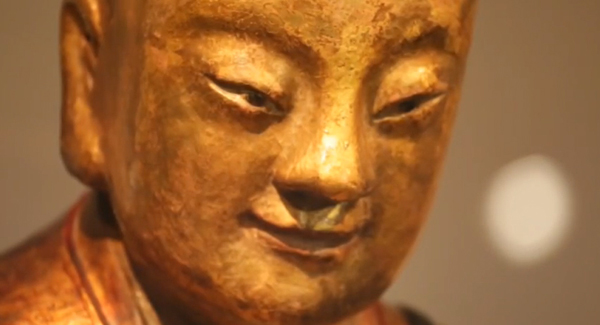
The face of the mummified Buddha. Photo provided to chinadaily.com.cn |
Twenty years ago, a seated Buddhist saint – Patriarch Zhanggong– was reported missing from Yangchun village in Southeast China's Fujian province. This March, the gold-lacquered statue was discovered in the possession of a Dutch art collector in the Netherlands.
With a centuries-old smile that appeared to be radiating from inside, the eastern style Buddha impressed audiences. It also sparked questions among experts and the general public in China and overseas. How was the monk's body preserved? Who was the monk? Why is he being worshipped?
Scientific study of the Buddha
According to a 1997 examination, when the statue was removed from its base plate, a handful of dead beetles fell out together with a linen cushion inscribed with Chinese characters. Inspection revealed a number of brittle bones poking through dried skin, and the remains suggest the statue contained a mummified body of a Buddhist monk.
In 2013, the statue was taken to Germany, where a CT scan was conducted under the German Mummy Project. The result showed that inside was a perfectly mummified body, with the entrails removed.
"There was also some tissue like stuff where the lungs would have been and we suggested they had been preserved, but they turned out to be paper with Chinese characters," said Vincent van Vilsteren, curator of archaeology at the Drents Museum.
Carbon-14 radioactive isotope dating showed that the Buddha died between 1022 and 1155, proving that the Buddha had lived during the Song Dynasty (960-1297). It was also estimated that the monk died between 30 to 40 years of age.
Erick Bruijn, a Dutch expert in the field of Buddhist art and culture, took part in a study of the mummified Buddha by the Reiss-Engelhorn Museum in Mannheim, Germany. According to Bruijn, the monk might have died of disease or an abstemious, vegetarian lifestyle.
"He obviously pined away, it might be his fasting near the end of his life to prepare for his mummification," Bruijn said. "Given that such an abscess develops slowly, the monk must have suffered excruciating recurring pains over a long period of time".
Some monks would live on dried linseed biscuits and yellow wax beans only, which implied that after two years they tend to be near death and would have skin as tough as leather. This is how mummified monks were preserved.