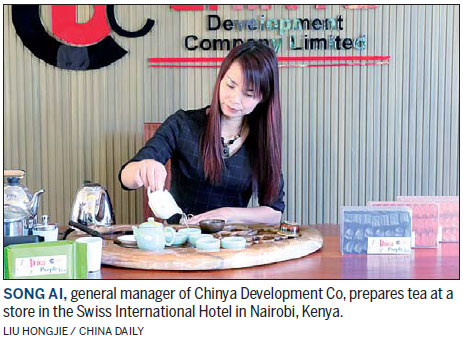
Ideal conditions for growing led to startup of company catering to sophisticated tastes
Hailing from Zhenghe in northern Fujian province - the source of several types of tea - Song Ai has a special feeling for the product.
Now Song, general manager of Chinya Development Co, hopes to introduce ecologically grown tea from Kenya to people in her home country.
Song moved from China to Kenya in 2008 to work for a Chinese construction company building a road in Nyeri, 150 kilometers north of Nairobi.
|
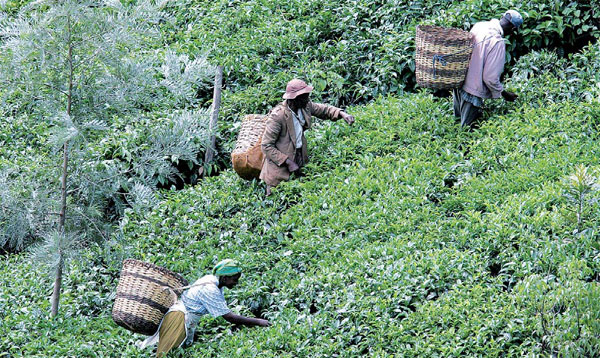
Tea pickers work on a plantation in Ikumbi, Kenya. Getty Images |
When she arrived, she stayed in a hotel and tried the tea in her room.
Although it had been coarsely produced, the taste attracted her as she had grown up on a tea farm amid tea processing equipment.
She tracked down the Kenyan tea farm and brought some samples to Beijing for tests. The results were surprising: The level of trace elements such as tea polyphenols, thearubigins, theaflavin and anthocyanidin were much higher than in the tea grown in China.
Later, a professor from Yunnan Academy of Agricultural Sciences was invited to Kenya to conduct an inspection of the soil, climate, tea varieties, terrain and environment of the farm. Song talked to the farm's owner and arranged to buy the best tea at the best price.
In 2010, the tea business started. It began to produce Chinese tea with plants grown in Kenya. Equipment was brought from China and tea masters were invited to choose and produce tea. They are the people responsible for the timing of picking tea leaves, and for the techniques of processing, withering, twisting, fermentating and drying.
"Tea farms in Kenya are pollution-free, use manure as fertilizer and enjoy long periods of sunshine and constant temperatures. Tea trees are planted in soil containing volcanic ash. The conditions are, not surprisingly, far better than on farms in China," says Song. "These factors produce the best quality tea in natural conditions."
In 2015, Chinya Development Co was registered in Kenya. The name Chinya is a combination of China and Kenya, with pronunciation similar to chai in Swahili, which means tea.
Chinya soon became the first Kenyan tea brand made by a Chinese company and gained recognition from the Kenya Bureau of Standards, the authority that monitors quality.
"We are at an early stage of production and sales," Song says. "Once the market is ready, production will go into full swing."
Song agrees it has taken a while to get the product to market but she is confident about its prospects because it is produced from the best raw materials in Kenya.
"When we choose tea leaves, we will only use the tips with one sprout and two leaves grown at the best location on the farm," Song says.
Over the past year, the company has invited tea masters from different provinces in China to process tea in an effort to finalize the Chinya brand. This is because each master produces his own signature tea, just as a chef cooks his own trademark dishes. The company intends to combine the advantages of different masters to produce a certain standard of tea.
At present, the company has produced black, purple and green tea and will soon be producing pu-erh tea, which is easy to store. Techniques for producing black, purple tea and green tea are at quite an advanced stage, Song says.
Annual capacity will be 12 tons, in anticipation of growing demand.
"Right now, the market is centered on Kenya and the neighboring countries," Song says, adding the company is talking with agents in the hope of bringing some quality tea back to China.
The quality of Chinya tea will eventually be recognized by the Chinese consumers who know tea well, Song says.
"It is then that Chinya tea will enjoy great popularity in the Chinese market."
panzhongming@chinadaily.com.cn