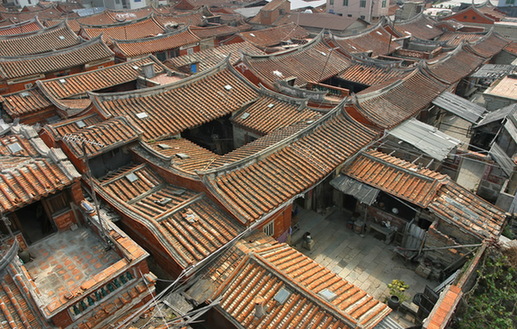
Yu Block
Ancient houses in Jinjiang constructed in the Ming Dynasty and the Qing Dynasty feature a typical architectural complex of two rows and three rooms per row. However, it’s only when the architectural complex comprises a front yard, a back yard, and rooms to the west and the east of the patio, could the house be considered, a complete residence. Hence, this kind of two-row housing is the most common architectural style in Jinjiang. Some simple residences do without the front yard, forming a great yard with three surrounding walls. These simple ones are named ‘Sanjianzhangjutouzhi’(Residences with three rooms in only one row).A larger house might have three rows but there are also a few who have a four-row structure. In conclusion, most of the ancient houses developed along the orientation of the landscape, which suggests that there would be shield houses constructed in the east and the west.
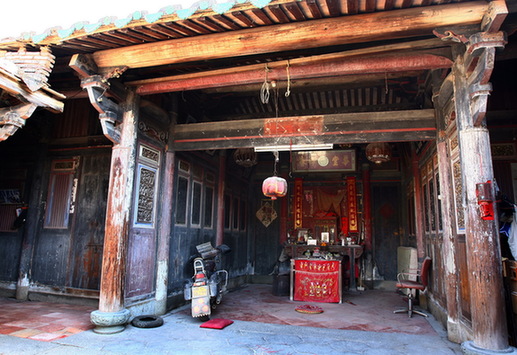
Yangjizun
The middle part of the front yard is the hall, while rooms in the east and the west of the hall are servants lodgings. When a residence has five rooms in a row, they might have two corner rooms. The gates of these ancient houses usually are recessed into the residences and therefore, it’s called ‘Tashou’ in Chinese. Nearly all gates in the ancient house of Jinjiang are ‘Tashou’. There are two kinds of ‘Tashou’. One uses only a single hollow, while the other uses double hollows.
The back yard is the major part of the residence and there are three or five rooms in a row in the back yard. The hall in the back yard is the living room of the family where ancestor worship is held. Behind the hall stands screen or sometimes ancestors are enshrined behind it. In front of the shrine, there was a long table where sacrifices were offered. Behind the screen is the corridor which leads to rooms behind the hall.
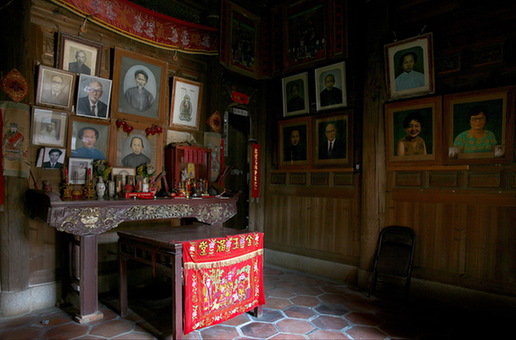
Sanchengpai (Three rooms in a row)
Rooms set aside as the living room are called the master rooms. If there are five rooms in a row, there would be attaching rooms near the master’s rooms. Larger houses might boast six rooms in a row.
The space under the eave in the living room is called ‘Bukou’. Earlier architectural complexes such as General ShiLang’s residence have a special screen to ensure the privacy of the family. In the late Qing Dynasty, this screen was placed next to a spacious corridor.
Rooms in the east and the west of the patio are called‘Jutou’. There is only one‘Jutou’ in the residence. If there is more space, it is made into a corridor. However, some might have a small room in the corner and leave a little space under the eave named ‘Jutoukou’. Some big houses with five rooms in a row might construct a small patio near the attaching house of the back yard. The alley between ‘Jutoujian’ and the back yard is called ‘Zisun Alley’, which leads to the side doors.
Ancient houses of a large scale might have a garden and a study behind the house or in one corner of the house. The rockery, the pond, the pavilion and plants would endow house with the feeling of nature.
The typical ancient houses in Jinjiang are of the royal palace style. They are symmetrical, elegant, rigid, and luxuriously decorated. Businessmen and officials in ancient times constructed this kind of house in Jinjiang.
Recently, in the hope of getting more space, people constructed attics in the attaching houses, or the corner rooms. These attics are called ‘Jiaojiaolou’ in Chinese. Since there is a rule that the roof should not exceed the height of the ridge of the back yard, roofs are divided into two part. Some are flat while others are turned into pavilions. Here the luxuriously decorated pavilions are called ‘Xiaojielou’ (the Ladies’ Building).After 1911, the height of some ‘Jiaojiaolou’ exceeded the height of the ridges. At the time, these attics functioned as the guarding towers of the house.