Biz updates
Inland areas 'catching up'
Updated: 2013-01-14By Hu Yuanyuan ( China Daily )
|
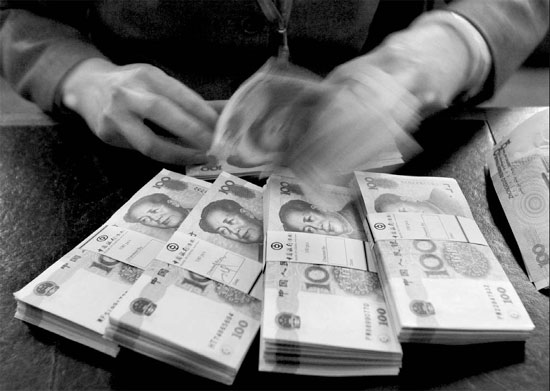
By the end of 2012, the number of Chinese high-net-worth individuals - those with investable assets of more than 6 million yuan - will reach 1.74 million, an increase of 17 percent from the end of 2011. Provided to China Daily |
Millionaires increasing investments in gold, 10-carat diamonds and art
The total value of private investable assets in China reached more than 73 trillion yuan ($11.6 trillion) in 2012, up 14 percent on the previous year, according to a recent report by Boston Consulting Group and China Construction Bank Corp.
By the end of 2012, the number of Chinese high-net-worth individuals (HNWI) - those with investable assets of more than 6 million yuan - will reach 1.74 million, an increase of 17 percent from the end of 2011. That growth, however, is much slower than the 38 percent growth from 2009 to 2011, according to the report.
At present, HNWI in China are still concentrated in the economically developed southeast coastal region. The number of HNWI in Guangdong, Beijing, Shanghai and Jiangsu is more than 100,000.
But under-developed inner land provinces are catching up and have become a new growth point. The number of high-net-worth households in Anhui, Gansu and Hunan provinces, for instance, was expected to increase by more than 30 percent in 2012, higher than the national average and that of first-tier cities.
In terms of the structure of private investable assets, funds and stock net value slumped by 7 percent and 5 percent respectively between 2009 and 2011, while resident bank wealth management and trust assets grew fast at a compound annual growth rate of 78 percent and 60 percent respectively, the report showed.
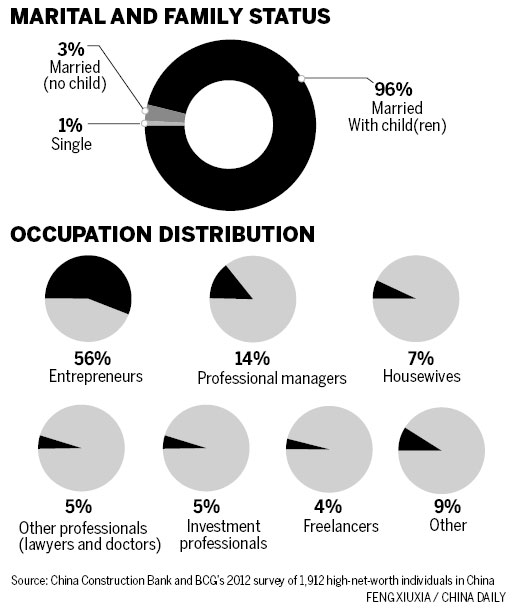
Entrepreneurs make up the largest proportion of HNWIs at about 56 percent. Among these nearly 60 percent of the corporations they run are at a mature stage of development. Furthermore, managers, housewives and professionals such as lawyers and doctors and investment professionals are now making up a bigger proportion, according to the report.
Meanwhile, around 59 percent of private banking clients made their fortunes from running a business while the proportion of those investing in real estate declined.
"In the context of interest rate liberation and advancement of financial reform, commercial banks should clarify their private business positioning as soon as possible. In China, the position of private banking should be the service channel for HNWIs," said Richard Huang, a BCG partner based in Beijing. "Its core business should be marketing, product and service integration and coordination of internal and external resources."
According to the BCG survey, private banking clients seem more conservative, with the proportion of clients seeking inflation-proof products increasing from 30 percent in 2011 to 36 percent in 2012. The number holding low-risk investment portfolios rose from 40 percent to 47 percent.
In terms of investment products, more interest is shown in fixed income and trust products (from 57 percent to 65 percent and from 53 percent to 61 percent respectively) while there was less interest in stocks and real estate (from 36 percent and 24 percent to 34 percent and 17 percent respectively).
In terms of other financial products, besides priority transactional services, private banking clients showed more interest in private-banking lending in 2012. In the non-financial value-added services, like the results in 2011, premium healthcare, travel and child education advisory services were most valued.
Meanwhile, more dollar millionaires increased their investments in gold, diamonds and art.
According to Song Yunpeng, deputy general manager of KEER Diamond Corp, the company's sales of diamonds bigger than one carat increased more than 50 percent this year.
In the past decade, the average price of a one-carat diamond has increased 18 percent, and that of a 10-carat diamond has soared 50 to 60 percent.
A more conservative wealth management trend is also seen among ordinary Chinese people.
Eight out of 10 Chinese mainlanders plan on saving the same amount they have been, or even more, in the next six months as a precaution, according to a recent report from MasterCard.
That result is similar to the proportion of Taiwan residents (79 percent) and Hong Kong people (71 percent).
The latest survey shows that money management strategies are conservative throughout China.
For instance, people on the Chinese mainland plan to save an average of 26 percent of their income in the next six months, followed closely by Taiwan (23 percent) and Hong Kong (21 percent). Interestingly, Hong Kong (94 percent) had the largest proportion of respondents planning to save the same amount or more in the next six months, followed by the Chinese mainland (92 percent) and Taiwan (80 percent).
While most respondents on the Chinese mainland are saving for investments (59 percent), the majority of people in Hong Kong (60 percent) and Taiwan (51 percent) are setting aside a portion of their income for retirement.
A total of 53 percent of the Chinese mainland respondents in 2012 saved for international travel, compared with 18 percent in 2011, the survey showed.
huyuanyuan@chinadaily.com.cn
(China Daily 01/14/2013 page14)
News