Life
Gansu gets bigger role on cultural map
Updated: 2013-02-20By Li Yang and Xue Chaohua ( China Daily )
|
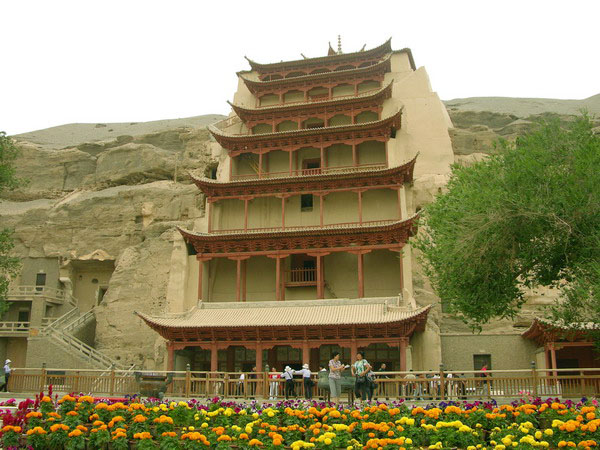 Tourists walk along a tower in the Mogao Grottoes in Dunhuang, Gansu province. [Wu Zhijun / Asianewsphoto] |
Zone could be heritage blueprint for other financially stretched provinces
China is to create its first "Inheritance and Innovation Zone of Chinese Civilization" in northwestern Gansu province.
Revealing the plans in Beijing on Tuesday, Minister of Culture Cai Wu said the central government viewed the project as representing "a new path for the scientific development of culture, in economically underdeveloped regions".
He added that officials will be asked to create commercial opportunities out of the province's cultural resources, which could then be used as a blueprint for other regions that are economically poor, but culturally rich.
But great care will also be taken to make sure the province's cultural treasures are protected.
|
 Wang Sanyun, Party chief of Gansu province
|
Gansu is considered a birthplace of Chinese civilization, and one of China's key historical gateways for cultural exchange and trade with the West.
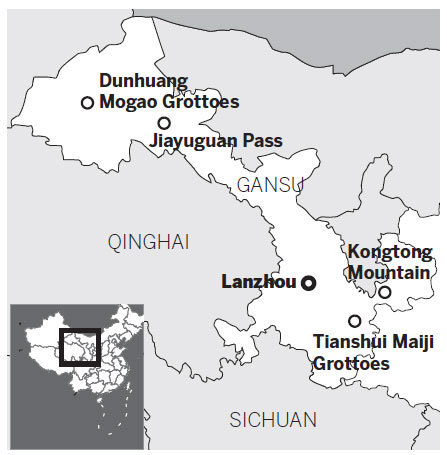
The province is home to some of China's best-known historical and cultural sites, including the Mogao Grottoes in Dunhuang - also known as the Caves of the Thousand Buddhas, which form a system of 492 temples - the Maiji Grottoes in Tianshui, the Jiayuguan Pass, which represents the western starting point of a section of the Great Wall, and the famous Kongtong Mountain, one of the sacred mountains of Taoism.
Since China reopened trade with overseas, Gansu has gradually declined from being a prosperous trading corridor between China and the West, becoming one of the country's poorest provinces.
The province's annual urban disposable income in 2012 was 17,237 yuan ($2,736), with the figure standing at just 4,495 yuan in rural areas.
Wang Sanyun, Gansu's Party chief, said the creation of the zone would help protect the province's historical and cultural sites, boost the development of the local cultural industry, and improve cultural services for residents.
Ouyang Jian, deputy Party chief of Gansu, added that officials will work on three main fronts within the plan - "one belt", "three areas" and "13 sections".
The "one belt" refers to the Silk Road Cultural Development Belt that stretches 1,600 km.
The "three areas" refers to southeast Gansu with its Fuxi culture, the Hexi Corridor, with Dunhuang at its core, and the area of Lanzhou famous for Yellow River culture.
|
 |
And the "13 sections" are various other main areas of cultural preservation, including the collation and publishing of ancient books, the holding of sports, cultural events, and exhibitions.
To help with these efforts, Wang and Ouyang said private investment will be welcomed, as will the involvement of cultural organizations from home and abroad, pledging to provide favorable policies with regard to finance, taxation and land for any partner developments.
With the support of the central authorities, they said they were confident Gansu could pilot various schemes aimed at both heritage protection and cultural industry development, which could be of local economic benefit.
They said every effort would be made to ensure that all commercial activities will be managed carefully, guaranteeing the protection of the province's treasures.
Wang explained that more than half of the "13 sections" of the plan were aimed at protection.
Contact the writers at liyang@chinadaily.com.cn and xuechaohua@chinadaily.com.cn
News