Religions
Ethnic group eyes development from nature worship
Updated: 2013-05-14( Xinhua )
LANZHOU - For many Chinese, environmental protection is instinctive. But for one ethnic group living in a panda habitat, a love of nature is in their religious discipline, and they hope it can make their community more prosperous.
In Wenxian County, in northwest China's Gansu province, small temples to mountain and river gods are scattered on lush mountains astride the Bailong River. The walls of mountain-top wooden huts are decorated with animal graffiti by local children, many of whom are of the Baima ethnicity.
Their religion is devoted to caring for animals and nature and resisting practices that will have a negative impact on the environment, even in the case of profitable industry embraced elsewhere in modern China. While sometimes limiting income, the approach has resulted in a rich natural habitat.
"The Baima people worship nature. Mountains, rivers and animals are all gods," says Yang Xiaohua, deputy head of the county's Tielou township. She herself is Baima.
Now, with Chinese increasingly concerned about smog and other pollution scandals, authorities in the area are planning to develop it into a resort capable of attracting environmentally conscious tourists. In so doing, they can alleviate some of the financial pressures the county faces.
Speaking a similar language, the Baima people are categorized as a branch of the Tibetans. With a population of less than 20,000 nationwide, they mainly live in Gansu and its neighboring Sichuan province, also two major habitats of giant pandas.
"I would often spot wild pandas on mountains here when I went gathering firewood as a boy 30 years ago," says Ban Fuquan, head of Shimengou village in Tielou."I would even give them a playful poke in the belly with twigs, " he laughs. "I meant no harm. They were very cute.
"But unfortunately, pandas were later taken away by animal experts."
In the late 1970s, a large stretch of bamboo in Wenxian county flowered due to natural disasters. By nature, bamboo withers after bloom. With bamboo forests shrinking, animal protection authorities decided to take away wild pandas and nurse them in reserves.
"We wanted the cute animals to have a better home," Ban says, recalling that all the villagers went out searching for pandas and sent them to the nearby protection zone.
"But some wild pandas still live in the mountains. I sometimes see their excrement," he adds.
Aside from pandas, other animals living with the Baima people seem lucky too. Wild boars often come and trample crops. But they face not traps but firecrackers, jackstraw or merely barking dogs.
"To some extent, boars are also divine. We are reluctant to hurt them," Ban explains.
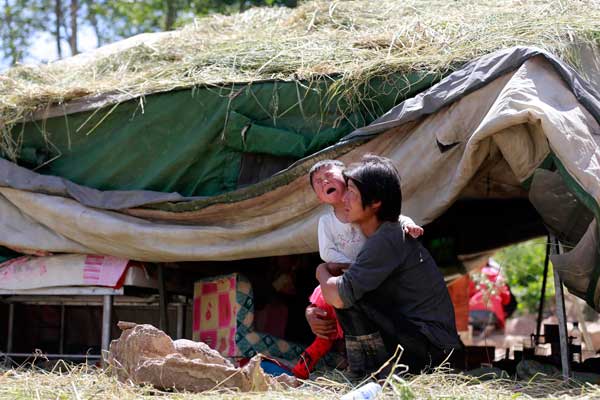
Since mountains are gods to the Baima people, trees become holy as well. Tielou was seriously affected by the massive Wenchuan earthquake in 2008, and when the Shimengou villagers started to rebuild their homes, most of them preferred reclaiming lumber from damaged buildings to chopping down trees.
The Baimas also pay respect to water and know how to harness it. Each Spring Festival, they hold rituals around wells and pray for blessings from water gods.The villagers have built channels to guide running water to mills. The water pushes water wheels and then powers stone mills to grind crops.
"Although we have electric machines, stone mills are more nature-friendly and seem able to produce better flour," Ban notes.
However, behind the idyllic picture, adhering to their love of nature is not that easy. The villagers are unwilling to build factories or over-exploit natural resources. Becoming migrant workers is one of the few choices left for locals to make a better living.
In 2012, the average income for villagers in Shimengou was 2,600 yuan (414 US dollars), just above the national poverty line of 2,300 yuan.
"I saw on TV that many big cities have air pollution problems and it popped up in my head that our beautiful scenery may be very appealing," Ban says. "Protecting the environment may be a way to make money."
The villagers aim to build Shimengou into "a resort with raw natural charms and the Baima culture." Their homes are now topped with enlarged copies of the Baima people's traditional lotus leaf-shaped "Shaga hat" - as an ornament and a trademark. The big plume on the hat can be seen from afar.
"We have a lot to do to achieve our goals, but the first thing is to better protect the environment and stick to our religious beliefs," Ban adds.
News