Life
Experts investigate Silk Road's ancestors
Updated: 2013-08-02( Xinhua )
When German geographer Ferdinand von Richthofen coined the term "Silk Road" in 1877, he may have never imagined that similar roads had existed long before the ancient trade route originated in the 1st century BC.
At the archaeological site of the former Heishui country (2100-1500 BC), located in what is now Zhangye city in Northwest China's Gansu province, a team led by Zhang Liangren carefully clears away dust with professional equipment, slowly revealing the walls of an adobe house.
The adobe house being unearthed in Heishui country was built 900 to 1,500 years after China's earliest adobe houses were constructed in Yingcheng city, Hubei province in 3000 BC. But the adobe construction method is similar to that seen in Central Asia, according to Zhang, who is also a professor at Northwestern University's School of Cultural Heritage.
"And Western Asia should be the initial source, since the adobe house was developed there as early as 8000 BC," Zhang said.
He confirmed that there were cultural exchange roads linking the Zhangye area and the West 4,000 years ago.
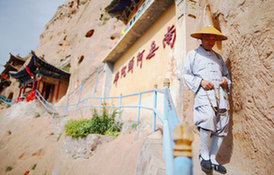 |
| Gansu's great Silk Road secrets |
"Information discovered at the site indicates that there had been roads for such exchanges since prehistoric times, much earlier than the Silk Road, which was opened during the Western Han Dynasty (202 BC-25 AD)," Zhang said.
The well-known Silk Road refers to the land passage opened when Zhang Qian was sent west on a diplomatic mission during the Western Han Dynasty.
Starting from the city known today as Xi'an, the ancient Silk Road ran through Northwest China's Gansu province and Xinjiang Uygur autonomous region, and Central and Western Asia, before reaching the Mediterranean.
Findings and research related to the theory that other roads linked China and the Western world had existed prior to the Silk Road began appearing in 2006.
Since then, archaeologists have unearthed and salvaged a stretch of cemetery from the Warring States Period (about 475-221 BC) in Gansu's Tianshui city.
The burial goods included animal-print gold leaf that came from what is known today as the Russian republics of Altai and Tuva.
Of the objects found, glass cups and the tradition of using goldware and silverware also originated in the West.
Wang Hui, director of the Gansu Provincial Institute of Archaeology, confirmed that roads existed that facilitated Chinese and Western cultural exchanges in 2000 BC. "Although it was not dominated by the silk trade then."
Zheng Binglin, a professor at the Institute of Dunhuang Studies of Lanzhou University, said that both archaeological and historical documents can prove the existence of roads that made cultural exchanges possible prior to Zhang Qian's missions.
A prominent book in the Pre-Qin Dynasty (2100-221 BC), "Legends of Mountains and Seas," included references to Lop Nor, a lake in present-day Xinjiang Uygur autonomous region, and Dunhuang, home of the Mogao Grottoes. It said three rivers in the Dunhuang territory flowed west and fed into Lop Nor.
"This indicates that people in the Central Plain had recognized the Lop Nor and Dunhuang prior to the Qin Dynasty," Zheng said.
The beginning and end points of the more ancient roads have yet to be located, and the exact length and route also remain unclear.
However, Gao Qi'an, director of the Dunhuang Business Culture Research Institute affiliated to Lanzhou University of Finance and Economics, acknowledged that more and more evidence will be discovered to prove the existence of pre-Silk Road passages that boosted East-West cultural exchanges.
"Ancient roads linking China and the Western world may not have been deliberately constructed by humans," Gao said, "but born of the prosperous cultural activities among different nationalities in different regions."
News