Biz updates
Local spending raises concern
Updated: 2013-08-16By Zheng Yangpeng ( China Daily )
|
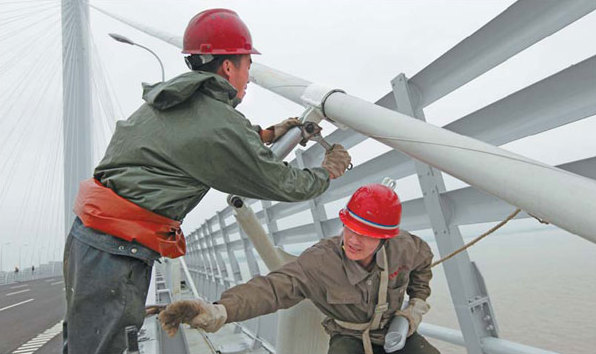
Workers fasten cables on the Jiaxing-Shaoxing bridge in Zhejiang province. Some local governments still see big-ticket infrastructure projects such as rail lines and urban renewal programs as a way to shore up economic growth. Shen Da / For China Daily |
For the central government, it is time for cautious mini-stimulus. But in reality, some local governments may be making mini-stimulus into, once again, a campaign for building huge public projects on huge investment and huge borrowing.
Experts said they worry that some of these projects aren't commercially viable. They urged an overhaul of China's local financing system.
Just this past Sunday, Chongqing municipality approved the construction of a 51-kilometer urban rail line. The line is scheduled for completion by 2018, with total investment of 31.4 billion yuan ($5.13 billion).
Another local rail line costing 4.1 billion yuan also passed preliminary evaluations.
A few days earlier, Northwest China's Gansu province approved a feasibility study for the first subway line in the capital city, Lanzhou. The project would cost 18.9 billion yuan.
Citing Zhu Maokun, former chief engineer of the Ministry of Railways, which is now named China Railway Corp, the 21st Century Business Herald reported that 36 cities have approved the construction of urban rail projects.
By 2020, there will be nearly 6,000 km of urban rail systems in China, and total investment could hit 4 trillion yuan.
While domestic media were quick to characterize the urban rail construction boom as a localized version of a "stimulus program", experts said projects should be weighed on a case-by-case basis.
"These cities, such as Chongqing, Lanzhou and Kunming are large by Western standards. The concentration of population makes it viable to build an urban rail transit," said Shi Hongxiu, a public finance professor with the Chinese Academy of Governance.
He said as China's urbanization proceeds, urban rail projects, as well as flood control and sewage systems, will be in great demand. Grouping all of these under the umbrella of "stimulus" spending might be misleading, he said.
Lu Ming, an economics professor with Shanghai Jiao Tong University, said that as exports and consumption are hard to expand in the short term, scaling up infrastructure investment was indeed the most effective way to spur growth.
Lu and other experts said the key cause for concern was whether these cities' already-high liabilities would be increased - whether these new projects could recover their costs.
To address the financing problem, Shi said it is essential to develop China's capital markets and allow city governments to issue project-backed bonds directly. At present, local governments are banned from issuing bonds directly.
As a way around this restriction, many local governments in recent years turned to financing vehicles.
But the central government has moved to rein in these operations since 2010, pushing some local governments to turn to high-cost shadow-banking debt.
That has exacerbated doubts about their repayment abilities. Lu noted that urban rail systems rarely achieve an operating profit, and local governments should consider allowing operators to participate in their development projects.
Local governments also plan to invest in inter-city railways and highways, airports and urban renewal projects.
Since mid-year, the State Council, China's cabinet, has ceded more administrative approval power to provincial governments. This was seen as a major move to facilitate the project launch process.
Chongqing's urban rail system is the first infrastructure project to be approved by the municipal government.
Shi said he is worried about giving more approval power to local governments, not because the central government is wiser, but because giving provinces this power could make it easier for local administrators to interfere with the market.
Local governments "tend to be insensitive to the risks and price signals of the market".
Rather than delegating approval power to local governments, it would be better to just remove such power, Shi said.
"We cannot say all of the projects are unnecessary. But we also have to ask, how many of these projects have undergone rational examination?" Lu said. "Is there a more economical way to carry out these projects? For example, light rail and tram systems can also reduce congestion, but they are much cheaper than subways."
Apart from direct investment, some local governments have reportedly secured funding support that is essentially coming from the central government.
For example, Shanghai will receive a 250 billion yuan loan from Agricultural Bank of China Ltd to help fund the city's planned Disneyland park and free-trade zone, according to a South China Morning post report.
Lu said although he could not comment on the specific project, the measure could be necessary. "Shanghai, with its free-trade zone plan, is projected to be a growth hub for the next decade. Financial resources should go to where the growth is," he said.
zhengyangpeng@chinadaily.com.cn
(China Daily 08/16/2013 page13)
News