Local
Jiuquan’s scenic sites promoted at tourism festival
Updated: 2014-07-02( chinadaily.com.cn )
As part of the Fourth Dunhuang Tour Silk Road International Tourism Festival on June 16, visitors toured Western Han Dynasty relics, Jiuquan’s Bell Tower, Drum Tower and other regional sites.
The nearly 300 participants included representatives from two international tourism organizations; ambassadors from 25 countries and regions; and roughly 100 representatives coming from travel agencies, international media outlets, and domestic provinces.
The Western Han Dynasty relics, classified as national 4A tourist attractions, are located 2 km east of Jiuquan and stretch over 270,000 square meters. The relics, which originated from the Western Han Dynasty (206 BC-AD 24), form a classical garden known throughout the Northwest for its beautiful combination of Han-era masculine power and Southern Chinese feminine elegance.
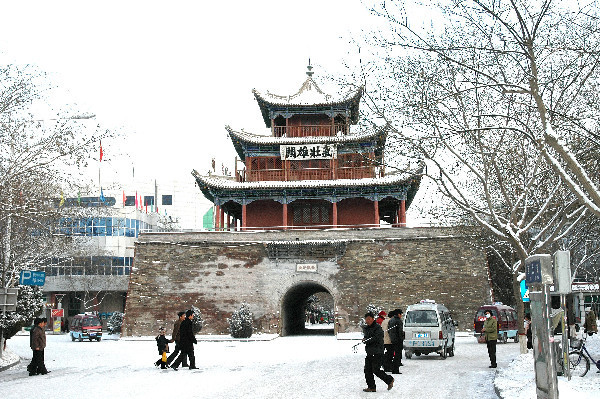 |
| Snowy scenery of No 11 Drum Tower [Provided to China Daily] |
The site is divided into a cultural zone, a scenic zone and a zone for rest and entertainment. In the garden, the ancient buildings stand alongside springs, lakes, pavilions, terraces and antique corridors.
Visitors can also admire the Zuogong willows, which were planted by famous Qing-era military leader Zuo Zongtang and his soldiers. The willows are lush and healthy despite a history of over 130 years. Poets, writers, soldiers and officials alike have written poems to commemorate ancient Jiuquan.
Jiuquan is located in the west of the Hexi Corridor at the intersection of Gansu, Xinjiang, Qinghai and Inner Mongolia. With a history of over 2,000 years, Jiuquan is a major tourist attraction along the Silk Road. Jiuquan includes Jinta county, Suzhou district, Yumen city, Guazhou county, Dunhuang city, Subei Mongolian autonomous county and Akesai Kazakh autonomous county.
The area incorporates more than 40 ethnic groups including the Han, Mongolian and Kazak, and the population totals 1.1 million. CCTV once named Jiuquan China’s “most popular western city”. In 2007, it was constructed to become an outstanding center for Chinese tourism.
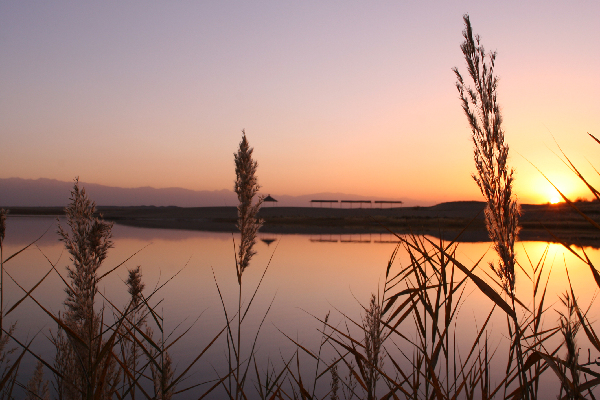 |
| No 26 scenic Huacheng Lake in Jiuquan city [Provided to China Daily] |
At the promotional event, Liu Xiaoyang, director of Jiuquan’s municipal tourism bureau, introduced four touristic itineraries. These routes are designed to lead visitors through the appreciation of both natural and cultural wonders.
Sites include the Mogao Grottoes, the Thousand Buddha Cave, Mingsha Mountain, Crescent Spring, the Great Gobi, forests of desert poplars and the Jiuquan Satellite Launch Centre. There are also suggestions to sand ski, parachute, ride camels, climb glaciers, take drives and watch the dances of the region’s many cultures.
Jiuquan is easy to get to. It has three airports—Dunhuang, Jiayuguan and Dingxin—with regular service to Beijing, Shanghai, Chengdu, Xi’an and Guangzhou.
After 30 years of development, Jiuquan has 22 grade-A tourist attractions, 63 starred restaurants, 73 travelling agencies, more than 500 tourism buses and over 1,200 licensed guides speaking seven languages. It’s safe to say that the region is well prepared for any tourists that come its way.
Edited by Noelle Mateer and Le Qin
News