Local
City of red hills and rich culture
Updated: 2015-10-08By Xue Chaohua And Liu Lu In Zhangye ( China Daily USA )
Northwest China's Zhangye revives its ancient culture through tourism and ethnic development
With its long history, vibrant local culture and stunning natural landscapes, the city of Zhangye in northwestern Gansu province is attracting more tourists each year.
"Today's Zhangye welcomes visitors as a link of the New Eurasian Land Bridge," said Mao Shengwu, Party chief of the city.
Blessed with numerous streams, abundant sunlight and fertile soil over an area of 42,000 square kilometers, Zhangye's popularity as a tourist destination is rising in the northwest thanks to its rich historical sites, glorious past and beautiful natural scenery, he said.
Ancient Zhangye, originally called Ganzhou, was an important commercial hub along the ancient Silk Road, and one of four counties in the Hexi Corridor. It was the political, economic, cultural and diplomatic center of Northwest China in each dynasty, continuing to attract merchants from the West to trade.
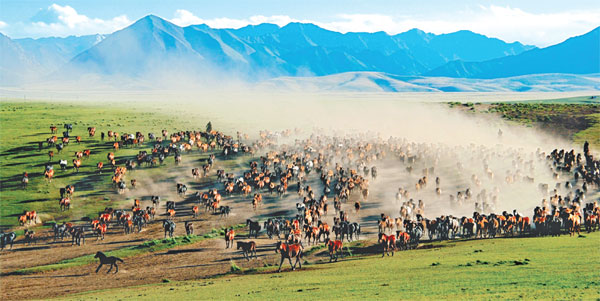
The city's current wealth of historical sites includes the Wooden Tower of the Sui Dynasty (AD 581-618), Danxia National Geological Park, Giant Buddha Temple in Shandan and Shandan Horse Ranch.
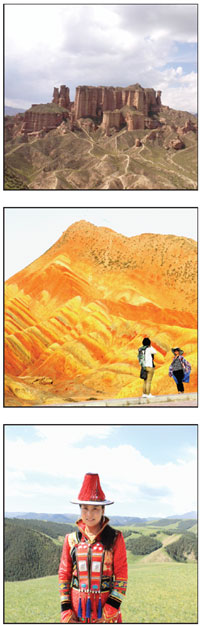
The Danxia National Geological Park, also known as Zhangye Danxia Geopark, is located in the northern foothills of the Qilian Mountain, in the counties of Linze and Sunan. Best known for its colorful rock formations, it has been voted by Chinese media as one of the most beautiful landforms in China, Mayor Huang Zeyuan said.
This special Danxia geological structure, featuring layers of multicolored sandstone and steep cliffs, is the result of deposits of sandstone and other minerals being pressed together over a span of more than 24 million years and raised up by seismic activity. Erosion of the sandstone by weather elements has formed isolated peaks and steep outcrops in the area.
A visit to the Danxia geopark is a must if visiting Zhangye, and is often at the top of the list of tourists to the ancient city, Huang said. "One will feel it is like beautiful layers of color painted onto the surface of the rocks, which is like nothing else you have ever seen."
Another must-see is the city's Giant Buddha Temple, which was built in 1098. In its long history, the temple has been restored many times. Up to eight people can fit on just an ear of the large reclining Buddha, which depicts Sakyamuni's attainment of nirvana. Ten of Buddha's disciples are shown behind him with vivid facial expressions.
The two-storied Giant Buddha Hall is 33 meters high, 49 m wide and 24 m long. It is the largest architectural relic in the city. The Buddha is the largest indoor sleeping Buddha anywhere in China.
The Mati Temple Scenic Area is also a well-known scenic spot in Zhangye, which integrates grottoes, cave art, Qilian Mountain scenery and the unique customs and culture of the local Yugur minority group. The scenic spot 65 kilometers south of the city boasts more than 70 caves and shrines.
The Yugur ethnic group, which is unique in Gansu province, has lived at the foot of snowcapped Qilian Mountain in the south of Zhangye for generations.
Visitors to Mati Temple and the Yugur Folk Customs Valley can enjoy the special culture and traditional lifestyle of the Yugur people; sample their milk tea, traditionally cooked mutton and alley wine; and admire their colorful costumes and lively dancing. The ethnic group follows Tibetan Buddhism and their own primitive religion.
Kang Qing, publicity and information chief of Zhangye, said the best time to visit Zhangye is from June to September "when the weather is more comfortable". The rest of the year is usually dry and windy. "It is also best to visit in the morning and at dusk, especially at sunset, when the gorgeous colors change continuously in the sunlight," Kang said.
Try to plan your Zhangye tour in advance to avoid national holidays, which are peak domestic travel periods.
Contact the writer at xuechaohua@chinadaily.com.cn
|
Wildlife adds vigor to Shandan Horse Ranch in the city of Zhangye, Northwest China's Gansu province. The city has been a draw for tourists thanks to its natural landscape, historical sites and ethnic cultures. Photo By Pei Mingxing |
Tour Routes
One-day tour route:
Giant Buddha Temple-Danxia National Geological Park-Yugur ethnic family
Giant Buddha Temple-Zhangye Desert Sports Park-Zhangye National Wetland Park-Pingshanhu Grand Canyon
Giant Buddha Temple-Yanzhishan Forest Park-Shandan Horse Ranch
Giant Buddha Temple-Biandukou Ecological Area-Mati Temple
Giant Buddha Temple-Zhangye National Wetland Park-Gandu Magistrate's Yard-Yushui Garden-Pingshanhu Grand Canyon
Giant Buddha Temple-Zhangye National Wetland Park-Memorial Hall of the West Road Army of Chinese Workers' and Peasants' Red Army-Gaotai Lakebay
Two-day tour route:
Giant Buddha Temple-Zhangye National Wetland Park-Danxia National Geological Park-Binggou Danxia Geological Park-Danxia National Geological Park
Giant Buddha Temple-Zhangye National Wetland Park-Yanzhishan Forest Park-Shandan Horse Ranch-Biandukou Eco-Area-Mati Temple
Giant Buddha Temple-Zhangye National Wetland Park-Pingshanhu Grand Canyon-Zhangye National Wetland Park-Danxia National Geological Park-Binggou Danxia
Giant Buddha Temple-Zhangye National Wetland Park-Memorial Hall of the West Road Army of Chinese Workers' and Peasants' Red Army-Gaotai Lakebay-Wenshu Temple-Qiyi Glacier
|
Top: A castle's basics still stand amid red cliffs and rocks at Binggou area of Zhangye. Middle: Tourists enjoy themselves inside the Danxia National Geological Park in Zhangye. Bottom: Tour guide Li Xuemei is good at telling ethnic tales of the Yugur people in the region. Photos By Xue Chaohua |
|
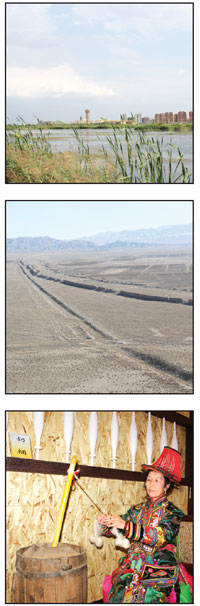
Top: Zhangye National Wetland Park lies close to the city. Middle: Ruins of the Great Wall built since the Han Dynasty nearly 2,000 years ago in Zhangye. Bottom: Ke Cuiling, intangible heritage inheritor of Yugur ethnic garments, works on thread materials in the Yugur Museum of Sunan county, Gansu province. Photos By Xue Chaohua |
News