Life
Remote school with NZ ties trains technicians
Updated: 2015-11-23By Li Yang and Xue Chaohua in Shandan, Gansu ( China Daily USA )
Unique vocational studies combine classroom and practical instruction
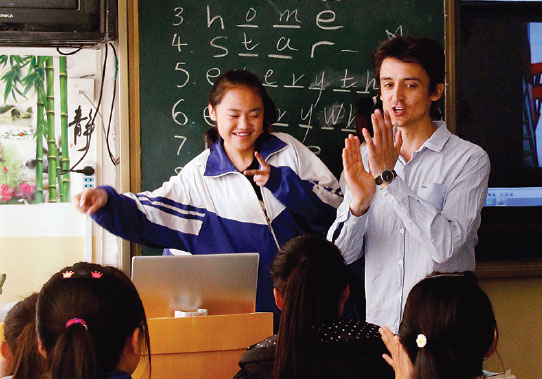
As the only foreigner working in Shandan, a remote county in Gansu province between the Gobi Desert and the Tibetan-Qinghai Plateau, Michael Forde occasionally feels isolated from his New Zealand home.
But Forde, who volunteered to teach English at Bailie Vocational School for a year, needs only to think about the school's colorful history to realize his roots are all around him. He is the 28th volunteer from his island country who has taught at the school since 1987.
|
Michale Forde, a teacher from New Zealand, instructs students at a class at Bailie Vocational School in Shandan, Gansu province, in October. Zhai Jizong / For China Daily |
Rewi Alley, a New Zealand-born educator and social reformer, founded the school in February 1945, just before the end of World War II, with George Hogg, a freelance reporter and British adventurer who was sympathetic to the Chinese people's suffering during the War of Resistance Against Japanese Aggression (1937-45).
Forde, who has a friend at the New Zealand China Friendship Society, which supplies a teacher each year to the school in Shandan, was captivated by what he heard about the school, which has 2,120 students, 148 teachers, and 15 majors in industry and agriculture.
"He told me the interesting stories about Rewi Alley and the school," Forde said. "So I decided to see the school."
Colorful history
Named after Canadian missionary Joseph Bailie, who actively promoted agricultural education in China in the early 20th century, the school has an intriguing focus on vocational instruction that emphasizes using "hands and mind together".
At its founding, Alley acted as the school's headmaster, instructor, academic dean, dorm supervisor and liaison officer for overseas support.
He required the students to use their hands and brains equally, and emphasized analysis and innovation. He believed China needed a large number of technicians and engineers to fuel industrial growth.
With assistance from New Zealand and international organizations, Alley's school offered free education and boarding to poor local students and trained them to be carpenters, architects, agricultural technicians, mechanists, miners, civil engineers and doctors.
"Alley's students transformed Shandan's productivity level from medieval to industrial age in a few years in the late 1940s," said Zha Jiguang, 58, the school's headmaster. "Alley's students also became backbone technicians for the oil fields that developed in the 1950s and 1960s in Gansu, Heilongjiang, Shandong and Liaoning provinces."
Alley died in Beijing in December 1987 at age 90 and the Chinese government reopened the Shandan Bailie Vocational School that year at his request. Since then, the school has produced more than 10,000 technicians. It became a national key school in 2007.
Xi Zhongxun, a revolutionary leader in Northeast China in the 1930s and 1940s, a former State leader of China and father of President Xi Jinping, was among the school's honorary headmasters.
'Ideas live on'
Wang Wenchang, who has been teaching electromechanical engineering at the school for 26 years, said Alley's fundamental ideas live on.
"The teachers here pay special attention to implementing the 'hands and mind, create and analyze' principles of Rewi Alley. Our graduates are very popular among employers, because they are good at putting knowledge into practice and thinking," Wang said.
Every year, the New Zealand China Friendship Society, a nonprofit Alley established in 1952, sends one teacher to the school.
"We find the people who are really interested in Rewi Alley's background and the special nature of the school," said David Bromwich, the society's president, who has visited Shandan twice a year since 2001.
"We believe this form of education is still very important. In fact, we think we should have this style of education in New Zealand. It puts hands and minds together. The students not only have classroom instruction, but also practical instruction," he added. "Local students are very enthusiastic."
Deepening exchanges
The society also helps Shandan with poverty-alleviation projects, which have included the introduction of advanced agricultural technology and New Zealand sheep breeds.
Apart from teaching English, Forde also helps students prepare for China's national college entrance exam, the gaokao.
"They are pretty energetic. They have goals and they try," Forde said.
Teachers such as Forde have given an immeasurable advantage to the school, said Ma Guohua, an English teacher who also serves as the school's director of international exchange.
"Thanks to the New Zealand teachers, English has always been a strong subject in the school, and there are more interactions between the students and teachers in this school than many other Chinese schools," Ma said.
The connection to New Zealand has offered other advantages as well. Twenty of the school's teachers have had the opportunity of a year's study in New Zealand through exchange programs, and 17 students have visited their sister school in New Zealand.
Ma Yanshun, a 2002 graduate who is now an automobile dealer in Zhangye, Gansu, said he appreciates the "three meaningful years" he spent at Bailie.
"The school is different because of its historical connection to the developed countries," Ma said. "I developed independent and analytical thinking."
Contact the writers through liyang@chinadaily.com.cn
(China Daily USA 11/23/2015 page5)
News