New features changing holiday spending habits
( China Daily )
Updated: 2014-02-08
High-end gifts, pricey eateries fall from favor; cinemas see 98% rise in patrons
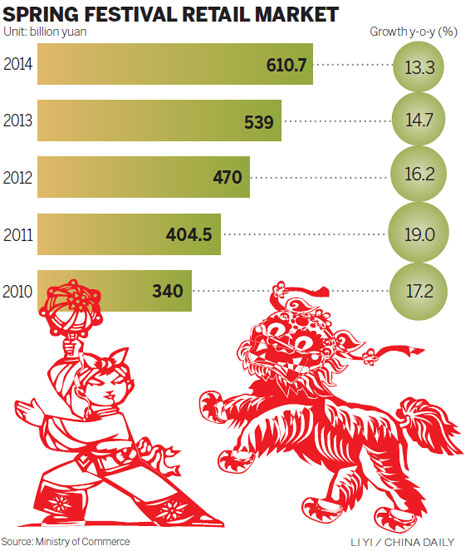
China's spending during the traditional Spring Festival maintained double-digit growth this year but the pace marked the slowest in more than a decade, according to the Ministry of Commerce.
The central government's promotion of frugal dining and restrictions on public spending on high-end gifts and restaurants were mainly to blame. However, a new emphasis on cultural, recreational and tourism spending will continue to set the country's purchasing trends in the near future, a senior commerce expert said.
|
Shoppers choose Spring Festival items at a supermarket in Fuyang, Anhui province. During the week-long holiday, nationwide sales of retailers and catering businesses rose 13.3 percent year-on-year to 610.7 billion yuan ($100.7 billion). Wang Biao / For China Daily |

Data from the ministry showed sales of China's retailers and catering businesses went up 13.3 percent from a year earlier to 610.7 billion yuan ($100.7 billion), during the week-long holiday which lasted from Jan 31 to Feb 6 this year. Gatherings and reunions during the break usually boost spending.
"This year's slowdown of consumption growth during the holiday break was mainly caused by the decline of high-end spending," said Huo Jianguo, president of the Chinese Academy of International Trade and Economic Cooperation, a think tank at the Ministry of Commerce.
"However, we should feel glad for the slower, but still robust and satisfactory consumption growth during the holiday because it reflected the true purchasing power of ordinary people. Although we don't know the specific share of spending of the public funds, we noticed a remarkable drop this year, which is a good signal," he added.
The central government called for more frugal dining last year and prohibited expenditure on cards, calendars and gifts on public funds at the end of last year.
Affordable and simply packaged products for the festival were especially welcome, while the sales of high-end gifts significantly decreased - by about 70 percent year-on-year in many wine stores in Fuzhou, Fujian province, and 40 percent in some cigarette and wine retailers in Luoyang, Henan province, according to a news release on the website of the ministry.
Electronic gadgets and jewelry remained the major targets of the festival holiday shopping. The sales of digital products, such as personal computers and cell phones, doubled in Hebei and Anhui provinces, and jumped 61 percent year-on-year in Gansu province. As 2014 is the Year of the Horse, horse-featured gold and silver jewelry became hot products during the holiday. Their sales surged 35 percent year-on-year in Hubei province and 31.6 percent in Liaoning province, said the release.
High-end catering was eschewed during festival gatherings but that did not affect more ordinary dining. The operational revenues of popular catering businesses increased about 20 percent year-on-year from Anhui province to the Guangxi Zhuang autonomous region. The turnover of surveyed high-end restaurants dropped more than 20 percent in Heilongjiang province, according to the ministry.
More spending on recreational, tourism, cultural and educational activities as well as entertainment and bodybuilding has become a new highlight of the holiday. The capital city of Beijing earned 4.384 billion yuan in tourism income during the holiday week, up 13 percent from the same period last year. It welcomed an estimated 9.75 million sightseers, up 12.3 percent year-on-year, said the Beijing Municipal Commission of Tourism Development on Thursday.
Cinemas across the country reeled in 1.4 billion yuan during the holiday, up 86 percent year-on-year. The whole of January only generated about 1.9 billion yuan in box office takings, according to Tencent, a news portal. In addition, the number of moviegoers increased by 98 percent from the same dates in the previous year, amounting to 39 million yuan during the seven days.
"These new highlights will continue and shape consumption trends in the near future. But the government needs to improve the purchasing environment, such as better and more fitness and cultural facilities in communities, which will encourage the emerging spending models but also increase domestic demand," Huo said.
China's flourishing e-commerce facilitated the holiday expenditure as more people turned to online shopping for railway tickets and goods celebrating the festival. Instant messaging systems such as WeChat and QQ, which are relatively new vehicles to express New Year wishes, greatly increased information-related use, according to the ministry.
In contrast, the fever for sending greetings via short text or multimedia messages to relatives and friends cooled during the festival, according to figures from provincial telecom companies.
China Mobile's Tianjin subsidiary said it recorded 245 million mobile phone messages on Lunar New Year's Eve this year, down by 12.5 percent year-on-year. In Shaoxing, a city in Zhejiang province, the number of messages sent on Lunar New Year's Eve decreased by 21 percent year-on-year.
China's three telecom carriers did not disclose their nationwide figures for such messages during Spring Festival this year. But industry insiders expect the total number of short text messages to have dropped by 10 percent and multimedia messages by 20 percent from the same holiday period during the previous year.
Overall, eastern areas witnessed a more significant drop than middle and western regions. That is because eastern regions are usually equipped with faster, more advanced mobile networks. The younger generations in those areas tended to use instant-messaging tools, such as WeChat, to send their New Year greetings.
On Lunar New Year's Eve 2013, China Mobile, the country's biggest telecom carrier, serviced 9.1 billion text messages, an increase of 3 percent year-on-year. The company also carried more than 250 million multimedia messages, up 18 percent from the same period a year earlier.
Shen Jingting contributed to this story.
lijiabao@chinadaily.com.cn
(China Daily 02/08/2014 page9)

-

Major Economic Parks and Industrial Centers