Prowling China's Jurassic Park
Updated: 2009-09-28 15:09
By Raymond Zhou
|
|||||||||||


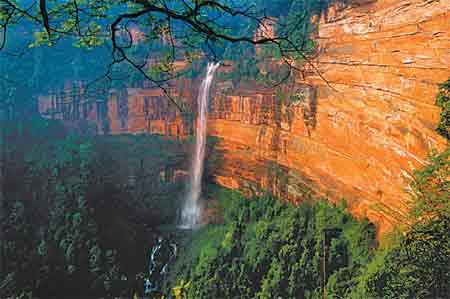
Red sandstones stand out among verdant vegetation and are carved by gushing cataracts.
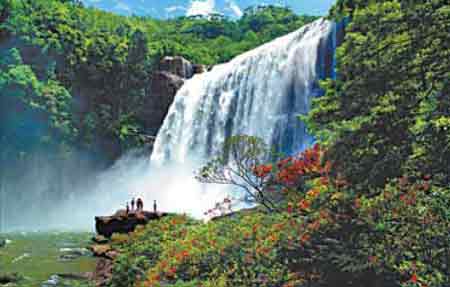
The Shizhangdong Waterfall sits on the upper reaches of Fengxi River, about 30 km from downtown Chishui.
In the art world or in the natural world, green usually serves as a supporting color for red, which blossoms and catches all the attention.
But in a river range in northwestern Guizhou province, red gives birth to green. They compliment each other and form the most vibrant, almost dizzying, dichotomy.
Green here is the primeval forest and lush vegetation, while red is the land and rocks.
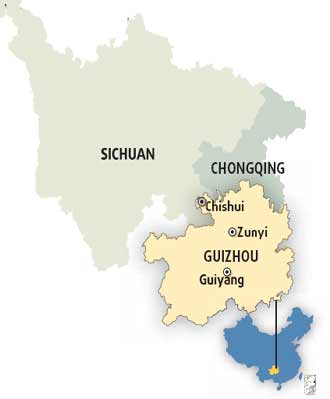
At the place just before Chishui River flows from Guizhou to Sichuan stands a vast expanse of rocky mountains and plunging waterfalls. To date, 72,178 hectares of this has been designated as danxia landforms and is currently inspected by UNESCO experts for a potential natural heritage listing. Literally meaning "red rocks", danxia refers to red-colored sandstones and conglomerates of the Cretaceous age, which often look like stacked pancakes.
"Some 230 million years ago, this was the bottom of the ocean," says Tu Yuling, geologist with Guizhou Normal University.
"During the Jurassic age, this was an inland lake. Later it was elevated but managed to retain the red sandstones of that age."
Red is the result of oxidization of iron that permeates rocks and soil. Locals extract color dyes out of the material.
Not only are mountain rocks crimson but also the soil exudes a rich vermilion.
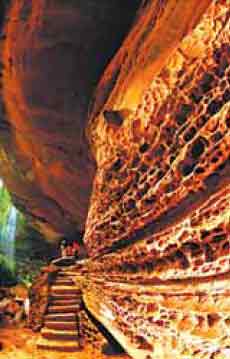
When it rains, the river changes to a muddy reddish color with almost tragic overtones.
But vegetation in this area is so verdant it takes time and effort to locate bare rocks with no shrubbery.
Near the Five-Pillar Peak, there is a gorge that resembles a cistern and the top edge is a striking circumference of danxia stones. Zhang Yimou, the filmmaker famed for using - or overusing - bright colors, would love it.
To prove that dinosaurs once roamed here, there are 40,000 alsophila trees in Jinshagou, one of the scenic parks in the area. Alsophila is a kind of fern.
But unlike the other two-dozen fern species found here, it is much taller, about 5 to 6 m - the highest reaching 9 m - and 20 to 25 cm in diameter. Some are pairs that grow together.
This oldest and rarest fern variety dates back some 200 million years.
"Dinosaurs used to eat the little things on these trees," explains Zeng Qiang, a local official. Some 100 km from here, in Zigong of Sichuan province, fossils of every dinosaur species have been discovered and displayed in a museum.
But human beings are not dinosaurs and have found little practical use for this fern tree. Some ferns are made into appetizers, but alsophila is not edible. In addition, the tree trunk has a lot of starch-like substance, which rules out the possibility of being turned into material for furniture.
Stranger still, alsophila cannot survive if you move it elsewhere.
"We sent some to the Kunming Botanical Expo, and they just died," Zeng says.
Kunming, capital of Yunning province, has a similar environment.
That means poaching is useless. In a sense, this fern has outlasted other things of its age by being irrelevant other than appearing in movies like Jurassic Park.
Scientists did not pay attention to it until 1983.
They were not looking for alsophila in Hainan but for another breed of rare flora in Chishui. While taking a break, one member noticed alsophila and wondered whether it was the one on the endangered list.
The next year, a protection zone was mapped out. In 2000, the local government opened its "Jurassic Park". The few dinosaur sculptures notwithstanding, only adventure seekers come here.
"It's not a place for leisure tourists," says Zeng Qiang, the local official.
However, pleasure seekers have an abundance to revel in. As long as you love the sight of water pouring down slopes, Chishui is gushing with delight. It isn't called the "city of waterfalls" for nothing.
"We have 4,000 waterfalls, and I'm counting only those at least 3 m tall," Zeng says.
Chishui is located at the edge of the Yunnan-Guizhou Plateau where it descends sharply to the Sichuan Basin.
Hence the ubiquitous gorges and canyons where water cascades its way into softer rocks and dances downslope, forming nature's most rapturous crescendo and mesmerizing landscapes.
The biggest, Shizhangdong, sits on the upper reaches of Fengxi River, about 30 km from downtown Chishui.
It is 76 m tall and 80 m wide - 8 m taller than Huangguoshu, China's largest waterfall, but 1 m narrower.
There are several points from where you can take photos or get wet. About 2 km downstream is Zhongdong, or the Middle Fall, which is 75.6 m by 18.5 m.
Unlike the unruly Shizhangdong, this one is like a curtain with one half incorporating a break.
Closer to downtown, only 15 km, is Sidonggou Scenic Area, with its succession of cataracts. The four big ones offer different ways of splashing, some passionate, some haunting. It looks like a fantasyland out of The Lord of the Rings.
If you love the land, you'll also love the people who inhabit it.
There are several old towns in Chishui. On your way to the Sidonggou waterfalls is Datong, a narrow street with pebble stones and old women sitting by the door, reading old books or playing mahjong. The only telltale sign of modernity is the TV behind every open door, which is always on.
Bing'an almost hangs onto the southern bank of the Chishui River.
Cross a suspension bridge, and you'll transport yourself into a world where salt merchants used to relax. They still serve tea with a panoramic view of the river. They still cook on the street for big occasions when every family comes out to help.
Fuxing used to be the old downtown. So many merchants lived here that those from Jiangxi province decided to build a hall complete with a stage.
Up the street a few restaurants serve "whitewater fish", a local delicacy.
The local government likes to call the place "China's Jurassic Park".
It wouldn't be kind to lump humans and animals together when we talk about dinosaurs.
But this immense territory is luxuriant and relatively unadulterated by human intervention.
One feels small in this terrain of feverish danxia and tranquil verdure, traversed by ribbons of water.
raymondzhou@chinadaily.com.cn