|
|
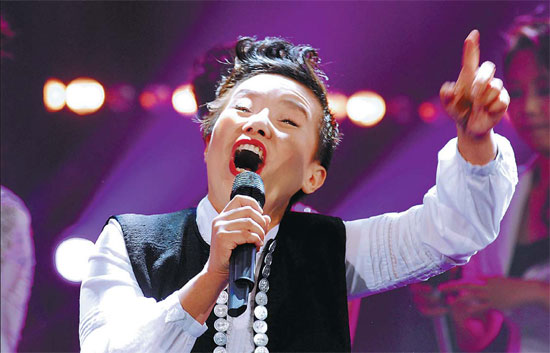
Folk singer Gong Linna has captured a fan base with her forceful interpretations of folk songs and classics. Provided to China Daily
|
Gong Linna continues to reshape folk music on the contemporary stage, Chen Nan reports.
From the day that Gong Linna became an Internet sensation for her lyricless song Tan Te, or "Disturbed", she was known as an unconventional Chinese folk singer who breaks all the rules.
With her powerful voice, wide vocal range and dramatic facial expressions, she attracts attention and gets rave reviews when she releases each new song.
Fa Hai, You Don't Understand Love, Gong's latest song - which, like Tan Te, was composed by her German husband, Robert Zollitsch - has conjured up yet another wave of attention and controversy.
First performed at the New Year's eve gala of Hunan Satellite TV on Dec 31, the new song soared to popularity overnight thanks to its contagious melody and quirky lyrics.
"Fahai, you don't understand love. The Lei-feng Pagoda will fall down," sings Gong, 38, in a white glittering dress, playing the role of White Snake, the protagonist of the Legend of the White Snake.
The song's melody and lyrics are direct and simple. After the debut performance, the song has been remade over and over by fans on the Internet. The video has been watched more than 100,000 times online.
However, some people complain that the song is boring and nonsensical.
"To be honest, I don't quite understand the song," says Zhang Chao, who has written songs for pop duo Phoenix Legend. "Maybe it's another experiment by the songwriter but it won't become mainstream music in China."
Jin Zhaojun, the Chinese Musicians Association's vice-secretary-general and a veteran music critic, explains that the repeating melody and direct lyrics makes the song popular instantly. "Good or bad, again, Gong raises eyebrows," he observes.
Gong says that she is getting used to the controversy caused by her songs.
"Ever since I sang Tan Te, I have heard the most beautiful praise and the worst criticism," Gong says. "We welcome those different voices."
However, both Gong and her husband, whom Gong refers to by his Chinese name Lao Luo, are confident about their music.
"We have a variety of songs, funny ones and serious ones," she says. "You cannot say something is a bad song only because it doesn't sound as you expected."
Because 2013 is the Year of the Snake in the Chinese zodiac, Lao Luo says he wanted to write a song about a snake. The Legend of the White Snake is a popular fairytale in China and the White Snake spirit is considered beautiful and good-hearted.
In the story, the critical-monk Fahai plots to break up the White Snake's relationship with her human husband and imprisons her in Leifeng Pagoda.
"The song is about breaking through the obstacles and finding love, which is an eternal theme," he says.
Love should be simple and straightforward, so he wrote the lyrics in a style that was very direct to suit the theme. Tan Te is far beyond the range of ordinary listeners, but he wrote an easy-to-sing song this time.
"I think that Leifeng Pagoda also exists in music and we need to break it down," he adds.
For Gong, the song is not as easy as it sounds. "Singing Tan Te seems like crying my heart out. But this song is like a woman whining and begging. It requires me to sing tenderly and slowly, which I am not so good at," she says.
Despite the different views expressed by critics and fans, Gong and Lao Luo stick to their way of exploring "new China's folk music". With the help of her husband, Gong has ended her struggles as a Chinese folk singer and been reborn.
A star singer in her hometown of Guiyang, the capital of Guizhou province in Southwest China, she started singing at the age of 5 and was never shy while performing in front of people.
The musically versatile young girl enrolled to study folk music at the Chinese Conservatory of Music in Beijing at 16. She held her first solo concert in 1999 and performed with the China Central Nationalities Orchestra, China's most prestigious traditional music orchestra. In 2000, she won the Chinese National Singing Competition as the best female singer and became a popular figure at various galas.
Although she was pursuing fame like other singers, she did not feel at ease with all the lip-syncing and stereotyped performances. She was lost.
Everything changed when Lao Luo and his music entered Gong's life. He has written most of the music for Gong's six albums so far. His love for reading and writing traditional Chinese poems enabled him to compose music with lines from famous poems such as Tang Dynasty poet Li Bai's Jing Ye Si ("Thoughts on a Still Night") and Bai Juyi's Ye Xue ("Night Snows").
"For me, singing onstage is like exploding my inner power thoroughly," she giggles. "Thanks to him, I found my own voice and my musical sparkles."
For Lao Luo, everything in his life is about creating something new, from songwriting to cooking for his children.
A month after Fahai, You Don't Understand Love, they will release another song, Jin Gu Bang ("Golden Stick"), which depicts the Monkey King, a main character in the classical Chinese epic novel Journey to the West.
The fast-paced song, Gong says, is even harder to sing than Tan Te, which requires long breaths and repeating high-pitched sounds. She has been practicing for a month to capture the correct tempo.
According to Lao Luo, the composition is based on the Monkey King, who can magically transform himself into various animals and objects.
Gong will perform Jin Gu Bang at Hunan Satellite TV Station's Spring Festival gala. The song is also a part of Gong's new mini-musical, which will be performed at Jiangsu Satellite TV Station's Spring Festival gala.
The seven-minute musical will contain three songs, the folk song Jin Gu Bang, pop song Big Idiot and A Dream, which is adapted from one of the Song Dynasty (960-1279) poet Li Qingzhao's works.
"Because Lao Luo grew up in the West," Gong says, "he is not constrained by any rules in China. I have no idea where he will lead me to on the musical road, but I am looking forward to it."
Contact the writer at chennan@chinadaily.com.cn.
|
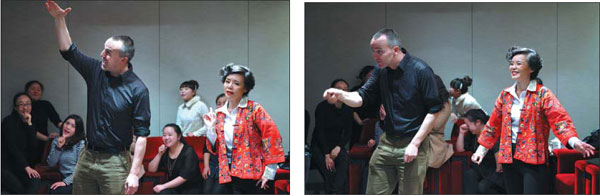
Gong Linna and her husband Robert Zollitsch rehearse for Gong's Spring Festival performances. Photos by Zou Hong / China Daily
|
|