|
|
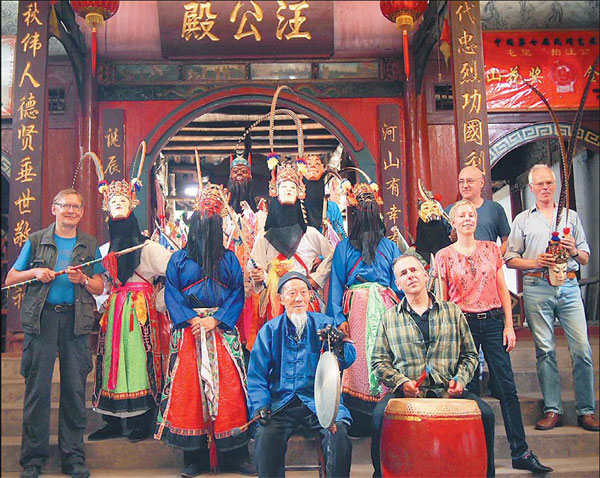
Five world-acclaimed musicians - (from left) Kalevi Aho, Michael Gordon, Augusta Read Thomas, Sebastian Currier and Robin Holloway - take a closer look at the country's folk arts and culture, such as Luoxi Opera in Anshun, Guizhou province, during their 2011 visit to China. Photos Provided to China Daily
|
Five new works by international composers that were inspired by a visit to China signify a new approach to cultural exchanges. Chen Jie finds out more.
Five renowned composers recently debuted their China-themed works in one concert, a landmark event that signifies a new approach to the country's diverse cultural environment. Kristjan Jarvi and Zhang Yi took turns with the baton to conduct the National Center for the Performing Arts Orchestra during the Sunday concert in Beijing at the NCPA. All five pieces were inspired by a September 2011 visit to China by the five composers that took place in Beijing, Shanghai, Shaanxi, Guizhou and Yunnan provinces. During this time the composers were introduced to the country's folk arts, culture and people.
American composer Michael Gordon's Beijing Harmony is inspired by the Temple of Heaven's Echo Wall; while British composer Robin Holloway's In China depicts the unchanging beauty of the countryside.
Finland's Kalevi Aho's Gejia-Chinese Images for Orchestra reflects his visit to a Gejia ethnic group village in Guizhou; American Sebastian Currier's Quanta interprets Chinese characters; while fellow American Augusta Read Thomas' Harvest Drum celebrates the Miao people, another ethnic group in Guizhou.
"Each of the five works is extremely different. They portray China from different angles but have certain common characteristics - the great spirituality of the country, its culture and people," Jarvi says.
"I must say the NCPA is an active and imaginative organization to invite such great foreign musicians to see China, compose for the country and promote its culture," the conductor adds.
"What is China? How is China?" composer Hao Weiya rhetorically asks after the concert. "There is never a single answer. The five pieces of music prove it. From their musical language I can tell they have so much to say, that they are eager to express. Obviously, their first China tour gave them enough material to create."
Hao says Debussy (1862-1918) heard Southeast Asian music for the first time at the Paris World Expo in 1889, which greatly influenced his compositions and other Western composers of the time.
He hopes the five composers' music has a similar effect on predominantly Western audiences.

"It's great to have Chinese arts and culture promoted through Western musicians' works," Hao says.
"Any concert premiering five contemporary works is inevitably a major event, let alone five big musicians all writing about China," says Ren Xiaolong, NCPA's deputy programming director.
China's booming economy, the second largest on the planet, has also energized its arts scene and the NCPA has become central to this renaissance since it opened in December 2007.
Even so, NCPA President Chen Ping's ambition is not only to host big names, but also to launch a variety of projects, such as hosting an opera festival, dance competition, and collaborating with other top festivals and theaters around the world, in addition to commissioning original works.
As for the latest commissions, echoes play a big role in Gordon's Beijing Harmony, which was inspired by the capital city's architecture and has the theme of the past reverberating into the future. "I live in a very big city, New York, and I was certainly dazzled by Beijing, an even bigger city. Every city produces its own set of harmonies. In Beijing, I was enchanted by Echo Wall, a part of the Temple of Heaven, where voices echo from one side of the structure to the other," Gordon says.
"I envisioned a modern orchestra performing at the Temple of Heaven in the 15th century. Because of the expansive spaces in these ancient structures I imagined the sound would bounce off the stone floors and walls creating a fanfare of echoes, an acoustical rebounding and ringing that would slowly grow in zeal and fierceness."
To Holloway, the commission was both a challenge and pleasure. He was moved and stirred by the contrast between the timeless landscape and the 21st century world of technology and new constructions.
"I was inspired by the bold and exuberant new skyscrapers of Shanghai, contrasted with what they so strangely resemble, the weird and lovely mountain-shapes of Guilin," Holloway says.
Before the tour, Aho explored Chinese music to enrich his musical language. He says one of his favorite instruments is the guqin, a seven-string plucked instrument that has been listed as a UNESCO cultural and intangible heritage.
On his first day in Beijing, Aho was impressed by a traditional Chinese orchestra concert at the NCPA. The percussion group in the orchestra inspired him to begin his piece, Gejia, with a solo for three percussionists, two Chinese gongs and a small Chinese opera drum.
In Gejia village, the composers listened to young women singing folk songs. Aho used the melancholic melodies to ground his composition.
Before his trip to China, Currier had often been asked how China is different from the United States. Implicit in the question is that it is indeed very different, he says, and of course in many ways it is, but there are similarities, too.
"Sure, when one visits the treasures of the past like the Forbidden City and the Temple of Heaven, one encounters differences. But that is to travel far back in time. The more modern the context, the more similar we seem," Currier says.
The grid structure of cities, the materials used for roads, the design of traffic lights, the modern architectural elements, all have close parallels in the US. But there is one thing, totally ubiquitous, that does remind him of the difference - and that is written Chinese. "A Westerner is immediately struck both by its aesthetic beauty and its total incomprehensibility. The piece I wrote, Quanta, starts from this observation."
Augusta Read Thomas was fascinated by the drums, legends and mythologies of the Miao ethnic group in Guizhou.
"Drums reflect many of the unique social and historical patterns that evolve throughout a culture. The rich array of artistic expressions of Chinese drum culture - sacrifice, worshiping and farming - give full expression to the vitality of the Chinese nation," she says.
China has hundreds of so-called cultural communication events and projects every year. But what is real communication? Meeting, getting to know each other, making friends and even clashing.
These five musical works are a response to China and a medium for Chinese to rethink their diverse culture.
Contact the writer at chenjie@chinadaily.com.cn.
|
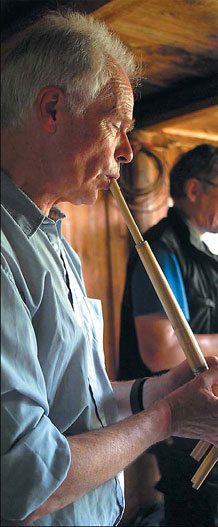
Britain's Robin Holloway depicts the unchanging beauty of the countryside with in China.
|
|
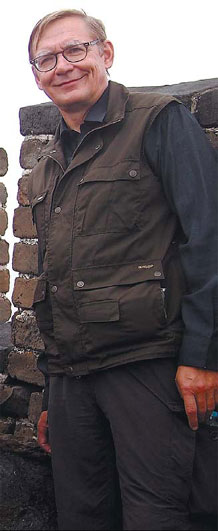
Finland's Kalevi Aho reflects on his visit to Guizhou with Gejia-Chinese Images for Orchestra.
|
|
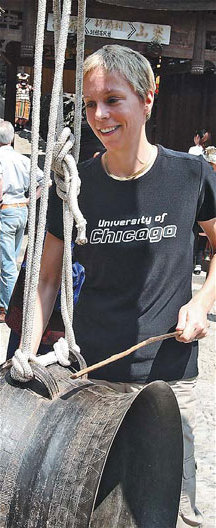
American Augusta Read Thomas' Harvest Drum celebrates an ethnic group in Guizhou.
|
|
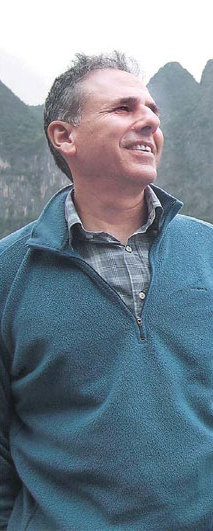
American Michael Gordon's Beijing Harmony is inspired by the Temple of Heaven's Echo Wall.
|
|
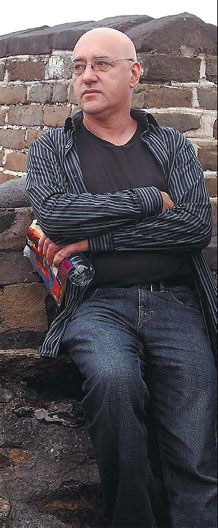
American Sebastian Currier's Quanta interprets Chinese characters.
|
|