Comments
  Print
Print  Mail
Mail  Large Medium Small
GUIYANG - Chinese government officials, environment and energy experts, and entrepreneurs have vowed to join hands in accelerating the process of building a nationwide carbon emissions trading market.
"The country will soon carry out scientific methods to record enterprises' carbon emissions in major industries and find ways to allocate emissions quota appropriately, as preparations for a nationwide carbon emissions trading market," said Su Wei, director of the climate change department of the National Development and Reform Commission.
Su said at an ongoing international environmental protection forum held in Guiyang, capital of southwest China's Guizhou Province, that as pilot carbon emissions trading schemes will be launched successively in seven provinces and cities in 2013 and 2014, the country is gaining momentum in curbing greenhouse gas emissions with a market mechanism.
Experts and industry leaders, on the other hand, have warned of potential difficulties in terms of the legislature, carbon financing, statistics gathering and quota allocation, monitoring and assessment systems -- all of which are key to building a mature market.
"Carbon emissions trading will remain a fake market until these problems are solved," said Xiong Yan, head of the Chinese state-owned Property Exchanges Association.
PILOT SCHEME PROGRESS
One month prior to the forum, China launched its first regional market for compulsory carbon trading in the southern city of Shenzhen after more than two years of preparations.
The scheme covers 635 industrial companies and some public buildings that account for about 40 percent of the city's carbon emissions. The carbon intensity, or the amount of carbon produced per unit of gross domestic product, of the 635 industrial companies in 2015 will drop 32 percent from the levels in 2010.
Under the trading program, those that emit below their quotas could sell their excess limits to other emitters and even investors for profit.
Eight deals, or 21,112-tonne carbon quotas, were traded on the first day at prices ranging from 28 to 32 yuan (about $4.6 to $5.2) per tonne.
Following Shenzhen, six other areas -- Beijing, Tianjin, Shanghai, Chongqing, Hubei and Guangdong -- will launch the scheme soon.
"These areas were carefully chosen, because they vary in levels of economic development, industrial structure as well as residents' ?environmental protection awareness," said Su, who added that the experience gained can be applied to the whole country.
"Shenzhen, which is already a harbor for high-tech and environmentally-friendly enterprises, will further raise the market entry threshold and reject energy-consuming and high-polluting companies. But for the less-developed western city of Chongqing, the government has to persuade heavy industries to balance profit growth and environmental protection," said Su.
Qi Shaozhou, a professor at Wuhan Univerisity, said the emissions trading scheme in Hubei will set an example for parts of central and western of China on how to lift people out of poverty while still curbing pollution. It will also help the regional government, local enterprises and environmental protection organizations come to a consensus on eco-development plans.
Experts on the forum also applauded how the public has changed its concept of carbon trading.
"Five years ago when the China-Beijing Environmental Exchange was launched, officials would prevaricate, and enterprises and the general public said they did not understand the reason why such an exchange should be established," said Xiong Yan. "But things are totally different now."
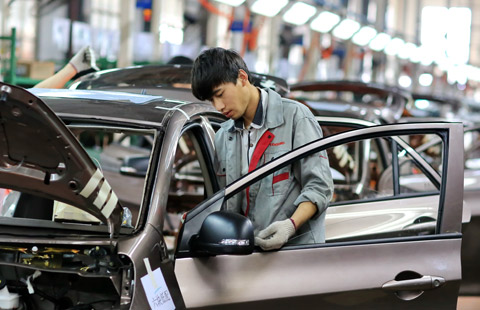
Chery Auto has invested 20 million yuan in the water supply network and rainwater collection system in its plant in Guiyang, reducing sewage disposal, said a manager surnamed Wang at Chery's subsidy in Guiyang.
She said more companies in western regions, including those in the steel, cement and chemical industries, value corporate social responsibility greatly and are willing to participate in carbon emissions trading.
CHALLENGES FOR NATIONWIDE MARKET
While they hailed the pilot schemes as a landmark step for China in building a nationwide market, experts said fundamental problems should be resolved before a market mechanism for curbing greenhouse gas emissions can be called a success in the country.
"We want a law on carbon emissions trading and low-carbon development as soon as possible," said Li Junfeng, head of China's National Climate Change Strategy Research and International Cooperation Center.
He said administrative means have limited influence in raising people's awareness. With a legal bounding, companies will learn their rights and duties more clearly.
"A law on climate change will enable government departments and public sectors to have a clear-cut division of work on the issue," said Wang Yi, deputy director-general of the Institute of Policy and Management with the Chinese Academy of Sciences.
Apart from legislature, Wang and his fellow experts appealed for the government to determine China's total allowed carbon emissions.
The country has pledged to reduce carbon dioxide emissions by 40 to 45 percent per unit of GDP by 2020, compared with the levels in 2005.
"Without setting a figure for the intensity cut, or a date by which China's total emissions would start falling, we cannot allocate quotas scientifically," said Wang, who added that only when carbon emissions quotas become a scarce resource will companies be willing to trade for it.
However, Wang also admitted that setting a figure for a developing country that still relies heavily on energy-consuming, high-polluting industries for economic development and poverty relief, determining a figure is not as easy as it seems.
Pilot carbon emissions markets currently allocate quotas to enterprises according to their historical carbon emissions.
"How to monitor companies' carbon emissions and which organization can we appeal to when we are unfairly treated in emissions trading or quota transfers, are all to be decided," said Huang Yaping, vice board chairman of Huaneng Coking Gas Co., Ltd.
"It seems unfair that companies that emitted less pollution historically could receive stricter requirements. But we have to consider whether those that polluted more can afford substantial emissions reductions in a short period of time," said Su, adding that reducing emissions is a long-term task for these enterprises.
How to introduce carbon finance, or the creation of financial instruments that are tradable on the carbon market, is another important issue, said Li Junfeng.
He said the government should be cautious not to let speculative investment result in negative price spikes while still introducing financial instruments to the market.
 Beijing sees blue sky as B&R Forum opens
 Would-be dads taste pain of labor
 Belt and Road receives global backing
 Soldiers who safeguard China's 'green treasure'
 Flowers, posters greet Belt and Road forum in Beijing
 Rainstorms cause floods, trap cars in Guangzhou
 Chinese submersible explores turbidity current in South China Sea
 Couple uses 200-year-old Qing Dynasty home as backdrop for wedding
 Homemade armed helicopter Z-19E rolled out
 Wuhan student recreates Marilyn Monroe portrait using only nails and string
 Train attendants prepare for trial operation of Nairobi-Mombasa railway
 Rainbow village in Indonesia becomes social media hit
 Madrid a draw away from Spanish title after win over Celta
 Italian Cup title puts Juventus in line for treble


Copyright 1995 - . All rights reserved. The content (including but not limited to text, photo, multimedia information, etc) published in this site belongs to China Daily Information Co (CDIC). Without written authorization from CDIC, such content shall not be republished or used in any form. Note: Browsers with 1024*768 or higher resolution are suggested for this site.
License for publishing multimedia online 0108263 Registration Number: 20100000002731