|
|
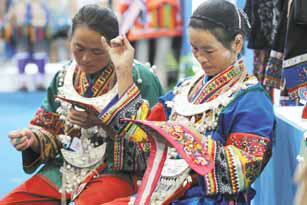
Miao women show their embroidery expertise on the spot at the second China-Kaili Silver Embroidery Exhibition in Guizhou province. Zhu Xingxin / China Daily
|

Ethnic culture is playing an increasingly important role in the development of Guizhou, where ethnic groups account for 38 percent of the province's total population.
The Qiandongnan Miao and Dong autonomous prefecture in the southeast of the province is one example of this trend.
Qiandongnan is home to 33 ethnic groups, with the native Miao accounting for some 42 percent of the population and the Dong, 32 percent.
Local decision-makers have said that publicity is the key to growth in the lesser-known mountainous region. Its diverse cultures will be the centerpiece of these campaigns.
"We have vast potential for tourism," said Li Feiyue, Party chief of the Qiandongnan prefecture.
He explained that Qiandongnan has more than half of the country's Dong people, who have worldwide reputation for their folk music.
Because they have no written language, the Dong people have long passed on their history, culture and knowledge through songs, which have evolved part of their lives over centuries.
One of the best-known folk music traditions of the group is the Dong Grand Chorus, a multipart polyphonic choir without accompaniment or a director. It was included in UNESCO's list of intangible cultural heritages in 2009.
"The Dong Grand Chorus has won worldwide acclaim. It is not only a cultural heritage that we need to protect but also a window open to the world that helps more people to learn about us," said Xie Weiping, a researcher at the Guizhou Academy of Social Sciences.
Folk music is not the only element that attracts tourists. For ethnic minority groups in the southwest of China, clothes are an integral part of their cultural identity.
Most often, traditional costumes in this part of the country use bold colors combined with intricately crafted jewelry.
Each ethnic group has its own designs, but the types of jewelry remain roughly the same - crowns, necklaces, earrings, bracelets, rings and waist hoops.
For the Miao, silver is their most-prized material for crafting jewelry.
Traditionally an ordinary Miao woman cannot get a piece of silvery jewelry until she is getting married and receives such a gift from her elders to adorn her wedding outfit.
To prepare for this, her parents usually have to save up for years.
In recent years, souvenirs like silver ornaments and jewelry have become popular with travelers in the Qiandongnan prefecture.
Blooming tourism
More than 4.19 million tourists visited Kaili, capital of the Qiandongnan prefecture in the first four months of this year, generating some 5.25 billion yuan ($855 million) in revenue, an increase of 66 percent year-on-year.
Among them, 3,900 travelers are from abroad, bringing in combined revenue of $681,600.
"Although the overseas tourist number is not as big as those of visitors to metropolises like Beijing and Shanghai, but we consider it a good start," said Huang Yuanliang, Party chief of the city.
The capital city is not the only beneficiary of the tourism strategy that capitalizes on local cultural diversity.
More counties and townships in the Qiandongnan prefecture are following suit by combining ethnic culture and tourism together.
"Our ultimate goal is to build a world tourist destination," Li said, adding that to pave the way, local authorities are accelerating infrastructure construction covering a traffic system.
As well, dozens of hotels and motels will also be added to meet the needs of the blooming tourism industry.
Local authorities expect to draw a group of internationally influential tourism companies and an influx of large capital to Qiandongnan in a bid to boost local tourism, Li said.
"It needs a fostering process", he said, noting that as a long-run investment, it takes time for investors to get to know Qiandongnan's advantages and features in tourism. Yet, Li stressed that he has faith in the campaign.
zhaokai@chinadaily.com.cn
(China Daily 07/24/2013 page24)
|