|
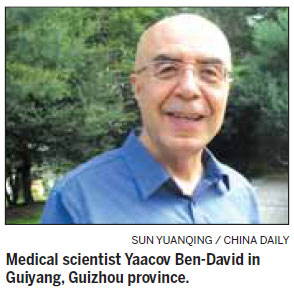
A Canadian medical scientist has moved to China in the hope of discovering a cure for cancer using a mix of Western and Eastern medical practices.
Yaacov Ben-David is an internationally renowned molecular biologist and he recently put down roots in Guizhou province in Southwest China, a place he believes the next generation of cancer cures will come from.
With its ample resources of traditional Chinese medicine and specialists with the knowledge of how to extract pure compounds from natural herbal remedies, Guizhou is only a step away from finding the ultimate cure, Ben-David says.
"They develop compounds from TCM but there is no one here to find the functions against the disease, particularly cancer. That is my expertise. I saw the match between me and this group," he says.
Based on TCM natural cures and ethnic medicines, Guizhou's pharmaceutical industry totals 20 billion yuan ($3.27 billion) a year. It is now seeking driving forces through further research and innovation, and part of the effort is to attract overseas professionals.
"Yaacov Ben-David makes up for what we lack the most, preclinical models for diseases, especially cancer. These models will help us select the right compounds against cancer," says Luo Heng, a researcher in Ben-David's tumor pharmacology research team at the Key Laboratory of Chemistry for Natural Products of Guizhou Province under Chinese Academy of Sciences.
At a time when Western academies are suffering budget cuts, China is trying hard to attract more academics and entrepreneurs from abroad. In late 2011, the government initiated the One Thousand Foreign Experts Project, to invite more specialists into the country in the next 10 years.
Successful candidates get a subsidy of up to 1 million yuan from the central government and scientific researchers can get 3 to 5 million yuan in research allowances.
As a key foreign expert brought in by Guizhou this year, Ben-David is also applying for the project with his team in order to obtain stronger support for their project.
The group already has 2 million yuan from the provincial government as startup funding and another 5 million yuan to build the largest international laboratory in Guizhou. This kind of support would not have been possible back in North America given the current economic situation, he says.
"It is very hard to find funding in Canada at the moment. My work was not moving ahead any more because there is no funding. There are too many scientists who cannot find government support," he says. "Also, you need chemists, people who can provide compounds and modify them for you. I didn't have that opportunity at home."
Born in Iran, Ben-David received his PhD in Molecular Immunology from the Hebrew University in Jerusalem, Israel in 1987. He later served as a professor of medical biophysics at the University of Toronto and senior scientist of molecular and cellular biology at the Sunnybrook Research Institute.
He successfully isolated several cancer genes responsible for the induction and progression of leukemia. He also identified the mechanisms of these cancer genes - knowledge which can be used for the clinical treatment of the cancer.
In the last five years, he has focused on how to develop compounds and drugs against cancer, as he wanted to transfer his work from the lab to the hospital.
Ben-David first visited the laboratory in Guiyang through an introduction by Yang Meili, one of his researchers in Canada who happened to be a former student of Hao Xiaojiang, director of the laboratory.
When he saw how Chinese chemists were working to develop the wide range of flora in Guizhou for the use of TCM, he saw his niche.
"I am the biologist and they are chemists. They develop compounds from TCM and there has to be somebody to understand their functions. I thought it would be a very good opportunity to collaborate."
Apart from the financial and team-building support in China, there are also opportunities for breakthrough discoveries as few studies have been done about natural compounds extracted from TCM.
"When I was in North America, everything I used was already known. Here everything is locally sourced and not yet categorized yet. It's all novel and unique," Ben-David says. "They told me that there are 55 compounds that have not been characterized yet. This is amazing."
As TCM is still not widely accepted globally, he hopes his research can change that.
"The potential is very high. Not many studies have been done about TCM. And not many scientists in the world have access to these compounds. I am hoping to collect all these and collate them in a data library that more people can have access to."
Yang Jun contributed to the story.
|