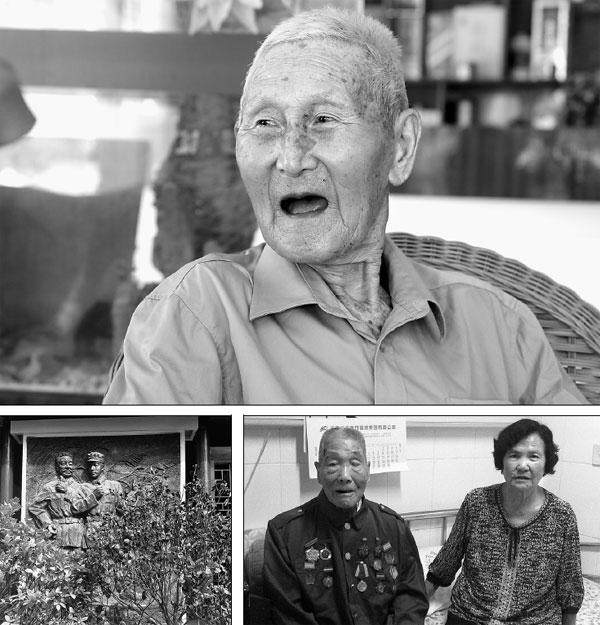
Nearly eight decades since the Long March ended, only a handful of the survivors are still alive. Satarupa Bhattacharjya interviews two veterans in Tongren
Huang Jianjun has been staying at Tongren City People's Hospital for the past four years owing to high blood pressure and ailments related to his heart and lungs.
He was in his early teens in 1934, when a column of Communist troops was passing through his hometown in North China's Shanxi province as part of the Long March, which was a strategic retreat over 24 months undertaken by the Red Army since that year to avoid being captured by then-ruling nationalist Kuomintang forces.
The Red Army, the forerunner of the People's Liberation Army, lost thousands of its men and women during the march from the country's south to the north and west. A large number of civilians who followed the soldiers were also killed by the KMT and war-lords, according to historians.
Tongren is a prefecture-level city in Guizhou province, in the country's southwest, where Huang has lived since retiring as a PLA surgeon in 1957.
Less than 15 such veterans are alive in Guizhou, local government officials say. They estimate that nationwide, only a few dozen - mostly in their 90s-remain.
Huang, 93, largely ran errands for the Red Army during the march. He carried messages for the Communist troops hiding in rural Shanxi and served in their makeshift kitchens, he says in a very soft voice when asked about his earliest memories of the campaign.
His second wife, Zhang Chunyun, 80, relays his answers to make them audible during a recent interview. The former employee of a textile company has shifted to her husband's hospital room that has a TV, cooking stove and two beds, among other items of daily use. They live on government pension.
Huang used to work at the same hospital earlier.

"He (Huang) once wrote diaries about his days in the Red Army but doesn't remember where they are," Zhang says.
She helps him wear his moss-green military jacket, on which are pinned medals from the several battles he participated in, including Pingxingguan during the Japanese invasion in 1937 and Liaoshen from the civil war of 1948. Huang treated soldiers injured on the front lines.
"A simple way to stop infections from spreading was to cut off their (soldiers') limbs," Huang says of war scenes at the time.
He learned surgery in the battlefields from the late Canadian physician Norman Bethune, who was assisting Communist troops in the 1930s in China's northern villages.
At a distance of some 120 kilometers from Tongren is Yinjiang, a county where Meng Shaojin, another veteran of the march, lives. He too was in his teens when a faction of the Red Army that was being led by area commander He Long, visited his village in 1934 to mobilize local support.
Meng, now 95, betrays signs of aging like Huang. Both have heavily pigmented wrinkled skin on their hands and are hard of hearing. But sitting at a restaurant that is by the side of a small river, in a blue shirt and dark trousers, Meng appears more collected in his thoughts while talking about the march.
Along with an older brother, Meng had joined the village militia to help Communist troops. They walked long distances for weeks, with spears in hand to defend against attacks by the KMT or local warlords, occasionally functioning as porters for the troops carrying crops and goods from village to village, his son, Meng Shaoping, says.
In October that year, when the troops were in Lan Bagou, a neighboring village surrounded by hills, they came under fire, Meng Shaojin says.
"The fighting started around noon. We were suddenly attacked by KMT forces from up in the hills," Meng Shaojin says.
Most Communist fighters had swords or spears. A few had the Tao Tong handmade guns, he adds. He was in the vicinity when the bullets started to rain from the other side and was asked by a senior trumpet player of the Red Army to seek cover behind a big rock.
"It was fierce," Meng Shaoping, 65, quotes his father as telling him later.
Many Communist troops were killed and after the fighting was over, the remaining soldiers had dispersed. Meng Shaojin stayed under-ground for months fearing he would be executed by KMT backers if found. Slowly he re-emerged in his village and took up farming. He worked in the county's forest department until 1957.
Among the 300 people from the county who had become guerrilla fighters, 20 were women, he says.
In nearby Yanhe county, 40-year-old Liu Yongpiao, says he is honoring the legacy of his late grandfather, Liu Guofu, a Communist guerrilla during the march, by employing more poor villagers in his honeysuckle and plums business.
Yang Jun and Dong Xianwu contributed to this story.
Contact the writer at satarupa@chinadaily.com.cn
|
Top: Long March veteran Meng Shaojin, 95, during the interview in Yinjiang county, Guizhou province. Above right: March veteran Huang Jianjun, 93, and his wife, Zhang Chunyun, in a hospital in Tongren, Guizhou. Above left: The former house of Zhou Yiqun, a Communist patron, is turned into a museum dedicated to the campaign in the same city. Photos By Yang Jun And Satarupa Bhattacharjya / China Daily |
(China Daily 07/08/2016 page20)