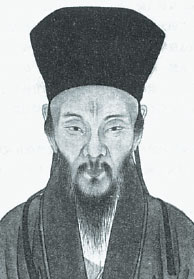
Wang Yangming (1472-1529), literary name Bo'an, was a Chinese idealist Neo-Confucian philosopher during the Ming Dynasty (1368-1644).
Known as "Yangming Xiansheng", meaning "Master Yangming", he is widely regarded as the most important orthodox philosopher after Zhu Xi.
Born into a scholarly family in Zhejiang province, he spent his childhood reading and gaining proficiency in the martial arts.
Wang went to Beijing to attend school when he was 12. On his first day of school, he asked his teacher "what is the point of studying?" His teacher replied: "To pass the imperial examination." Wang, however, was not satisfied with his teacher's reply and said: "I think the point of studying is to become a sage."
His road to wisdom was far from smooth, however. He twice failed the imperial examination, and when he finally passed it at the age of 28, he became a Ministry of Works official.
Wang was hit by a critical event at the age of 35 when he defended a supervising censor who had been imprisoned for attacking a powerful, corrupt eunuch. As a result of his actions, he was beaten with 40 strokes, imprisoned for several months, and banished to remote Guizhou.
During AD 1508, Wang arrived in Longchang, an ancient place near today's Guiyang in Guizhou province, where, despite encountering many hardships, including basic living conditions, which often failed to protect him from the elements, he began to formulate some of his most influential theories and principles. He also took the opportunity to deliver lectures to local people.
One of Wang's principles, the doctrine of "the unity of knowing and acting", states that knowledge and action should be combined, and that one can only acquire knowledge through simultaneous action.
The "knowledge" he speaks of in this principle refers to the knowledge that comes from heart rather than from external influences.
Wang also developed the notion of "idea knowing", which states that every person is capable of discerning right from wrong from birth. He claimed that such knowledge is intuitive and not rational.
His theory of benevolence, derived from Confucianism, says that as component parts of the world, every person should maintain close relationships with other people and be aware of their actions. Such revolutionary ideas were to inspire the philosophers, both domestic and foreign, that followed Wang over the following centuries.
Another Ming Dynasty philosopher, Huang Zongxi, acclaimed Wang's theories as "the greatest accomplishment since Confucius and Mencius".
The modern Chinese philosopher Xiong Shili claimed that Wang's principles were still relevant and important, even after the passage of centuries.
Tu Weiming, a Chinese-American scholar in Confucius Studies described Wang as one of the greatest teachers of Confucian principles.
Sun Yat-sen, revered as China's "father of the nation", was also heavily influenced by Wang's theories.
Provided By The Memorial Museum Of Wang Yangming
(China Daily 10/27/2016 page24)