In the 1990s, Mo Xiaohui was one of millions of migrant workers in Shenzhen, Guangdong province, the front line of reform and opening-up at the time.
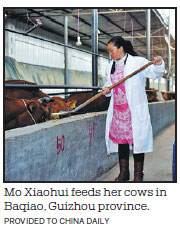
The 44-year-old now raises more than 300 cows in her home village of Baqiao in the mountainous Qianxinan Buyi and Miao autonomous prefecture, Guizhou province.
In 1992, at age 18, she moved to Shenzhen in search of work. She stayed there for five years, during which time she married a man named Zhou Guangqiang, also a Qianxinan native, and had four children.
"In Shenzhen, I worked many jobs including livestock breeder and salesperson, but I didn't earn much," Mo said. In 1997, she and Zhou returned to Qianxinan, and made a living selling honeycomb briquettes, which were used as fuel for fires.
"We still didn't earn much, just enough to support our family," she said. "So, I decided to start a business at home rearing cattle."
Mo has deep affection for cows. "I spent my whole childhood with cows and always sat with them after class," she said, adding that her parents raised about 20 cows.
"I wanted to improve standards in the livestock industry in our village, so it wouldn't have an adverse affect on the land and hills," she said.
However, Zhou was strongly opposed to the idea. "Rearing cattle is hard work. We had experienced such a tough life when we were young, and I didn't want to live like that again," he said. "Moreover, we might suffer losses. I really could not understand my wife's idea."
Although Mo's parents and other relatives asked her if she was mad, she persisted.
"I didn't say much, I just decided that I would have to develop the business efficiently, and let my actions show if I was mad or not," she said.
She had her own ideas about how to run the business. "Almost all the young people in our village had moved to work in big cities, leaving the seniors to raise cattle at home," she said. "But their breeding methods were mostly traditional and outdated, and the cattle had little energy to plow the fields, which affected the farms.
"I asked myself: 'Why don't we rear the cattle by advanced methods and sell the best to other families?' In this way, the cattle would be strong enough to work, which is what every family wants."
In 2012, the couple raised 2.2 million yuan ($318,275) by selling a number of houses and cars they owned and taking out loans. They rented 66.6 hectares of land and set up a cattle station. Mo worked from 5 am until midnight every day, tending the cattle and collecting their manure to sell as fertilizer.
After six years, the station's annual revenue was 3 million yuan, generating a profit of 200,000 yuan, and Mo employed more than 15 villagers. Now, she's planning to expand into breeding chickens.
"When they are asked about the most important thing for a startup, many people will say money," she said. "Superficially, they need money most, but essentially we are also short of confidence, as well as concepts, courage and action.
"Our hometown in the mountains is so backward and lacks access to transportation. That's all right, though. No matter how tough my life is, I just want the younger generation to have a good life and promote the livestock industry in our hometown."
(China Daily 12/28/2018 page6)