|

A woman injured in a subway escalator accident in Beijing on July 5 is taken to hospital. One boy was killed, and 30 people were injured, when the ascending escalator at Beijing Zoo station suddenly reversed. Zhu Xingxin / China Daily
|
Growing concerns that standards in China are too lax, Jiang Xueqing reports in Langfang, Hebei province.
It took dozens of phone calls, and a train ticket, to eventually locate Zhang Lexiang.
The deputy secretary-general of the China Elevator Association has been the center of media attention after a recent South China Morning Post article about escalator safety. He was quoted as saying, in the article, that subway lines on the Chinese mainland purchased cheap, light-duty escalators designed for shopping malls, instead of heavy-duty escalators, to save money.
He did not expect the brief interview to create such a stir. The reporter called him on July 5, shortly after an ascending escalator on Beijing subway Line 4, an Otis 513 MPE, suddenly reversed. A 13-year-old boy was killed and 30 passengers were injured.
"I don't pick up phone calls from Beijing," he said.
In an e-mail sent to his friends and China Daily, Zhang sought to clarify his position on subway escalators. "My understanding is, compared to heavy-duty escalators, public transport escalators ... are actually light-duty.
"Subway companies should raise standards concerning escalator purchases and choose more sturdy products according to the requirements of Chinese subway system. The buyers should be self-critical, rather than always pointing fingers at escalator manufacturers whenever accidents occur," the e-mail said.
Industry insiders say that the definition of public transport heavy-duty escalators is vague.
Based on its initial investigation, the Beijing Bureau of Quality and Technical Supervision said the Otis 513 MPE had design flaws and the company was inescapably responsible for the accident. The use of all 257 Otis escalators was suspended for inspection.
The accident is still being investigated. The inspectors and experts involved are not allowed to release any information, said Li Shoulin, director of the National Elevator Quality Inspection and Testing Center in Langfang, Hebei province. A news release is planned after the investigation is closed.
Duty ratings
Meanwhile, escalator manufacturers denied that they provide light-duty products for public transport. The Otis global company said on its website that Otis 513 MPE is a heavy-duty public escalator for both indoor and outdoor use and that it was designed to withstand the most punishing treatment.
"I'm responsible for telling you this: All the Otis escalators used in subway projects are heavy-duty escalators. You can tell from the type," said Li Mingjie, spokeswoman for Otis China.
She would not give the price for the Otis 513 MPE.
Zhang said that whether an escalator is a heavy-duty escalator for public transport depends mainly on its specifications. Compared with escalators for commercial buildings, heavy-duty escalators have larger specifications such as track radius to increase the equipment's safety and lifespan.
The American Public Transportation Association requires heavy-duty escalators that rise more than 10 meters to have a minimum of four flat steps at each end and an upper track radius of more than 2.6 meters. As the specifications go higher, product costs increase significantly to meet the demands for long and continuous hours of heavy-duty transport.
"Elevators and escalators are manufactured based on the customers' requirements," Zhang said. "As a result, the products can be widely different."
The Shenzhen subway had a similar accident in December, also involving an Otis 513 MPE. Inspectors have not found any connections between the escalators in Shenzhen and Beijing, because their specifications and structures are different, said Li of Otis China. The specifications were based on the customers' requirements, she said.
The customer in Beijing denied there is such a difference.
"I don't know what you mean by specifications," said Yang Ling, spokeswoman for Beijing MTR Corp. "We have already released information on the specifications of the malfunctioning escalator (in Beijing) on our official website."
A China Daily reporter looked through all five escalator accident briefings and a news conference transcript posted on the company's website July 5-8, but did not find that information.
China's standards
China has adopted safety rules for the construction and installation of elevators, escalators and the horizontal conveyors often seen in airports. Chinese technical standards are equal to European standards (EN81-1:1998 for elevators and EN115:1995 for escalators), but the passenger flow at Chinese subway and railway stations is much greater than that in Europe.
Every day, more than 7 million journeys are made on 14 Beijing subway lines, which run a total of 336 kilometers, Li Xiaosong, spokesman of the Beijing Municipal Commission of Transport, said at a news conference.
Besides traffic flow, local area characteristics and environment are important considerations in setting safety standards for elevators and escalators, said an expert at the Guangdong Elevator Technology Institute who asked to remain anonymous. For example, compared with European cities, Beijing needs sturdier elevators and escalators because it is windier, dustier and more polluted here.
"The safety standards for elevators and escalators in China should be set higher than the European standards, so that the standards will conform more smoothly to the Chinese conditions," the expert said.
The standards are only a threshold for market access, Zhang said, but an escalator of good quality far exceeds the basic standards.
"If a truck with a loading capacity of 20 tons and above is called a heavy-duty truck, do I need to buy a truck that can carry a maximum weight of 50 tons or 100 tons?" he said. "It's a complicated calculation based on many factors."
Experts said that because safety standards do not meet the actual demands of public transportation in China, it is hard to simply blame either manufacturers or operators.
The government is tightening its supervision of inspections of escalators and elevators. Zhao Hui, who lives in an Air Force residential compound in Beijing, noticed that the safety test certificate posted in an elevator of her building had expired. The next day, she ran into a person changing the certificate, who explained the elevator had been repaired in February but the bill hadn't been paid. Now with the government checking elevators, the managers had to replace the certificate in a hurry.
Elevators should be cleaned, lubricated and inspected at least once every 15 days, according to safety regulations for special equipment. In addition to the 478 registered elevator manufacturers, about 4,500 service companies have obtained permits to install and maintain elevators.
Booming industry
Thanks to the fast development of the real estate market and public transportation systems in recent years, China has become the largest manufacturer of elevators in the world, with the most existing installations and newest installations, according to statistics from the China Elevator Association.
By the end of 2010, China had nearly 14 percent of all the world's elevators and more than 44 percent of its escalators. Brands owned by Otis accounted for the largest proportion (20 percent) of new installations.
China produced 45,000 escalators and horizontal conveyors last year, accounting for 90 percent of new installations worldwide, and 320,000 elevators, 64 percent of the world total. About 37,200 of the elevators, escalators and conveyors produced were exported.
Statistics on elevator and escalator accidents, especially in recent years, are extremely hard to find, despite central government requirements that different levels of safety supervision bureaus inform the public regularly about accidents.
According to an old report posted on the China Elevator Association website, China had 53 serious elevator and escalator accidents in 2003, including 24 in passenger elevators and four on escalators. The accidents caused 39 deaths, 18 injuries and direct financial losses of 1.34 million yuan ($207,260). While the number of accidents fell the next year to 22, with 18 deaths and nine injuries, the financial losses rose to 2.06 million yuan.
'It takes joint efforts'
Zhai Qi, a 28-year-old writer who lives in the Guangquan residential complex in Beijing's Chaoyang district, was caught in an elevator about two months ago. It happened during morning rush hour.
The Xizi Otis elevator, with seven or eight people on board, suddenly shook roughly and stopped halfway down the 22 stories. The door remained shut. Some passengers pushed the emergency button to alert the elevator supervisor, but no one answered. Others called the property management company and were told to wait for help.
Before anyone arrived, the elevator resumed operation and released the worried passengers safely to the ground. It lasted only about four minutes, Zhai said, but felt much longer.
Another elevator in his building broke down every one or two weeks, Zhai said. It once took a month to have it repaired. The property managers posted a notice accusing some residents of breaking the elevator on purpose and warning that the police would be called if it were damaged again.
"The maintenance of elevators does not simply rely on manufacturers or service companies," said Li of the elevator quality center. "It takes joint efforts of all related parties to ensure elevator safety."
|
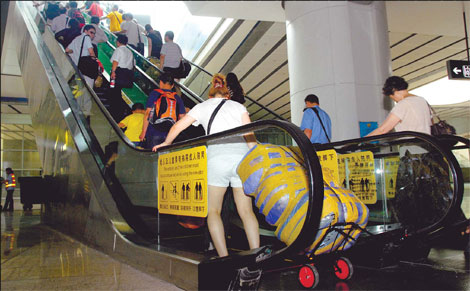
The escalator at the Beijing South Railway Station is one of the busiest in the city. The government has tightened supervision of escalator inspections, and those for elevators, in locations ranging from public transport stations to residential buildings. Geng Feifei / For China Daily
|
|

A victim of the escalator accident at a Line 4 subway station is on her way to People's Hospital nearby in Beijing. The accident on July 5 killed a 13-year-old boy and injured 30 passengers. Zhu Xingxin / China Daily
|

(China Daily 07/14/2011 page1)