Sudden illness left Ye Xiaoli almost completely deaf in one ear, but now the sky's the limit for this indomitable parachuter. Huang Zhiling reports in Qionglai, Sichuan.
To most Chinese, the age of 39 is too old for an athlete. But Ye Xiaoli is still very active. During the 37th World Military Parachuting Championship held in Qionglai, Sichuan province, last week, the mother of a 9-year-old girl grabbed two of the 18 golds for the championship.
On Oct 24, she won a gold medal for the women's formation skydive with three other aces from the August 1st Parachuting Team of the People's Liberation Army of China.
"The August 1st Parachuting Team won many golds in the World Skydiving Championship, World Military Parachuting Championship and World Military Games after it was set up 55 years ago. But it was the first time the team won the gold medal for the women's formation skydiving category," says Chen Wei, chief of the August 1st Parachuting Team.
|
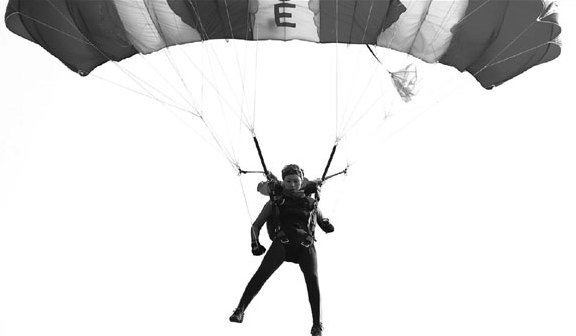
Ye Xiaoli during a training session. Photos provided to China Daily |
A few days earlier, Ye won the gold medal for the Women's Individual Accuracy category in the 37th World Military Parachuting Championship.
"A total of 370 competitors from 31 countries competed in events such as accuracy, formation skydive and style," says Shen Jinke, an information officer with the PLA airforce.
Organized by the PLA airforce and co-sponsored by Sichuan local governments, this year's contest marked the first time the championship, which is one of the 26 sporting events of the International Military Sports Council, was held in China. It had been held exclusively in Europe and the United States until this year.
The council, founded in 1948, is one of the largest multi-disciplinary organizations in the world. It organizes various sporting events for the armed forces of its 133 member countries.
The parachuting event is judged on accuracy, style and formation skydiving.
Since she became a parachuter at the age of 15, Ye has parachuted more than 10,000 times and grabbed 13 gold medals in major international competitions.
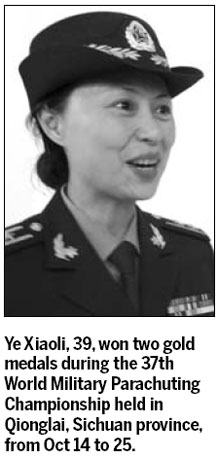
Standing at 1.65 meters tall, Ye has a constant, tender smile. As a high school student, Ye was good at sports and was goal keeper in her schools' women soccer teams. When the Sichuan Provincial Parachuting Team recruited parachuters in the Chengdu No 20 High School where she studied in 1989, Ye entered her name and was selected.
"The first time I parachuted, I was breathless, pale and trembling. I hesitated for quite a long time by the doorway of the helicopter more than 1,000 meters above the ground. For fear of being sent back to my high school as a coward, I closed my eyes and jumped out of the helicopter," Ye recalls in front of a tent at the August 1st Parachuting Team in Qionglai Stadium.
Only after parachuting more than a dozen times did Ye adapt to her new life as a parachuter. Three years later, Ye, an ace in the Sichuan Provincial Parachuting Team, joined the August 1st Parachuting Team where she made rapid progress.
In 1992, she won the gold medal for the women's individual accuracy category in the National Parachuting Championship. In 1999, she won the gold medal for the women's team accuracy category with her teammates in the World Military Games known as the military Olympics of the army.
But misfortune came unexpectedly one night in June 2001, when she was training in a military airport in Jiajiang county, Sichuan.
"My left ear rang and I could not hear with it. The next morning, I could not stand up and felt dizzy," Ye says.
Her condition did not improve, despite spending two weeks in a military hospital in Sichuan's provincial capital Chengdu. She was sent to the Beijing Air Force Hospital where medics diagnosed her as suffering from sudden deafness.
Considering it a problem of the nervous system, they said her chances of regaining her hearing and standing up were 80 percent - if she had sought treatment the same day she fell sick. The chance of recovery was 50 percent if she came within one week after she fell sick. Unfortunately, her chance of recovery was very slim as it had been two weeks since she had taken ill.
"Doctors did not allow her to stand. But she learned to walk by leaning against the wall. Later, I gave her a helping hand when she practiced walking," says her husband Liang Yong, a fellow teammate in the August 1st Parachuting Team.
Liang, 40, is the oldest parachuter in the team. He has parachuted more than 11,000 times, more than any other parachuter in China. His wife Ye is in second place, having parachuted more than 10,000 times.
When Ye was discharged from hospital in late August 2001, she could walk normally, but was deaf in her left ear.
"Whenever I speak with her, I try to stand by her right side," Liang says.
Soon after returning to the team, Ye was asked to parachute again as the team was short of aces.
But with the negative impact of sudden deafness on her psychology, Ye could not parachute as well as before. Before she gave birth to her daughter Liang Yahan on Aug 10, 2004, Ye asked for a long maternity leave and spent the entire second half of 2004 in her parents' home in Chengdu to rest psychologically.
It was a wise move as Ye found herself regaining her competitive edge after returning from maternity leave.
In July 2006, she won gold medals for both the women's team accuracy and women's individual accuracy categories in the 30th World Military Parachuting Championship in Russia. In 2009, she won the gold medal in the women's individual accuracy category in the 33rd World Military Parachuting Championship in Slovakia.
"In a competition of either the team accuracy or individual accuracy category, one's heels have to land on spots the size of coins. To prepare for both categories, parachuters have to practice several hundred times a day. It is boring," Liang says.
But the biggest problem for Ye is that such dedication means she cannot see her daughter, now a fourth-grader in a primary school in Beijing, very often.

Apart from major domestic and international competitions, she and teammates are in training sessions in Qionglai and Pingquan county in Hebei province each year.
"Each training session takes two or three months. The longest time I stay with my daughter is during the Spring Festival when we are together for several days," Ye says.
When her daughter was a toddler, Ye would weave a sweater for her in her spare time to show her love.
During the summer vacation, her daughter stayed with her during the training session in Qionglai. "When I parachuted well, she would present me a flower fresh from the fields in the airport. When I did not do well, she would show her disappointment in an exaggerated way," Ye says with a broad smile.
But it may be another two years before she can lead a normal life with her daughter. "I might retire in 2015," Ye says.
Contact the writer at huangzhiling@chinadaily.com.cn
(China Daily 10/29/2013 page20)
|