|
|
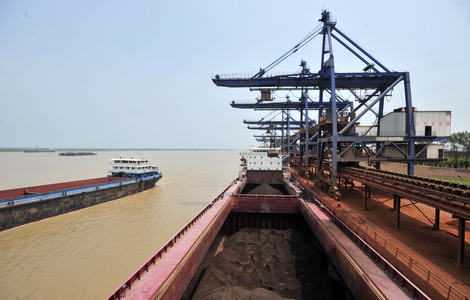
A shipment of Brazilian iron ore arriving in Wuhan, Hubei province. Brazil hopes to expand and diversify its exports to China, such as poultry and other agriculture produce. [Photo / China Daily]
|
Bilateral trade relationship between China and Brazil is set to expand
BEIJING - Adriano Zerbini has been receiving an increasing number of calls from Chinese dealers asking for information about Brazilian poultry exporters, but sadly he's unable to help them.
"They've made me much busier, which is a good thing, only we can't find supplies for them," said Zerbini, market relations manager of the Brazilian Poultry Association (UBABEF), the country's largest poultry industry organization.
Brazil is the world's largest exporter of poultry and the increasing demand in China has resulted in a rise in imports.
However, not all Brazilian slaughterhouses are allowed to export to China, because some of them have yet to implement the technical and hygienic procedures required to obtain a green light from Chinese regulators.
Therefore, Brazil's current output, most of which has already been sequestered by other countries, is unable to satisfy orders from Chinese dealers, said Zerbini.
In 2004, Brazil and China signed a hygiene agreement for poultry, allowing trade to flourish. Since 2009, 24 out of Brazil's 48 poultry exporting facilities have obtained certification from the Chinese authorities.
Analysts said the poultry business is a microcosm of trade between China and Brazil. They are two major emerging-market economies and could prove crucial for the ongoing global economic recovery, especially at a time when Europe is suffering a sovereign debt crisis and the US economy remains fragile with uncertain prospects.
Brazilian poultry, which the UBABEF said boasts integrated production methods and high standards of hygiene and technological support, can easily meet the increased demand from China. However, Chinese buyers need to have a deeper understanding of Brazilian products prior to making their orders, said Ricardo Joao Santin, markets director of the UBABEF.
He said a Chinese delegation may visit Brazil in March 2012 to assess production conditions in the poultry industry and decide whether to allow more imports from the country.
At present, Brazilian poultry exports to the Chinese mainland account for less than 5 percent of the country's total poultry exports. "We estimate our poultry exports to China could expand to between 180,000 and 200,000 tons this year, from 120,000 tons in 2010, doubling its proportion within our total exports," said Santin.
Meanwhile, in recognition of the fact that the two economies are complementary, Brazil also needs to gain a better understanding of Chinese exports and the country's increased investment, analysts said.
Last year, China invested $12 billion in Brazil, overtaking the US to become the top investor in the South American economic powerhouse.
The volume of Sino-Brazilian trade surged by 47.5 percent year-on-year in 2010 to reach $62.5 billion. Meanwhile, during the period between 2005 and 2010, the bilateral trade volume grew by an annual average of 43.3 percent, 23.1 percentage points higher than China's overall trade growth.
In the first three quarters of this year, trade between the two countries amounted to $62.4 billion, with year-on-year growth of 37.2 percent, the fastest among China's 10 biggest trading partners, according to data from the General Administration of Customs.
However, rising Chinese investment and the increasing volume of imports from the world's top manufacturer have ruffled the feathers of local producers and provoked a backlash. So, as a result of intense lobbying from local producers, Brazil sharply raised its tariffs on car imports in September, a move which could prove harmful to Chinese car exporters.
China has now become subject to Brazilian trade-remedy measures and investigations. In the latest case, the country launched an anti-dumping investigation against Chinese-made copper tubes last week.
"The two countries have had complementary trade relations," said Song Hong, head of the Department of International Trade at the Chinese Academy of Social Sciences (CASS).
In the 1980s, some South American countries, including Brazil, suffered a dollar-denominated debt crisis caused by high interest rates combined with the appreciation of the US currency. That affected their ability to borrow and develop local industries, said Song. Since that time, the South American markets have become more open to foreign products, and Chinese exports have helped to satisfy local demand.
In the bilateral relationship, China mainly imports resources and agricultural products, such as soybeans, while Brazil imports Chinese-made machinery and equipment.
In recent years, Brazil has been trying to change its export mixture, which is currently centered on raw materials, such as iron ore, and good.
"The two sides can join together and play a positive role in helping other countries to overcome their financial crises," said Song of CASS. "But they should first solve their own problems and iron out the trade disputes," he said.
|