The road once taken
By Cui Jia (China Daily)
Updated: 2013-10-29
A united front
One theory about the rapid decline of the traditions and language of the northeastern Xibe is that many of them fought in the War of Resistance against Japanese Aggression (1937-1945) when ethnic identity was the last thing on their minds and they adopted the language and lifestyle of their Han comrades in arms, said Sarkozi Ildiko Gyongyver, an anthropologist from the University of Pecs in Hungary, who has been studying the Xibe people in Qapqal since 2010.
 |
|
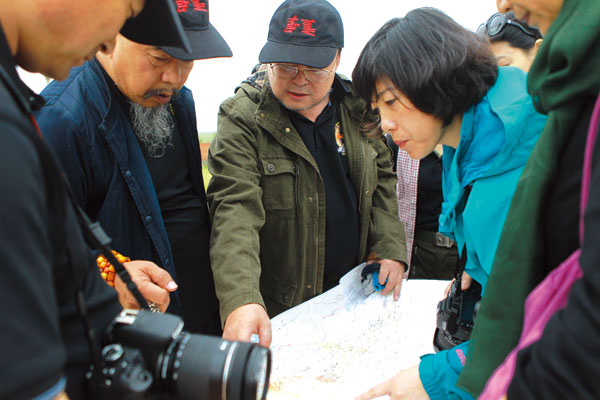
Guan Yunke (center) and his fellow travelers check a map after crossing into Mongolia. |
"By contrast, however, the Xibe population in Xinjiang is very small, which has forced them to emphasize their ethnic identity so they can present a united front to any possible threat," said the 35-year-old, who currently lives in Qapqal.
Before joining his fellow travelers to pay respects at the Xibe temple in Shenyang, where their ancestors bade farewell to their relatives, on April 18 - the date upon which the original journey began in the Chinese lunar calender - to kick off the modern-day journey, Meng took two bags of corn and rice seeds from Laohutou with him, planning to plant them in Xinjiang, just like the old times.
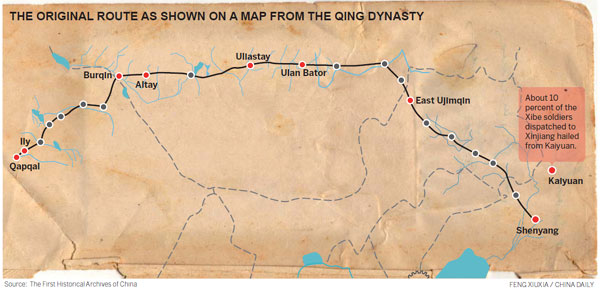
The group intended to follow the exact route that the Xibe soldiers and their families had taken, according to a detailed map from the Qing Dynasty.
"To be separated from your loved ones, not knowing if you will see them again is more painful than death. We still bear the pain today," said Guan Yunke, 60, who hails from Kaiyuan, but now lives in Beijing where he owns an art gallery.
Some people claimed the emperor had promised the soldiers and their families that they would be free to return home after 60 years of service, but no document has ever been found to support that theory, he added.
"The early generations of the Xibe people in Xinjiang were cremated when they died so their ashes could be carried back to Northeast China, but later burial became the norm and they decided to call Qapqal home," added Guan.
At the China-Mongolia border, He Xiaodong from Qapqal was busy talking on his cellphone with the staff at his restaurant in Beijing which specializes in Xibe cuisine. He was anxious to conclude his business before crossing the border and incurring extra roaming charges.
The 39-year-old spoke a mixture of Mandarin and Xibe. "The fact is that we can't speak the Xibe language as well as our parents did and the next generation is likely to be even worse because Mandarin and English are more useful than Xibe," he explained with a bittersweet smile.
Four SUVs and the Mongolian drivers were waiting for the group at Zhuengadabuqi land port in Inner Mongolia. The vehicles had been modified with reinforced internal bars to minimize damage and injury in the event the SUVs overturned, the bars are a must-have feature for vehicles in Mongolia.
"Our ancestors only had horses and oxcarts, but we have SUVs, which is such a luxury - mind you, they didn't need visas," laughed He, while getting his passport out ready for stamping.
As soon as the fleet exited China, the sealed road disappeared and the SUVs began to cruise across the vast grassland, following the tracks made by other vehicles. There were no road signs to guide them.

High-speed train debuts in Inner Mongolia
A bullet train departed Hohhot East Railway Station for Ulanqab marking the start of high-speed rail services using Inner Mongolia’s first newly-laid high-speed railway on Aug 3.