The vexed issue of clearing the filthy air
By Lin Boqiang (China Daily)
Updated: 2013-11-11
The level of air pollution in big Chinese cities shows how much China has paid environmentally for its economic growth of the past 30 years. Several weeks ago the State Council, China's cabinet, issued a plan on air pollution that details efforts the country will make over the next five years to improve air quality by drastically cutting pollution, especially in and around Beijing, the Yangtze River Delta and the Pearl River Delta.
The country's bad air can be attributed to many things, but the three main steps that need to be taken to reduce it are obvious: reducing energy consumption, changing the structure of the energy industry and increasing the supply of clean energy. To those ends, among the measures the government is taking is a pledge to build no new coal-fired power plants in these areas.
The plan also focuses on reducing coal consumption in eastern China, which has enjoyed particularly high economic growth and accounts for a large part of the country's energy demand. If cleaner energy cannot meet growing energy demand in this region, fossil energy resources, especially coal in the west of the country, will be needed to generate electricity.
Coal provides 69 percent of the country's primary energy and nearly 80 percent of its electricity. Hydropower development has limited potential. Other clean sources of energy such as wind and solar are too small to make a meaningful contribution at the moment. Nuclear energy could act as a substantial substitute for coal, but a longer-term development plan is needed. Natural gas could possibly replace up to 5 percent of coal in the primary energy mixture over the next few years.
Eventually, control measures will bring down air pollution in the east but result in raised pollution in the west. That is because industries that are highly energy-intensive will migrate from east to west.
There is clear evidence that industries that are highly energy intensive have begun moving to the west. Let's take aluminum, a highly energy intensive product, as an example. Xinjiang Uygur autonomous region produced 1.1 million tons of aluminum last year, 274 percent more than the year before. Gansu province produced 1.89 million tons, more than 65.6 percent than the year before. Elsewhere in the west, Ningxia Hui autonomous region's aluminum production rose 22.4 percent last year, Inner Mongolia autonomous region's production rose 14.6 percent and Qinghai province's production rose 13.2 percent. It is expected that by the end of this year Xinjiang alone will have 2.6 million tons of incremental aluminum capacity. More than 10 businesses are now developing aluminum plants in Xinjiang with long-term plans for total annual output capacity of 16 million tons.
Last year the Yangtze River Delta and the Pearl River Delta accounted for nearly 30 percent of total electricity consumption and about 25 percent of the incremental power demand in China. With limited clean energy potential in these provinces, stopping building coal-fired power plants implies substantial power imports, possibly by long distance ultra-high voltage transmission from the West.
What has happened in the eastern regions is not much different from the development experience of developed countries and has closely followed the Environmental Kuznets Curve of "pollute first and clean up later". So there should be important lessons for China here. How to balance economic growth and development with environmental sustainability is critically important.
Even with the heft of the government's efforts, the environmental clean-up in the eastern regions is highly problematic, particularly because of the high costs in developing clean substitutes and tackling allied social problems.
For the western regions, even with good environmental policies, environmental deterioration will be difficult to avoid. However, effective policies and help from the east should help keep a cap on that. Put another way, effective policies might well help keep the Environmental Kuznets Curve flatter.
For this to happen, the government needs to establish two mechanisms to avoid the west reproducing the kind of pollution that has long cast a pall over the east.
First, the terms of trade for energy transfer should be in favor of the west. The central government needs to coordinate and ensure reasonable energy prices that could support economic development in the west and curb energy consumption in the east.
Second, the government should ensure that ordinary people in the west benefit from the transfer of energy resources. With higher incomes, the people in the west could gain access to commercial energy, change their patterns of energy consumption, afford cleaner energy and reduce their use of coal.
In addition to short-term administrative measures to clean up the environmental pollution in the east, the government needs to keep in mind that environmental improvement in the longer term depends on adjusting the economic structure, improving energy efficiency, changing the structure of the energy industry, advancing technologies and raising income levels.
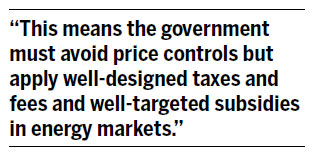
All these factors are driven by correctly pricing energy to take account of the impact its production has on the environment. Therefore, the government should continue to reform the energy price mechanism. The energy pricing reform will benefit both the current pollution clean-up in the east and reduce the chances of replicating earlier mistakes in the east. This means the government must avoid price controls but apply well-designed taxes and fees - and well-targeted subsidies in energy markets.
The author is director of the China Center for Energy Economics Research at Xiamen University. The views do not necessarily reflect those of China Daily.
(China Daily 11/11/2013 page20)

High-speed train debuts in Inner Mongolia
A bullet train departed Hohhot East Railway Station for Ulanqab marking the start of high-speed rail services using Inner Mongolia’s first newly-laid high-speed railway on Aug 3.