Countries to boost education ties
By Zhao Xinying (China Daily)
Updated: 2014-08-22
China and Mongolia agreed to strengthen ties in education, which has been expected by teachers and students from both nations for a long time.
President Xi Jinping announced during his visit to Mongolia on Thursday that China will provide governmental scholarships to 1,000 Mongolian students in the following five years.
In addition, both nations agreed to support Chinese and Mongolian studies, and meanwhile strengthen bilateral exchanges in fields covering culture, language, tradition, history, arts, sports and traditional medicine.
Cui Li, deputy director of the Liaoning People's Association for Friendship with Mongolia, said they had been long waiting for the moment.
"Many enterprises in Liaoning province want to develop businesses in Mongolia," said Cui.
"But they are disappointed that prospective employees who can speak both languages, understand both cultures and know both nations' laws well are nowhere to be found.
"We are all looking forward to President Xi Jinping's visit. We hope it will promote educational exchanges between the two nations, and therefore nurture more talent who can play important roles in bilateral exchanges in economics, trade and culture."
Cui was previously in charge of international student affairs at Liaoning University. She said the university considered setting up a Mongolian-language major, but did not go ahead because of a lack of teachers.
"There are very few people studying the Mongolian language in China," she said. "As far as I know, only a couple of Chinese universities have such a major, and they don't recruit students every year."
Cui said 30 Mongolians are studying at Liaoning University, a small figure compared with the numbers from other countries.
Most are studying for master's degrees, though there are some undergraduates and doctoral students. They are studying a wide range of specialties, including the Chinese language, law and trade and economics.
Mend Amar, a 37-year-old doctoral student from Ulan Bator, the capital of Mongolia, is one of them. She arrived at the university in 2012 to major in modern and contemporary Chinese literature.
She said she came to improve her knowledge of the language so she can teach it more effectively.
She worked as a teacher at Mongolia's Otgontenger University, where there is a Chinese language translation major that recruits 50 to 60 students each year.
"Many young people in Mongolia are interested in the Chinese language and would like to learn it," she said.
"They are working hard for the opportunity to study in China, and I hope I can help them to realize their 'Chinese dreams' through my efforts."
Amar started learning Chinese in 1995 when she enrolled at the Mongolian State University of Education and majored in the language at the suggestion of her father, a radio journalist who had visited China.
"My father said China was developing quickly and Mongolian graduates who could speak the Chinese language would be very competitive in our job markets," she said.
In 2003, Amar came to China's Shanghai International Studies University to study Chinese through a public-funded program. This laid the foundations for her being admitted by Liaoning University as a doctoral student with a scholarship provided by the Chinese government.
"I'm very lucky," she said. "And I hope that with the two nations' efforts to strengthen educational ties, the good luck can be extended to more Mongolian students who would like to study in China in the future."
zhaoxinying@chinadaily.com.cn
|
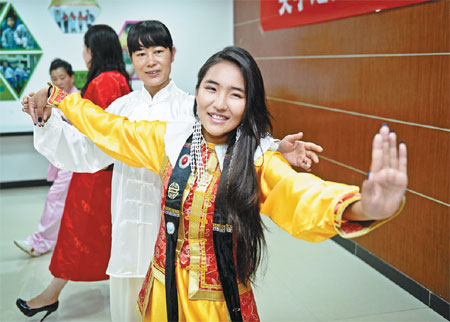
A Mongolian student learns tai chi in Hefei, Anhui province. She is on a cultural exchange program between China and Mongolia. Zhang Duan / Xinhua |

(China Daily 08/22/2014 page2)