
Innovation jumpstarts Jilin's economy
By Liu Mingtai ( China Daily )
2013-05-22
|
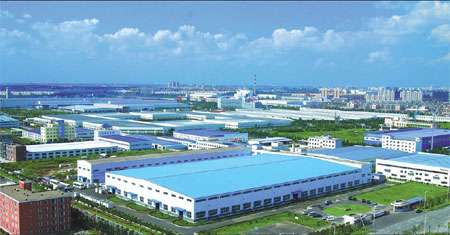
The sprawling Changchun National High-tech Industrial Development Zone is designed as a magnet for startup projects, investment capital and top experts. Photos Provided to China Daily |
Jilin authorities said they will continue policies that sharpen the province's edge in innovation to better promote efficiency and sustainable development.
Even with rich agricultural resources and a well-established industrial base, Jilin ranks just 22nd among the 31 provincial economies on the Chinese mainland. Its growth in GDP has surpassed the nationwide average for 10 consecutive years.
"Our potential lies not only in our advantages, but also in the gap," said Wang Rulin, Party chief of the province. "The enormous potential in innovation has far-reaching significance in realizing the dream of making our province powerful and our people wealthy."
Jilin Governor Bayin Chaolu agreed, noting "innovation is a key engine for development to change the economic model and optimize industries".
National granary
Famed as "the granary of the country", Jilin harvested 33.43 billion kilograms of grain in 2012, a record high in its history. Its yield per mu - about 0.07 hectares - was 130 kilograms more than the nationwide average, maintaining Jilin at the top of the country in yield, a position it has now held for 10 straight years.
The province's goal is to increase its annual total grain harvest to 37.5 billion kilograms in the next five years, according to local officials. The ambitious target is the result of innovations in farming techniques and operations.
Over eight years of tests in crop production technology, the Northeast Institute of Geography and Agroecology developed a combined new technology that increased the average corn yield per mu by up to 23.7 percent. The demonstrational farms using the new technology are planned to expand to 133,333 hectares in the province this year.
The technology seems simple - changing the direction of farming fields and the space between crop rows. It enables a sharp increase in sunlight and ventilation resulting in a rise in crop yields.
The technology is easy to learn, but was hard to popularize because the change in farming field direction broke through original boundaries of individual fields and easily triggered disputes.
But the difficulties in turn brought about innovative operations. In response, local governments have encouraged expansion in the scale of farming, the establishment of more cooperatives and improvements in production efficiency.
Re-rented fields that facilitate unified management and increase in production scale now account for 14 percent of the province's total. The percentage is expected to rise to 19 percent this year.
In Dahuang Village, Jilin city, all farms have been rented to one cooperative for unified operation. As a result, villagers had more than 18,000 yuan ($2,935.79) in per capita net income last year, far more than the nation's average 7,917 yuan.
After working on new technologies and cooperatives, authorities turned their attention to innovation in financial services. They have introduced a new type of low-interest loan that uses future yields as collateral.
Under the current legal framework, rented farmland cannot be used as loan collateral. The new lending approach clears that hurdle and helps resolve financing difficulties.
In less than a year, 2,000 farmers have been granted more than 60 million yuan in such loans in a pilot area. Plans call for the innovation to now be leveraged across the entire province.
As well, farm product processing has grown into the second-largest industry in Jilin province.
A traditional industrial center, Jilin province boasts well-established industrial facilities and a skilled labor force.
It is home to the headquarters of domestic auto company First Automobile Works.
In April 2012 FAW announced it would revitalize its signature Red Flag brand, which was China's first locally produced car. The household name, long linked to exclusive use by high government officials, has now hit the mass market.
To retool the proprietary auto brand, FAW established a 1,600-strong R&D team and invested 5.2 billion yuan in integrating resources. During the 12th Five-Year Plan (2011-15) period alone, 10.5 billion yuan will be spent on research.
"Through the Red Flag brand, we aim to achieve a breakthrough in domestic proprietary autos," said Xu Xianping, general manager of FAW, adding that the brand will be a measure of whether the auto domestic industry is qualified for international competition.
Such heavy investment and determination has brought a large quantity of intellectual property ranging from auto designs to test and production facilities.
As well, the new energy vehicles have hit the roads in the province, with 12-meter-long pure electric buses now in use and 50 plug-in hybrid cars put into operation for demonstration.
'Profound effect'
"Improving innovation capacities and making breakthroughs in key technologies has a profound effect," said Party chief Wang during his inspection of Jilin Oilfield Co, an affiliate of Petro China, in early May.
"We need to integrate resources across the entire province and form a joint force to enhance innovation, promote the industrialization of R&D results and drive healthy, sustainable growth," he said.
Innovation is not only vital to emerging industries, it also plays a key role in modernizing traditional sectors, local officials said.
At the 32,000-square-meter factory for CNR Changchun Railway Vehicles Co Ltd, high-speed train compartments are assembled and tested.
"The new locomotive is more powerful and has a 12 percent reduction in aerodynamic drag compared with previous streamlined models. It was developed entirely on our own," said a technician at the facility.
Such state-of-the-art technologies fueled an increase in annual sales from 1.5 billion yuan in 2002 to 23.93 billion yuan last year.
In another emerging sector - carbon fiber materials - the province has formed a complete industrial chain from scratch within three years.
With 818 tons of carbon fiber produced annually, 20,000 bicycles with the new material are rolling off the line each year and a series of carbon fiber car component projects have been put into operation. Officials said the province is on the path toward its goal of becoming "China's carbon fiber capital".
Over years of effort to diversify industries, Jilin has developed eight sectors each with an annual production value surpassing 100 billion yuan. Before the number was just two - auto production and petrochemicals.