
Promoting connectivity in Northeast Asia
By Zhong Nan and Liu Mingtai in Changchun
( China Daily )
2015-09-03
 |
|
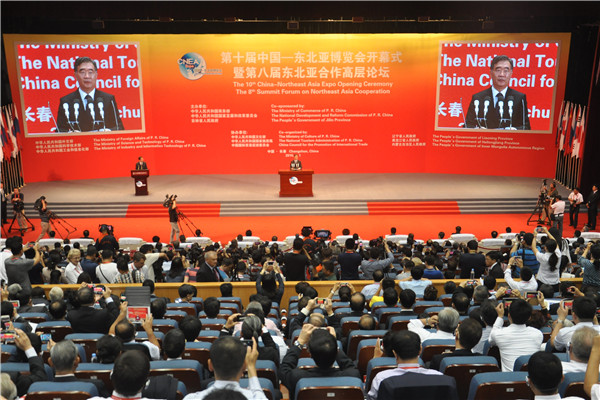
Vice-Premier Wang Yang gives the keynote speech at the 10th China-Northeast Asia Expo, which began on Tuesday in Changchun, Jilin province. Photos by Ding Luyang/China Daily |
Shared facilities and infrastructure will improve regional growth: Vice-Premier
Vice-Premier Wang Yang called on countries in the Northeast Asia region on Tuesday to promote regional connectivity as a priority to stimulate trade and attract investment to improve regional economic integration.
The six-member region, comprising China, Russia, Mongolia, the Democratic People's Republic of Korea, the Republic of Korea and Japan, represents a market with a population of 1.7 billion and more than 20 percent of the world's economic aggregate.
As global economic recovery still faces many uncertainties and challenges, including weak investment momentum and unstable financial markets, countries in Northeast Asia are having difficulties boosting exports and creating jobs.
"Developing combined transport by rail and sea, road passages and other infrastructure is practical to establish a flexible transportation network throughout the Northeast Asia region to improve and diversify regional economic growth," Wang said at the opening ceremony of the 10th China-Northeast Asia Expo in Changchun on Tuesday.
Because raising funds for big-ticket infrastructure projects is a tough job amid the current global economic climate, China supports the Asian Infrastructure Investment Bank and Silk Road Fund to provide cash and other financial needs for projects in the region.
"Countries in the region should also accelerate their pace to establish unified transportation regulations and technical standards for various transportation tools, which will further facilitate goods and service exchanges," Wang said.
Fang Aiqing, vice-minister of commerce, said companies within the region are encouraged to use their own currency to seal deals and build e-commerce platforms to save on both operating and trading costs, as well as carrying out closer cooperation between customs authorities to simplify clearance procedures.
China and other Northeast Asian countries have maintained close trade and economic relations. The trade value of the China-Northeast Asian countries in 2014 totaled $712.03 billion, accounting for 17 percent of China's total foreign trade.
China-Japan trade value stood at $312.48 billion, China-ROK trade amounted to $290.56 billion, China-Mongolia commerce reached $7.3 billion, that between China and the DPRK came to $6.38 billion and China-Russia trade registered $95.28 billion.
As China promotes its Belt and Road Initiative and Russia raises capital to develop its Far East region, as well as the Republic of Korea's Eurasian initiative, Fang said these platforms will include upgraded logistics services, giant international shipping companies, new air routes, pipelines, port facilities and land and sea telecommunications.
The Silk Road Economic Belt and the 21st Century Maritime Silk Road initiatives were proposed by President Xi Jinping in 2013, with the purpose of rejuvenating the two ancient trading routes and further opening up markets for Chinese companies.
Song Yaoming, commercial counselor with the Asian Affairs Department of China's Ministry of Commerce, said from a long-term view, these new projects would fully support trade, private investment, industrial productivity and the service sector in the Northeast Asia region.
"It is also a new way for governments, multinational corporations and wealthy individuals to readjust industrial structure and optimize financial resources in their countries and the whole Northeast Asia region," Song said.
To further enable the movement of people and the exchange of innovative ideas within the region, China, Russia and the ROK have signed agreements to simplify visa application procedures and ease barriers to interaction and mobility.
Contact the writers through zhongnan@chinadaily.com.cn