
Rundown community center rejuvenated by relocation program
By He Na and Liu Mingtai ( China Daily )
2015-10-16
Baishan was aging because its natural resources were depleted. Now, the city is coming back to life after a government initiative to create jobs through eco-tourism. He Na and Liu Mingtai report.
Arriving at Dahu village is like entering a park fitted with rows of neat, new red buildings, wide roads and a well-designed landscape containing colorful flowers in bloom and dancing butterflies.
A few seniors were playing chess on stone tables, while others were exercising on sports equipment installed in the small square nearby.
Dahu is just one of dozens of newly built ecological villages in Linjiang, Baishan city in Northeast China's Jilin province.
So far, more than 42,000 people have moved to these park-like communities.
Given the continuing rise in urban real estate prices, one could be forgiven for thinking that these must be high-end communities that only the wealthy can afford. However, the residents of these buildings are not rich; rather they are mine workers who were laid-off.
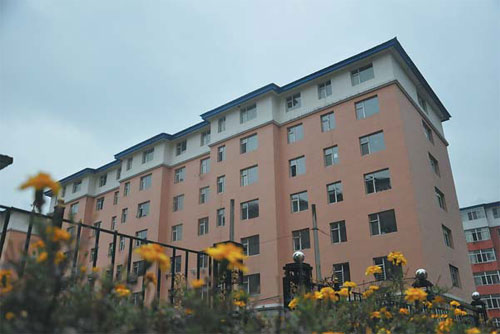
The neat apartments in Baishan's "ecological villages" offer new residents a convenient lifestyle. [Photo by Ding Luyang/China Daily]
Take Linjiang, a county-level city administered by Baishan, for example. It was once rich in coal and copper, but after years of resource exploitation it is now on a national list of cities whose natural resources have been exhausted.
Liudaogou Copper Mine, established in 1957, was once one of the largest enterprises in the region, and supported about 550 households. The gradual decline in the copper reserves resulted in the mine being closed in 1985, and the workforce was left with no alternative but to find temporary jobs in nearby cities.
The workers lived in houses built in the 1960s, but a lack of maintenance in recent decades saw the infrastructure, such as water, electricity and roads, fall into disrepair, causing inconvenience and risks to public safety.
In 2014, recognizing the difficulties facing the residents, the local government decided to relocate them and help to built new communities in nearby Liudaogou.
The old residential area became the site of a new industrial zone, established to attract new projects and create new job opportunities.
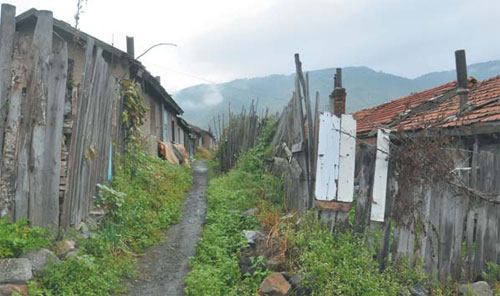
Before the relocation project, locals lived in the old, shabby houses in the mountains or near the mines. [Photo by Ding Luyang/China Daily]

Former mine and forestry workers have found new jobs in a local animal feed factory. [Photo by Ding Luyang/China Daily]
The relocation is just one of the measures undertaken by the Baishan government in recent years to cope with the transformation of resource-exhausted cities.
The end of logging
In addition to its coal and copper resources, Baishan, at the foot of the Changbai Mountain Range, abounds with forests that provided commercial timber. On April 14 last year, a ban came into force and logging became history.
In fact, the end of logging followed nearly 15 years of gradual depletion of local forestry stocks and resultant job losses.
No official data is available to indicate how the ban affected local employment levels, but there's no doubt that many people have been affected. Local officials say it's not just an economic problem, but also an important social problem.
However, rather than approaching the central government for funds and assistance, the authorities in Baishan decided to transform the local economy in an ecologically friendly way.
After years of effort, the decision is paying off.
"Ecology is the lifeline of the city's development. We are making a living from the mountains, so our first priority is to protect and improve the environment," Li Wei, Party chief of the city, said.
The local government formulated and launched a series of policies to promote sustainable development, including improving energy-saving and emissions-reduction measures at high-energy consuming industries and businesses, improving sustainable economic development and promoting the development of tourism.
Relocation project
Protecting the environment and resources has been the focus of the local government's work in recent years. It has pledged to help relocate the 199,000 people who originally lived in resource-exhausted areas or in the forests, water-source conservation areas and nature reserves and regions containing rare plants and animals within three to five years.
"The eastern part of Jilin (where Baishan is located) is an important ecological barrier. Gradually implementing the relocation plan will have great significance in promoting the recovery of the ecosystem," said Bayinchaolu, Party chief of Jilin province.
"The relocation of people is not a simple ecological and economic project, but an important civil project that concerns people's livelihoods. Baishan has made good progress in the past two years," he said.
Baishan is in the major section of the Changbai Mountain Range, one of the major ecological barriers for China's northeastern region and northeast Asia. The range is home to many rare plants and animals and is regarded as a natural gene bank.
In addition, Northeast China is an important agricultural base, accounting for 20 percent of the nation's crop yield. The relocation project can provide effective protection for the natural environment, especially the microclimate of the Songliao Plain - one of the world's most important corn-producing belts.
Raising living standards
The project is also designed to improve people's livelihoods and improve their quality of life.
In 2008, the local government placed the project at the top of its agenda, pledging to accelerate the pace of transformation in the forestry regions and resource-exhausted areas.
Former forestry worker Yu Xiushan was among the first group of locals to benefit. Yu moved into his new home four years ago, and he now lives in a 52-square-meter apartment with three members of his family.
"We used to live in a 30-square-meter house in the mountains. We needed to chop wood to cook meals and keep warm, but still it was very cold in winter and the roof leaked when it rained," he said. Yu's apartment has central heating, and more importantly, the location allows his son to study at a nearby school.
Xin Jianguo, deputy director of the Baishan Development and Reform Commission, said 910-sq-km of new forests will be recovered when the relocation program is complete.
"Moving people down from the mountains is the best way to protect the forests," he said.
Job opportunities
New jobs are also being created via the development of tourism, forest foods and medicines. Incomes are rising and unemployment is falling as the locals cultivate edible mushrooms, and raise pigs, deer and wild vegetables.
For instance, the Songjianghe Forestry Bureau has established production bases for medicinal herbs. In 2014, the bases generated 120 million yuan ($19 million).
"By cultivating mushrooms and planting ginseng, I can earn more than 4,000 yuan a month. Our lives are getting better every day," said Zheng Mingzhen, a forestry worker at the bureau.
Zheng, who used to live in Wangtiane, now a tourist resort, said initially he was unhappy about moving, because of the inconvenience of cutting wood and planting crops at his new home. He said Wangtiane has changed a lot since the relocation process ended.
With the rising number of tourists in recent years, Zheng has opened a home inn, which generates about 100,000 yuan a year, several times the average annual income of local residents.