
CSIC navigates 2013's troubled waters with higher revenues
By Zhong Nan ( China Daily )
Updated: 2014-01-21
|
|||||||||


China Shipbuilding Industry Corp, one of the nation's two major shipbuilding conglomerates and the primary contractor for China's naval force, said it managed stable revenue growth in 2013 as it continued to pursue a larger share in both domestic and global markets of non-marine and offshore engineering products.
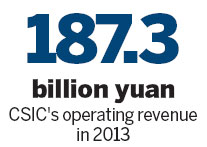
The company said its operating revenue jumped by 7.3 percent year-on-year to 187.3 billion yuan ($31 billion).
CSIC attributed the increase to its strategy of diversifying and adjusting its pillar products.
While many Chinese shipyards' earning capability was squeezed by low technical content, appreciation of the renminbi and blind expansion, CSIC devoted more of its resources to non-marine products, such as heavy port cranes, large steel parts and equipment needed for offshore oil exploration and the generation of wind power.
Sun Bo, CSIC's executive vice-president, said that the proportion of its non-marine products now exceeds its shipbuilding operations by more than half.
"As China's shipbuilding sector passes through a period of industrial upgrades and fierce market competition, we will continue developing non-marine products, expanding into industries such as energy, transportation and logistics, growing our presence not only in China but in the global market," said Sun.
With a workforce of about 140,000 people, CSIC oversees 46 industrial subsidiaries and 28 research and development institutes, including Dalian Shipbuilding Industry Co, Qingdao Beihai Shipbuilding Heavy Industry Co Ltd and China Ship Research and Development Academy. It has exported various types of vessels to more than 60 countries.
As builder of China's Jiaolong manned submersible, which can dive to a depth of 7,000 meters, CSIC is eager to grab more market share in China's emerging offshore engineering market over the next several years.
Offshore engineering products are essentially functional vessels and oil-drilling platforms that can float in deep water. Offshore gas and oil companies use these vessels to process the natural gas and crude oil pumped from the ocean floor. In some cases, the vessels also are used in the extraction process.
Bao Zhangjing, director of the China Shipbuilding Industry Research Center, said many countries' economic future will be decided in the deep waters offshore through technological development and international cooperation.
"Because this sector is unlikely to see a slowdown in the short term, deep-water fields are expected to be the main sources of conventional energy yet to be discovered and developed," Bao said.
These factors have pushed nations such as China, Singapore, South Korea, the Netherlands and even oil-rich African countries such as Ghana and Gabon to acquire more oil-drilling platforms, maritime crane ships and dredgers to support their economic growth.
"If you look at the global market for ships, you can see declining signs in the low-end ship market everywhere," Sun said. "We have already shifted our core business to offshore engineering, because, apart from higher profits, there is also less competition because not too many shipbuilders are able to produce sophisticated offshore engineering vessels.
"The expertise and technology gained from designing, building and maintaining ships provide a strong platform for us to move into offshore engineering products," Sun said.
The company so far has delivered 67 large-scale offshore drilling platforms and related products to various clients.
From a long-term perspective, the State Council--China's cabinet, said that, by 2015, the nation's shipbuilding industry should have 25 percent of global market share for high-end vessels and one-fifth of the market for offshore engineering products.
China COSCO Holdings, the country's largest shipping conglomerate, placed orders for four very large crude carriers (VLCCs) from CSIC last month in order to take advantage of China's new subsidy policy designed to reduce the number of aging ships and replace them with higher-tech vessels.
Sun said the company will continue to deploy its financial resources into the development of VLCCs, mega-container ships and energy-efficient vessels, as well as law enforcement vessels.
"With technologies gradually improving, China is in a better position to catch up with its rivals in South Korea or Japan, because large-scale Chinese shipyards still have better manufacturing facilities and technology support, as well as other advantages suck as lower labor costs and effective material supply chains."