

Machinery makers tap into Latin America
( China Daily Latin America )
Updated: 2014-02-10
|
|||||||||


 |
|
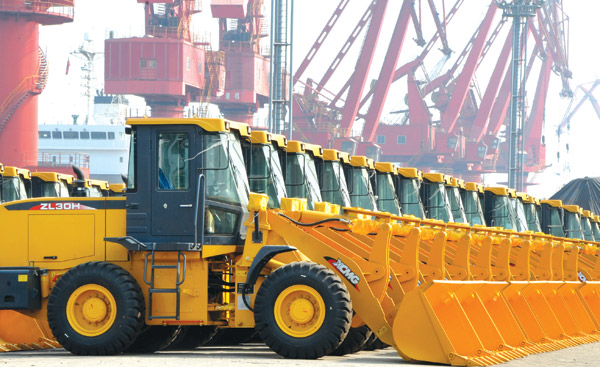
Excavators made by the Chinese machinery maker XCMG Group are ready to be shipped to Port Vitoria in Brazil from Qingdao port. Wang Chun / For China Daily? |
After three years of being held back by an ailing domestic market that has failed to improve, Chinese construction machinery makers are increasingly deploying their resources and money in Latin America to fuel its robust growth.
Opportunities in the region include the 2014 football World Cup and 2016 Summer Olympics in Brazil, Argentina’s road and housing projects, oil projects in Venezuela and manufacturing facilities in Mexico, as Latin American nations strive to achieve their goals in the areas of sports economy, infrastructure, and industrialization.
"The majority of governments in Latin America are acutely aware of how undeveloped infrastructure remains one of the major obstacles to the healthy growth of their economies," said Jean Aboussouan, division chief of infrastructure of the Inter-American Development Bank.
Indeed, restricted by aged roads and port facilities throughout Latin America, especially in Brazil and Argentina, two of the world’s largest grain producers, soybean and corn exports, and sometimes fruit and mineral resources have been delayed recently.
Eager to enhance earnings ability, international players such as Caterpillar of the United States and Japan’s Komatsu have been consolidating their presence by diversifying their localization strategies and sewing up more alliances throughout Latin America to grab more market share.
Chinese construction machinery makers such as Shantui Construction Machinery Co Ltd, Xugong Group Construction Machinery Inc and Sany Heavy Industry Co Ltd have also acted aggressively in the growing market, and have proved to be worthy opponents to their foreign rivals throughout the continent.
Cheng Zhaohong, deputy-general manager of Shantui, said that to encourage investment in various shapes, the Brazilian government has introduced fundamental changes in the management of public finances, empowering more financial autonomy to provincial governments to improve their economies and infrastructure.
"As a result, work on building new roads, highways, buildings and even small airport is feverish right now. Many people in Latin America are keen to buy construction machinery to become contractors or to lease it out," Cheng said.
The company shipped its first batch of construction machines, including excavators, bulldozers, pipe-layers, road rollers and wheel loaders, to Brazil from Qingdao port earlier this month, as part of its contact for 152 construction machines signed by its Brazil subsidiary last year. The total value of the contact is $14 million. The remaining products will be delivered in April and August.
Thanks to political stability and a relatively developed transportation system, Shantui’s branch in Brazil also plays an important role in supplying construction machines to Paraguay and Bolivia.
In contrast to Shantui, whose market sales in the Latin American market are being managed by country branches partly assisted by a number of regional dealers with more than 110 outlets in different cities, Xuzhou-based XCMG invested $200 million to build a plant to produce machines from mobile cranes to those needed for mining, forestry and work on hydro and road projects, in Pouso Alegre in the Brazilian state of Minas Gerais in 2012.
With the new manufacturing facility operational from this month, XCMG expects to gain $500 million in sales revenue in the Latin American market and enlarge its Brazilian employee number to 5,000 by 2015.
Wang Min, chairman of XCMG, said the company will not only focus on the market of infrastructure development, but will also pay close attention to developing cranes for wind and other clean energy projects, as many Latin American nations such as Brazil, Chile and Argentina try to shift away from fossil fuels and cut carbon dioxide emissions, which will be a new market growth point over the next decade.
"We have seen the trend, needs and opportunities for specifically designed cranes, such as machines that can be applied in the marine industry or special geographical locations like oilfields or plateaus," Wang said. "We would like to develop more purpose-built cranes to meet the growing demand in this market."