Guangdong is located in South China and mainly in the subtropical zone. The province covers an area of about 178,000 sq km (from east to west about 660 km across and 800 km from north down to south), plus about 180,000 sq km marine territory. 60% of the land is mountainous and the rest is composed of tablelands, river valleys, coastal plains and islands. It envelops the Pearl River (Zhujiang) Delta, Chaozhou-Shantou Coastal Plain (mainly the Hanjiang River Delta), mountainous Northern Guangdong, Leizhou Peninsula and the Southwest Coastal Plains. From east to west arranged in an arc are the Yunwu, Qingyun, Jiulian, and Lianhua mountains. Mt. Nanling is the largest in Northern Guangdong, consisting of five ranges: Dayu, Dupang, Mengzhu, Yuecheng and Qitian. So Mt.Nanling is also called Mt.Wuling (five ranges), which is also the watershed of the Pearl River and Yangtze River systems. Shikengkong Peak of Mt.Dadong in Ruyuan Yao Autonomous County in the Northern Guangdong is the highest geographic point of the province, about 1 902m high above sea level.
Facing the Pacific, the province is endowed with a long coastline of 3,368.1 km along the mainland, plus 1,649.5 km around 759 islands dotted in the South China Sea (Nanhai in Chinese) (excluding Hong Kong, Macao and Dongsha Islands). There are 1 631 reefs and rocks above the surface of the sea. The 1 600-sq-km island area accounts for 1.85% of the total land and the sea area is 350,000 sq km, almost twice as much as the land area. Besides, there are 180,000-sq-km of continental shelf within 200 meters deep, stretching from the south end of Taiwan Straits in the east to the east of Beibu (Northern) Gulf and the middle part of Qiongzhou Straits in the west and south respectively.
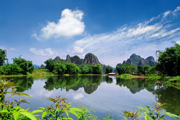
Guangdong province looks just like a gigantic land triangle on the map, with green mountains and hills undulating in the north, vast fertile lowlands in the south and still green hills scattered along the coast. The mountainous area (500 meters above sea level) takes 31.68% of the land; the hilly area 28.54%; tablelands 15.34%, plains 23.56% and water area on land 0.88%. The Pearl River Delta and Chaozhou-Shantou Coastal Plain (mainly the Hanjiang River Delta) are a land of rice and fish, occupying 1/3 of the total land of the province. With the longest coastline in China and two river deltas, Guangdong is endowed with a dozen natural deepwater harbors. Among them there are five important international ports: Guangzhou Port, Huangpu Harbor, Shanwei Port, Zhanjiang Port and Shenzhen Port. They have been playing an outstanding role in the social development of Guangdong Province by connecting the outside world. Geographically, Guangdong is bordered by Hunan and Jiangxi provinces to the north, Guangxi Zhuang Autonomous Region to the west, Fujian Province to the east, Hong Kong and Macao SARs to the south. Hainan Province, once part of the province, is down below south with the Qiongzhou Straits in between.
Located on the line of the Tropic of Cancer and between the north latitudes 20°09'--25°31' and the east longitudes 109°45'--117°20', Guangdong enjoys a most favorable geographic location. Guangdong has mainly got a warm and humid subtropical climate with nice mild winters as warm as spring May and long hot and humid summers like a rice steamer. This typical subtropical marine monsoon weather features a rainy season from April to September and frequent typhoons from May to November. Its annual average temperature varies from 19°C in the north to over 23°C in Leizhou Peninsula in the south, which is actually situated in the southernmost tropical area. In January, its average temperature changes from 9°C in the north to 16°C in the south, while in July, from 28°C to 29°C, with an annual evaporation amount of 1,000mm in the north and 1,200mm in the south respectively. Influenced by the monsoons from the SE, it has a rich rainfall of 1,500mm-2,000mm annually with 40 percent falling during the summer. The annual sunshine is about 1,750 hours in Northern Guangdong, 1,800-2,000 hours in the middle, and 2,000-2,200 hours along the coast. With plenty of rainfall and lots of sunshine, life is thriving. There grows very well a large diversity of vegetation including crops, vegetables, fruit as well as plants.