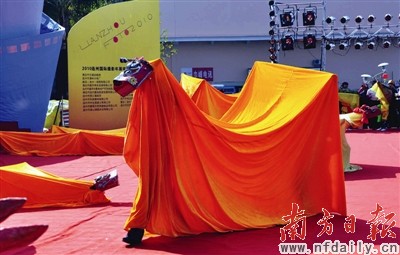
 |
| The cloth bag wooden lion dance |
The cloth bag wooden lion dance of Sanshui Yao ethnic township, Lianzhou city, is a unique tool-based dance in Guangdong province and in China at large. It is an art form that integrates singing, dancing and music. It was generated by the people of Yao ethnic group of Lianzhou in the past thousand years of long-distance migration. It expresses diligence and bravery of the Yao ethnic group and their aspiration for a happy life.
At the first Lianzhou International Photography Exhibition in 2005, the mysterious and primitive cloth bag wooden lion dance made its debut in front of Chinese and foreign tourists. It attracted a lot of media attention. The dance was termed the “living fossil of history of Yao ethnic group in Lianzhou,” since it concentrated on the culture, art and folk customs of the local Yao ethnic group. The diversified cultural features of the dance presented high academic values.
Following the death of the old generation actors, fewer people understand the dance. Efforts have been made to rescue and protect the cloth bag wooden lion dance. In 2009, the dance was admitted as an item of intangible cultural heritage under provincial protection. Its application for national protection has been submitted.
Historical origin: tool dance commemorating ancestors
The Yao ethnic group migrated to Lianzhou early in the Sui and Tang dynasties. At present, the ethnic group has 6,100 people, most of whom live in Yao’an and Sanshui ethnic townships. The Yao ethnic people are fond of singing folk songs and dancing long-drum dances. At Guabang village of Sanshui township, an unusual tool-based dance, cloth bag wooden lion dance is often performed.
According to Zhao Yongfu, an old actor of Guabang village, the wife of Zhao Chaosheng, an ancestor of the village, committed a crime and was punished. Twelve families from the Yao ethnic group petitioned by beating long drums and performing dog dances in front of the government office. They were suppressed and the Yao ethnic people fled in all directions. The long-drum player disappeared without a trace. The dog dancer, Zhao Chaosheng, escaped to Nanyue Mountain and was protected by a Taoist practitioner. Since Zhao was skilled in martial arts, he was conferred the title of master of lion of Nanyue Mountain. Zhao was modest and declined. Later, he was known as second master of the wooden lion of Nanyue Mountain.
Since then, the cloth bag wooden lion dance has been passed down. Cheng Shangou, a 70-year-old master of the dance, says that in the olden days, during lunar January and Panwang Festival, as well as lunar October 16, the lion dance team of the village would go and perform in neighboring Yao villages. First, they would burn joss sticks and candles to worship. Then, they would hit the gongs and drums, blow suona horns and vertical bamboo flutes, and dance the lion dance. They danced to hold memorial ceremonies for ancestors, prayed for people’s health and bumper grain harvests and for their domestic animals.
Artistic feature: 72 images reflecting 1,000-year change
The cloth bag wooden lion dance of Yao ethnic group is a comprehensive art integrating singing, dancing and music. The dance is comprised of the wooden lion dance and migrating lion tune. The dance movements demonstrate 72 lively images. The migrating lion tune consists of three parts, warning of prophets, folktales and proverbs of life. The singing is separated into the solo and the chorus, accompanied by drums, suona horns and bamboo flutes. It takes seven hours to complete the whole performance.
The cloth bag wooden lion has a unique model. The lion head is carved with princess tree wood, about 40cm long and 25cm wide. It is rectangular in shape, separated into upper and lower parts. The upper part shows the countenance of the lion, with five conoid horns. The lower part displays the chin, lips and teeth of the lion. The lion is is covered by a yellow cloth so that several people dance as the lion. When the wooden lion is danced, the lion would throw its head forward and the lips would shut.
Cheng Shangou says the wooden lion is danced by several people. Each section of the dance is called an image, or a scene. The dance performance has 72 images, classified into the seven categories of happiness, sadness, protection, thinking, rewarding, form and rebellion. They are largely used to reveal the hardship of Yao ethnic group over the past thousand years, and their diligence, bravery, and longing for a happy life.
The Happiness image is applied to celebrate the successful migration of Yao ethnic group and their homeland reconstruction.
The Sadness image shows that the King passed away before fulfilling his cause. He struggles to stand up before dying.
The Protection image displays adopting all measures to avoid disasters in the face of external threats. It symbolizes the hardship of migration by the 12 families of Yao ethnic group.
The Thinking image shows thinking of a way.
The Rewarding image describes the Yao ethnic people assisted by turtles, clams and carps in the seven days and nights of sailing across the sea. It shows that Yao ethnic people cherish the loving kindness of their benefactors.
The Form image symbolizes Yao ethnic people longing for a happy life after “sailing across the sea.”
The Rebellion image shows the spirits of Yao ethnic people fighting against feudal oppression.
Local scholars say the cloth bag wooden lion dance reflects incidents of the Yao ethnic group in the subject matters, contents, and artistic forms. It contains the rich features of the ethnic group, concentrates on its culture, art and folk customs. As a result, the cloth bag wooden lion dance is hailed as “living fossil of history of Yao ethnic group in Lianzhou.”
Inheritance: showcased at photo exhibition
Soon after the liberation in 1949, the cloth bag wooden lion dance was destroyed as a member of “the monsters and demons.” It once more saw the light of day till China implemented reform and opening up. The local tourism administration set up a folk custom zone at Guabang village of Sanshui township. In 1992, the cloth bag wooden lion dance was invited to participate in the celebration of Panwang Festival of Yao ethnic group at Liannan. In 1994, the dance was admitted in the touring performance celebrating Lianzhou’s expansion from county to city.
At the first Lianzhou international photography exhibition in 2005, the cloth bag wooden lion dance showed extraordinary talents. It surprised Chinese and foreign photographers and guests with its mysterious, simple and primitive charms. At photography exhibitions in subsequent years, Guabang village has received over 100 photographers and tourists each day who come to see the extraordinary dance performances.
Gao Wangjiao, head of the Sanshui township culture center, says young people of the village are less enthusiastic about traditional folk art. The dance is too complicated. This has indirectly hampered the inheritance and development of the wooden lion dance. Since many of the old generation folk artists have passed away, there are fewer people who understand and perform the dance year after year. There is some crisis in the inheritance of the folk art. Urgent measures are needed to rescue and protection the art.
Cheng Shangou, 70, has inherited and promoted the art of cloth bag wooden lion dance. He began to learn the 72 images of the dance movements when he was 14. He learnt it for two years. Cheng says “There are few people willing to learn the dance.” A few years ago, Cheng accepted nine disciples under the stimulation of the photography exhibition. But most of the time, the disciples work in the Pearl River Delta area. They returned only during festivals and holidays. None of the disciples have mastered the 72-image dance, not to mention the three-hour “migrating lion tune.”
To better inherit and promote the traditional folk art, Lianzhou intangible cultural heritage protection team has done an all-round survey about dance. It has prepared a full range of written materials and video recording of the dance.
At present, Lianzhou is exerting greater efforts to inherit and protect the cloth bag wooden lion dance of Yao ethnic group. It has subsidized folk artists to assist them promoting the skills, and buy them tools and instruments. In 2009, the cloth bag wooden lion dance of Yao ethnic group was approved as an intangible cultural heritage under provincial protection. It is waiting for its national protection application to be approved.