Expat programmer rewrites career in China
(China Daily)
Updated: 2016-08-19
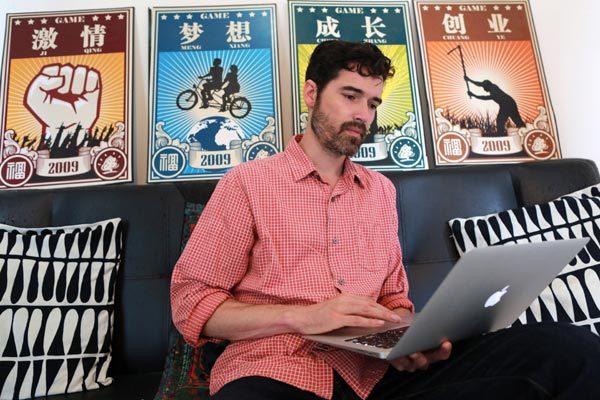
Tiffany Tan tells how an American guitar-strumming video game programmer reinvented his career in China.
After losing his job in the dot-com bust, video game programmer Joshua Dyer moved from the United States to Taiwan in 2002. Dyer, 40, a native of San Diego, California, decided to teach English in the city of Hsinchu to pay off college student loans and see the wider world.
Although he had researched teaching markets in Japan and South Korea, China became his main focus.
"I just thought learning Mandarin was going to be way more useful than learning Japanese or Korean," he says.
Little did he know that the decision would jumpstart his career, once Chinese mainland video game companies started to think global in the late-2000s.
Since 2009, a year after moving to Beijing, he has been earning a living from his combined knowledge of video games and the Chinese language. From his apartment, where he lives with a roommate and a cat, Dyer helps Chinese online and mobile game companies translate their products into English.
His work is targeted toward the North American and Western European markets. Most of it involves Massive Multi-Player Online Role-Playing Games, such as Mofa Zhi Men (Runes of Magic), which are free to play though users need to pay for additional game features.
Chinese online games are practically unknown compared to top titles such as World of Warcraft (developed by a US company) and Final Fantasy XIV: A Realm Reborn (Japanese). But China's game companies are striving for a bigger slice of the global video game market, currently worth $64 billion, according to DFC Intelligence research firm.
China is already a key player in the video game market, with 490 million users and earnings of $13.7 billion last year, figures released in the 2013 China Games Annual Conference show. Domestically developed games grew by 29.5 percent to $7.9 billion between 2012 and 2013.
On his big translation projects, which involve hundreds of thousands of Chinese characters divided among several translators, Dyer says the work is "intense". While chasing tight deadlines, he usually spends six days a week pounding the computer keyboard for up to 12 hours a day. This goes on for two to three weeks at a time.
Fluency in Chinese alone isn't enough to get the job. Clients look for translators who also understand the world of crafting video games.
"In translation, people want to believe in your language skills. But that's just 50 percent," Dyer says while sipping a cup of coffee. "They also want to believe in your knowledge of their industry. That's what is going to allow you to really get what they're trying to say, the subtleties of it."
His career took off quickly, he says, because it's rare to find a translator who has also worked at a video game company. Plus, he was trained in computer and information science in college and holds a master's degree in East Asian languages and cultural studies.
As a freelancer, he usually makes between $25 and $40 an hour, based on the volume of text he translates. Dyer can earn up to four times the average Beijing monthly salary, but periods of frantic typing over the years have taken a toll on his fingers.
The pain on them has also affected his music. He plays the guitar and dobro for Randy Abel Stable, a semi-professional alternative country band based in Beijing. Last year, he decided to shift the bulk of his work to literary and art translations.
Dyer has done short stories that are published in the literary magazine Pathlight, including Li Zhishu's Bei Bianchui (Northern Border), which talks about the loss of cultural identity among Chinese people living in Malaysia.
Though literary and art translations pay less than those for video games, Dyer welcomes the gentler work pace. It's not only good for his body but also his spirit, giving him the opportunity to immerse himself in worlds that authors weave.
He describes the process as going from a world of Chinese words to an "inner world of pure thought and feeling", and re-emerging into a world of English words. "It's a weird kind of concentration, but it's a very beautiful feeling," Dyer says, adding that it's an experience absent from the straightforward translations for games.
Even as a professional translator, he sometimes loses his fluency in Chinese. He spends the majority of his days working alone - reading, typing and writing - rather than conversing in Chinese.
"I worked in-house at a Chinese game company for one year when I first got started," he says, "and I used to give presentations at that company in Chinese. I would be panicked to do that now because my oral Chinese is rusty."
But he couldn't be happier with the professional niche he has found. Losing his job in the dot-com bust turned out to be the springboard for another career.
What we do
SAFEA is responsible for certifying foreign experts to work in the Chinese mainland and organizing overseas training for Chinese technical and managerial professionals.