Kung fu dreams
(China Daily)
Updated: 2016-10-03
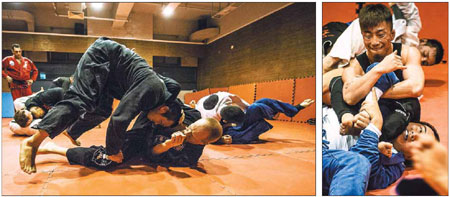
They are three foreigners who share a passion for an ancient Chinese art. They traveled halfway across the globe to realize their vision of opening up a gym to share their knowledge of martial arts learned in Brazil and Europe. Belle Taylor reports.
Up a narrow stairwell in a gym above a coffee shop in Beijing's Wangjing area, three friends from opposite ends of the globe, Norway and Brazil, are working hard at creating their own version of the Chinese dream.
They are not manufacturing products to export, or selling foreign made goods to the booming Chinese market - they are building a martial arts gym, bringing an international flavor to an ancient Chinese discipline.
"We have been friends for a long time and we started to talk about plans to open a gym in Scandinavia," says Brazilian Luciano Queiroz. "But we talked things over and we saw that it was going to be much better to come to China because China is growing so fast."
The trio, Norwegian Fred Thomassen and Agusto Miranda and Queiroz, both from Brazil, met as they pursued their sport by training and competing internationally over a number of years.
They are all impressively tall and well built, athletes with years of training behind them.
But their imposing physical presence has little relation to their friendly demeanor as they chat about trying to encourage more female fighters and the challenges of adjusting to a different language and culture.
They established Big King BJJ gym in Beijing 18 months ago, renting out rooms in Wangjing's KOO Gym to start taking students.
While China has a long history of martial arts, commonly known as kung fu, Queiroz says they want to "introduce a wider spectrum of martial arts to China, in particular jiu-jitsu".
Thomassen, Miranda and Queiroz teach a variety of disciplines with a focus on Brazilian jiu-jitsu, Thai boxing and reality based self-defense, a pragmatic form of martial arts that focuses on modern conflicts and crime situations.
Thomassen says there are similarities across the various forms.
"There are only so many ways the human body moves," he explains. "So if you go into the Chinese system you are going to find the same way to break an arm," he explains.
Thomassen first came to China eight years ago to study martial arts.
"I started doing some Chinese styles in Norway and Europe and I wanted to come over here and check out how good I could get, how real it could get, and when I came to China I tried to find a good school, there are some good schools, but for every one good school there are a hundred dancing academies, they just show you how to dance, it's not real, and all of us are more into competing or defending ourselves."
Big King BJJ has had the softest of soft openings, slowly increasing the size and number of their classes to ensure each new student feels like they are part of the business. Chatting to them, it is apparent that they are operating their gym with the same one-eyed zeal they approach their sport - this is less a business and more a labor of love.
"Most gyms here start out by looking for a lot of capital from an investor and then they start looking for the students. They are usually not that financially sound and the students don't feel that much ownership to the gym, so we are doing it the other way around," says Thomassen.
When Big King BJJ opened they had only one student - their neighbor who worked in a local horse riding equipment store.
"He was just your average Joe, you know?" says Thomassen. "And the thing is, we still have that kind of customer, not all professional fighters, not all rich embassy people or something, we want all kinds of people, all walks of life to just blow those barriers away and just communicate and be happy together," he says, sounding more yoga instructor than martial arts competitor.
Thomassen has a firmer grasp on Mandarin than his fellow trainers, although Queiroz says he's improving every day.
"'Hao, bu hao (good, or not),' you can teach a lot with just those words," Queiroz says with a grin.
"I really like China but it is completely different from Brazil and the Western world. Sometimes it's kind of strange and hard to deal with but still, I've been here a year and a half and it gets better every day."
"We work together as a team and we help each other out but it's also an individual challenge," says Thomassen.
The trainer's ultimate goal is to have students they can develop into serious competitors who will represent the gym at competitions in China and abroad. But for now, they are working on developing relationships, building a client base. They show off their logo, two chess pieces with martial arts belts tied around them.
"Jiu-jitsu's like a chess game, using the mind and body together," Queiroz says.
It's the same approach they are taking to building their Chinese dream.
What we do
SAFEA is responsible for certifying foreign experts to work in the Chinese mainland and organizing overseas training for Chinese technical and managerial professionals.