The big surprise
By Tiffany Tan ( China Daily )
Updated: 2012-06-03
|
|
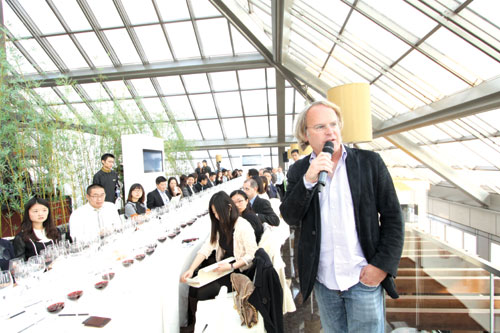
James Suckling first visited China's Shandong in the 1980s. Twenty years later, he was caught off guard by the changes he saw on a second visit. He tells Tiffany Tan what he thinks of Chinese wines and the progress in the last decades.
In 1987, it took James Suckling 15 hours by train to travel from Beijing to the vineyards in the eastern province of Shandong. Now, the trip takes only a third of that time, thanks to high-speed rail.
His final destination has similarly seen accelerated growth in the past three decades.
In the 1980s, a handful of wine-makers, recognizing the promise of the Chinese market, began producing European-style wines on the mainland. Now, China is the world's sixth largest wine producer - bottling an average of 157.6 million cases a year for the next three years, according to a study commissioned by Vinexpo, the wine and spirit exhibition.
By 2014, as China's production continues to grow, current market leaders - France, Italy and Spain - are expected to face declines, the study says.
Suckling, 53, an authority on some of the world's most prestigious wine regions such as Bordeaux and Porto, says he never expected wine-making to become so big in China.
"In the last 10 years, I think there's something like hundreds of new wineries," he told China Daily during a Beijing trip last winter.
When he revisited Shandong in 2009, more than two decades after his first trip, Suckling says he was surprised by the changes he saw.
"Going through the vineyards, they looked just like Europe. It was amazing."
But in the face of the country's rising wine production, the crucial question is: How's the quality of Chinese wines?
"The wines are good, international quality, but the problem is they're still not a great Chinese wine," says Suckling, former European bureau chief of Wine Spectator, the United States' most widely circulated wine publication, who now operates his own wine-review website.
"I think that a lot of people say, 'Oh, it's great!' But if that wine had a French label, they would have gone, 'Oh, it's OK.'
"I think because it's Chinese, they say 'wow'. But I don't think people should do that. Chinese wine has to be rated with the rest of the world." In other words, they need to lose that handicap.
The fundamental problem with Chinese wine, Suckling says, lies in the kind of grapes that go into them.
"Growers don't understand that they have to reduce the yield of their grapes," he says.
"To make quality wine, you have to reduce the quantity of the grapes." This is because huge harvests mean less concentration of sugar and flavors, which make the difference between mediocre and great wine.
But there's good news. Suckling, who also serves as wine editor for Asia Tatler magazine, says he has seen an overall improvement in the Chinese wine industry since his 1987 trip.
"The number of wineries making good quality wine has increased," he says.
Steve Chapman, an Australian winemaker who regularly travels to China to advise local winemakers, agrees.
"There is certainly more emphasis now on quality as opposed to quantity," says Chapman, who worked for three vintage periods between 1994 and 2001 at the Chateau Huadong-Parry in Shandong. This was among the country's first Western-style wineries, established by a Briton in 1985.
"There has been an explosion of investment and a vast improvement in equipment and technology, in addition to the education of the wine-making staff," he says.
The rise of Chinese wineries can be attributed to the government's support for the industry, and the fact that wineries remain government-controlled, according to the International Wine and Spirit Research's "China Wine Market Report" for 2011.
Also, Chinese wineries "have used Western expertise to improve their quality", it says.
For Suckling, the best Chinese wines are those bottled by Grace Vineyard, located in northern Shanxi province. He especially likes its 2006 Chairman's Reserve, a blend of Cabernet Sauvignon, Merlot and Cabernet Franc.
The wine, however, received only an 86 on Suckling's 100-point scale, in a 2009 review for Wine Spectator. Over the years, some of his perfect scores have gone to wines from Italy, France, Australia and the US.
But he did say Chinese wines still "have a long way to go" before they can compete among the best.
Contact the writer at tiffany@chinadaily.com.cn.