Land of fairy tales
By Zhang Zixuan ( China Daily )
Updated: 2012-06-23
|
|
Legend has it that many Chinese in the world originated from Hongtong county. Zhang Zixuan visits southern Shanxi province and discovers more intriguing tales.
A step into Hongtong county in southern Shanxi province and I found myself transported into a land filled with fairy tales.
One legend - probably the most important of the lot - claims that Hongtong is the birth place of many of the world's Chinese population.
The story started at the end of the Yuan Dynasty (1271-1368) where Shanxi was one of the few surviving places not affected by years of wars and natural disasters, which severely shrank the population within the central plains.
To solve the problem of the lack of manpower in other provinces, the imperial court during the beginning of the Ming Dynasty (1368-1644) ordered the people of Shanxi to migrate.
All the migrants were gathered under a humongous Chinese scholar tree in Hongtong, as the setting out point. According to folklore, the tree trunk was so huge that it required seven men and one woman to stretch their hands out to fully encircle it.
There were 18 waves of migration. It is said that the migrants settled in more than 2,000 cities and counties in 30 provinces. As years passed, their future generation is believed to have spread over 100 countries around the world.
Unfortunately, there is no trace of the legendary tree. It was apparently destroyed by floods in the Qing Dynasty (1644-1911). But the spot where the tree supposedly grew has become a popular tourist site.
It is located on the northern suburb of Hongtong, where a new tree now stands. Next to it is a peculiar-shaped tree root that is believed to be even older than the original legendary Chinese scholar tree.
More than 200,000 visitors come to the site every year to trace their roots and to worship their ancestors.
Within the site, visitors get to see how their ancestors used to live in houses made to look like those in the Yuan and Ming dynasties.
Millions of red and yellow strips of cloth carrying well wishes are tied to the second- and third-generation Chinese scholar trees.
And believe it or not, descendants of the great migrations still carry evidence of their Shanxi identity within their body. Anyone who has petaloid toenails - two split parts of toenails on the small toe - is believed to have originated from Shanxi. This is because, according to legend, every migrant was forced to have a cut on their pinky toe as a mark to prevent them from sneaking home.
The Chinese term used today to mean "go to toilet" or jie shou is also linked to the legend.
The migrants had their hands tied behind their backs when they migrated. They were only allowed to untie their hands when they needed to relieve themselves. Jie shou, which literally means to untie the hands, gradually became the term used for "go to toilet". The expression spread widely to the provinces where the Shanxi migrants were sent.
Another interesting tale on Hongtong involves a woman by the name of Su San in the Ming Dynasty, who became probably one of the most well-known prostitutes in Chinese history.
Su met young scholar Wang Jinglong at her brothel. The two fell in love and Wang stayed with Su for a whole year but was later chased out of the brothel because he ran out of money. Su was then sold to another man as concubine. She was framed for murdering the man, imprisoned and was sentenced to death.
Meanwhile, Wang who attempted the imperial examination, did well and was appointed governor of Shanxi. He heard about Su's case and helped with the investigation to deliver her from death row.
The lovers eventually got married and as how all fairy tales end, they lived together happily ever after.
The story has been adapted as a Peking Opera play The Story of Su San (Yu Tang Chun) and became one of the best-known Peking Opera plays in China. Hongtong county where Su San was imprisoned became well-known through the play.
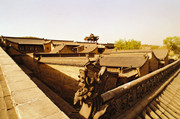
Although the original prison was severely damaged during the "cultural revolution" (1966-76), the present one restored in 1984 retains all its original features. For example, there is a cave used for dead bodies, and a well with very small mouth to prevent prisoners from jumping in to kill themselves.
Su San's story has brought fame to the prison, making it a must-see in Hongtong. Today the site is renamed as "Su San Prison", and her story is presented by a series of wax statues within the site.
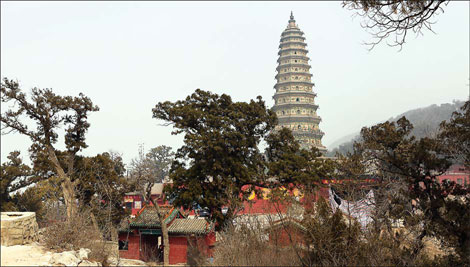
When in Hongtong county, also do not miss the Feihong Pagoda in Guangsheng Temple at Mount Huoshan. This 13-story pagoda is the largest and best-preserved glazed pagoda in the country.
The 500-year-old octagonal-shaped Buddhist pagoda is glazed in yellow, green and blue with spectacularly carved statues and patterns, which gleam in the sun.
Every piece of the pagoda tells a story, so do other cultural heritage sites in Hongtong. The best way to know more, is to visit the land of fairy tales.
Contact the writer at zhangzixuan@chinadaily.com.cn

(China Daily 06/23/2012 page10)