Action-packed preparation makes for an exciting dish
Soft and slippery on the outside, pared noodles (刀削面 dāoxiāomiàn) are actually pretty chewy. But, it's not just what's in the bowl that attracts its fans; the method itself is a real visual treat (眼福 yǎnfú).
In front of a boiling pot, the chef slices the dough into noodles with a flip of the wrist so quick that you'll swear black and blue that he's a kung fu master in disguise.
A skilled chef can make two slices a second and use 25 kilograms of dough in a single minute. Each slice is surprisingly consistent, roughly 20 centimeters long, in the shape of a willow tree leave with a fine edge and thick center. Viewers are often dazzled by the speed.
When the first slice touches the water, the next piece is in the air forming a white arc above the dough. All the noodles seem to splash about like hungry little fish.
Pared noodles are tightly connected to their roots in Shanxi (山西 shānxī) province, where grain abounds in the basin of the Yellow River and its tributaries. Naturally, Shanxi people rely on grain, mostly wheaten food (面食 miànshí), over rice, which is more popular in the south.
Like Sichuan people and their spices or Hunan people and their stinky tofu, the attachment between Shanxi people and their mianshi is deep; to the extent that they won't be satisfied if a meal doesn't have wheaten food (無(wú)面不歡 wú miàn bù huān).
Though the ingredients are simple, time and resourcefulness have given birth to a variety of dishes and flavors. As the saying goes: "With one kind of flour, there are a hundred ways to cook and eat it." (一樣面百樣做,一樣面百樣吃。Yī yàng miàn bǎi yàng zuò, yī yàng miàn bǎi yàng chī.)
Steamed, boiled and fried, there are more than 280 different dishes with established and delicious recipes. When you include all the variations and styles, there are as many as more than 400 different mianshi dishes in Shanxi culinary culture.
Of all these delicacies, pared noodles are perhaps the most famous, thanks to the unconventional technique and showmanship involved. And, as with just about everything in China, it has ancient origins.
Legend has it that, in the early Yuan Dynasty (1271-1368), the rulers confiscated all the weapons among the people for fear of an uprising. Even cooking knives were tightly controlled - 10 families needed to share one knife.
One day, an old couple wanted to have noodles for lunch, but it wasn't their turn with the knife.
The old man suggested they use a thin piece of iron they found on the side of the road, and said: "If it's too soft to cut, then shave." They never needed to borrow the town knife again.
Today, if somebody wants to try authentic pared noodles in Beijing, Jinyang Restaurant (晉陽(yáng)飯莊 Jìnyáng Fànzhuāng) may be one of his or her choices.
Founded in 1959, Jinyang Restaurant is Beijing's oldest Shanxi restaurant.
Jinyang is also the name of an ancient metropolis in Shanxi that served as the capital city for many dynasties.
A bowl of tasty pared noodles consists of three critical elements: the preparation of the dough, the slicing and the sauce.
The ratio of flour and water should be kept at three to one. After the dough is formed, it should be covered with a piece of wet cloth and set for half an hour.
Kneading requires strength and technique to get the dough well-shaped and balanced in terms of texture.
When it comes to slicing, chefs at Jinyang Restaurant maintain the tradition of using a thin iron sheet, which they sharpen themselves and bend to fit the curve of the dough. The sauce (鹵 lǔ or 澆頭 jiāotou) for pared noodles varies.
In the case of Jingyang Restaurant, their seafood flavored sauce is what keeps the customers coming back time and time again.
Courtesy of The World of Chinese, www.theworldofchinese.com
Recipe | Jinyang Pared Noodles
Ingredients
30ml of sesame oil 香油 xiāngyóu
30ml of Chinese prickly ash seeds oil 花椒 huājiāo
30ml of cooking oil 食用油 shíyòng yóu
500 g of flour 面粉 miànfěn
200ml of water 水 shuǐ
500ml of stock 高湯 gāotāng
1 egg 雞蛋 (beaten) jīdàn
4g of salt 鹽 yán
2ml of cooking wine 料酒 liàojiǔ
4ml of soy sauce 醬油 jiàngyóu
1 cucumber 黃瓜 huángguā (sliced)
100ml of starch sauce 淀粉 diànfěn
1 stalk of scallion 蔥(sliced) cōng
25g of sea cucumber 海參 hǎishēn
25g of shrimp 蝦仁 xiārén
25g of bamboo shoots 筍 sǔn
25g of fresh mushroom 鮮蘑 xiānmó
25g of Shiitake 香菇 xiānggū
25g of chicken (boiled) 雞肉 jīròu
25g of plain boiled pork 白肉 báiròu
25g of wood ear mushroom 木耳 mù'ěr
Method:
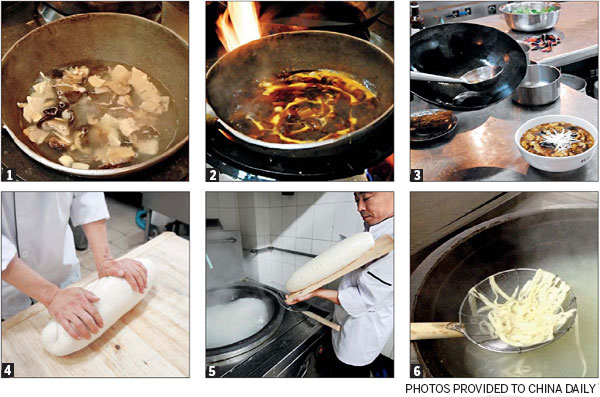
1. To prepare the sauce, add the sliced ingredients into a pot of boiling water and heat for 30 seconds. Drain and add in stock; heat until boiling.
2. Add salt, cooking wine and soy sauce. Add starchy sauce (mix starch and water in a bowl) for a thicker consistency. Pour the beaten egg into the sauce. Stir until the egg is congealed and turn off the heat. Pour the sauce into a large bowl.
3. Sprinkle the scallion slices over the sauce. In a dry wok, heat the three kinds of oil to about 240 C, and pour the oil over the sauce. It will create a strong aroma from the scallion and keep the sauce hot.
4. Combine the flour and water together to make a firm, cylindrical-shaped dough. Traditionally, the dough is kneaded by hand. To achieve the right shape, switch between kneading, folding, and rolling. Work your hands from one side of the dough to the other and maintain the same sequence throughout the process to achieve a smooth surface.
5. Hold the dough on a board. With a thin, wide blade, slice the dough into thin, long pieces. Use the force of your wrist to make fast, clean slices. This is the trickiest part of the whole dish, so be ready for a few practice rounds.
6. Boil the noodles for about three minutes. Drain the noodles and soak them in cold water to keep them firm. Drain again. Serve the noodles and the sauce separately for diners to mix their own bowls of noodles. A plate of sliced cucumber will be a refreshing addition to the overall taste.
The World of Chinese