The ancient town of Pingyao has embarked on a quest to resurrect the lost art of handmade lacquerware, Sun Yuanqing and Sun Ruisheng report.
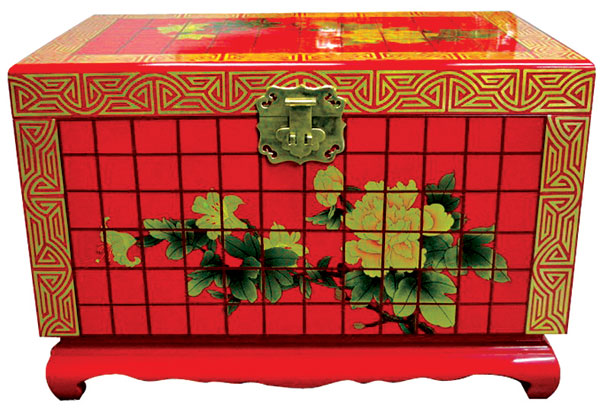
When a girl gets married in Pingyao, an ancient town in Shanxi province, at the top of her wish list is not a diamond ring, but a lacquer dressing case. Ideally it will be painted with peonies that stand for blessings, or scenarios from romantic fairy tales. The dressing case is considered not only a container of jewelry, but also a portent for a good life.
But it has been increasingly hard to find authentic handmade Pingyao lacquerware in Pingyao as the market is flooded with modern lacquerware made with chemical lacquer. That is about to change as the city embarks on a journey to rediscover its cultural heritage.
Once the Wall Street of the East, Pingyao is trying to prove that it is much more than delicate courtyards and breathtaking city walls. Pingyao lacquerware, a listed national intangible cultural heritage that is becoming a rarity in modern consumerism and tourism, is one of the cultural assets being revived in the city.
|
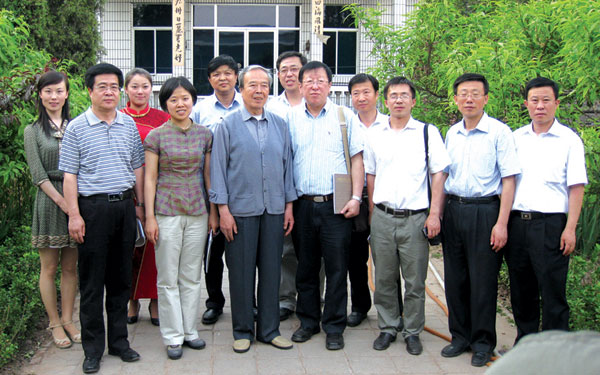
Lacquer art master and director of Tangdu Lacquer Art Museum Xue Shengjin (sixth from the left) with his students and colleagues. Photos provided to China Daily |
|
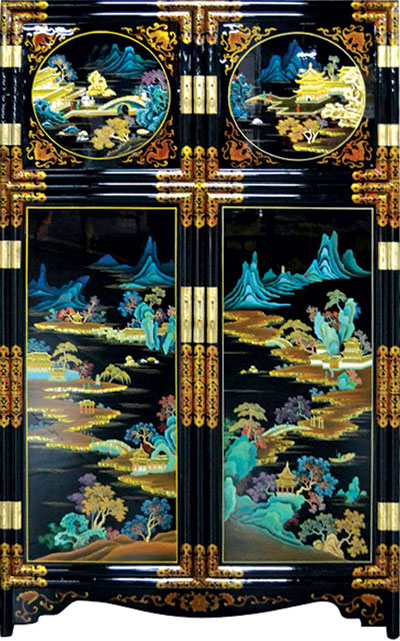
An award-winning Pingyao lacquerware cabinet. |
|
A Pingyao lacquerware trunk. |
"The modern lacquerwares can cater to tourists who want affordable souvenirs. However, they cannot be the ambassador for Pingyao lacquer art," says Xue Shengjin, lacquer art master and director of Tangdu Lacquer Art Museum.
"I'm not saying that chemical lacquer should be abandoned in Pingyao lacquer. (Whether using) chemical or natural lacquer, the key is to maintain the craftsmanship, like the hand polishing, the gold gilding and the ivory adorning," Xue says.
To preserve the genuine Pingyao lacquer art, the town invested 123 million yuan ($20.11 million) to build Tangdu Lacquer Art Industry Park in a former cotton mill to promote traditional Pingyao lacquer craftsmanship.
The park includes a production base dedicated to traditional lacquer making, a lacquer art museum, 15 masters' workshops and a training center that aims to breed the next generation of lacquer artists.
Park officials plan to build an experience center for visitors to see and experience the process of lacquerware making. It will also be equipped with catering and accommodation facilities that boast of eco-friendly lacquer tableware.
The park is also nurturing a lacquer tree forest to provide natural lacquer, the essential material in traditional Pingyao lacquerware.
The history of Pingyao lacquer art dates back more than 1,200 years to the Tang Dynasty (AD 618-907). As Pingyao became the national financial center in the Qing Dynasty (1644-1911), Pingyao lacquer art, fueled by the huge demand from wealthy local bankers, reached its peak.
Pingyao lacquer art is mostly known for its jade-like luster that comes from repeated hand polishing. When the pine wood is manufactured into the products, most of which are furniture, folding screens and tableware, it is wrapped up in linen and covered with a mixture of parget and pork blood for anti-corrosion effects. It is then polished with sandpaper and again covered with the mixture. The process is repeated several times in order to make a surface smooth enough for later procedures.
To paint on such a refined surface, artists have to train for at least four years. They draw with lynx hair brushes and outline the painting with gold powder. The painting is sometimes studded with ivory and jade for a more vivid effect.
When the painting is finished, it is covered with varnish and hand-polished by young women who are believed to have the smoothest palms. These women smear their palms with sesame oil and brick dust and polish the surface over and over until a sheen appears.
A piece of lacquerware could take months or even years to finish. Xue's representative work, a folding screen that features hundreds of playing cats, took him three years to conceive and accomplish.
Lacquerware can last for thousands of years as it is waterproof and fireproof. Today, traditional lacquerware can sell for tens of thousands of yuan to millions, depending on its size and craftsmanship.
In the early 1990s, as China developed a market economy, the traditional lacquer artistry was severely challenged by the rise of modern chemical lacquer. Intimidated by the high costs of natural lacquer and the complicated process of traditional lacquer making, producers began to use modern lacquer to cut costs.
"Sometimes the craftsmanship gets so coarse and the price gets so cheap that it is no longer what we call Pingyao lacquerware," Xue says.
Although Xue insists on using the traditional handicrafts, he encourages new artists to innovate on the shape, usage and color to cater to modern tastes.
Xue has more than 10 students at the moment, but very few of them are likely to carry on his craftsmanship. "It is very hard for the young people to settle down and devote themselves to the art for years. They are usually satisfied once they have acquired half the craftsmanship," Xue says.
Liu Jinhai, one of Xue's best students, combined anatomy in Western fine art and freehand brushwork in Chinese painting with lacquer painting to create a more lively effect.
While traditional lacquerware pieces are usually ornaments painted with scenarios from myths and fairy tales, young artists are also trying new designs.
"We are still quite limited in the aspect of carryable functional products, so we are trying to make lacquerware with practical usages and simpler patterns to cater to modern homes," says Liu.
Contact the writers through sunyuanqing@chinadaily.com.cn.
(China Daily 10/24/2013 page18)