 |
|
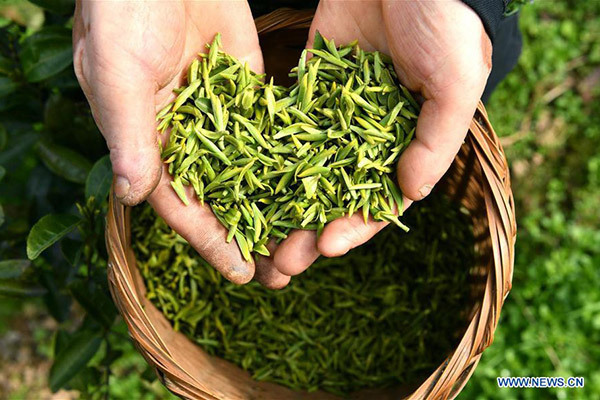
A villager picks tea leaves in Xiangjia village of Wanzhai town in Xuanen county, Central China's Hubei province, Feb 27, 2017. [Photo/Xinhua] |
The Belt and Road Initiative has inspired cities to revive another ancient trade route linking China, Mongolia and Russia, which is expected to boost tourism and trade along the route.
The route, called the Tea Road, first appeared in the 17th century when merchants from China's Shanxi province transported tea products and then other goods from South China to Mongolia and Russia, spanning more than 200 cities and 13,000 km.
It started from Wuyishan, a city in Fujian province, passed through Mongolia and stretched all the way to St Petersburg in Russia.
From May 15 to 18, government officials, scholars and leaders of various industries from cities along the route gathered in Pingyao county in Shanxi, to talk about how to revive the trade route and promote cooperation among them.
Li Zhaoshu, mayor of Chibi, a city in Hubei province, said it is planning to seize the opportunity to establish a tea processing base in Kungur, Russia, which has already established a sister-city relationship with Xianning, a city neighboring Chibi.
According to Li, Chibi has sold its tea products to Russia for many years, but is eager to set up a production base, which can cut logistics costs and also provide more products to local consumers.
Along the Tea Road, Chibi is the most famous place for producing brick tea, a kind of tea that is pressed into the shape of bricks at high temperature.
"The idea of reviving the ancient tea road provides great chances for us to enhance bilateral cooperation and promote win-win economic development," Li said, adding that governments may introduce supporting policies if cities have a high enthusiasm for the endeavor.
More than 400 representatives such as Li expressed hope for further cooperation on the "Tea Road" in different fields at the fifth China-Mongolia-Russia Mayors' Summit.
The summit was initiated by the Chinese Culture Promotion Society, an NGO administrated by the Ministry of Culture, and was launched in 2012.
Munkhnasan, the governor of Arkhangai province in Mongolia, said he came to find Chinese partners to invest and provide guidance in developing a tourism project in the province.
"China has abundant experience in developing tourism projects and building entertainment facilities such as glass skywalks, all of which can help promote the development of tourism in my hometown," he said.
The tripartite cooperation has already boosted solid foundations in different fields.
A China-Mongolia-Russia corridor, one of the six corridors in the framework of the Belt and Road Initiative, is being pushed forward.
Xing Guangcheng, a senior researcher on Russian and Central Asian studies at the Chinese Academy of Social Sciences, said the corridor is the modern Tea Road to enhance the three countries' cooperation.
Data from the National Development and Reform Commission show that trade between China and Mongolia reached $7.3 billion in 2015, and trade between China and Russia reached $64.2 billion, reported People's Daily website.