 |
|
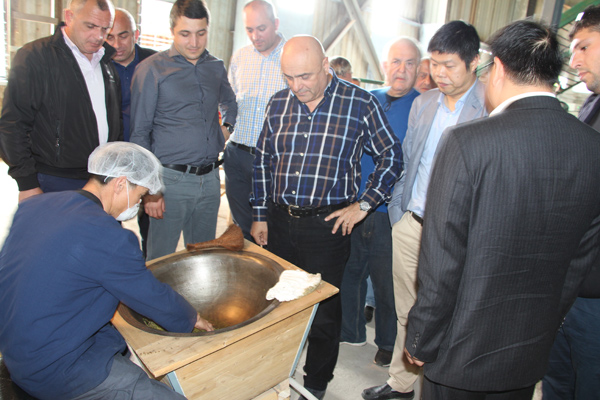
Staff members of a Georgia factory view a demonstration of Chinese tea processing techniques. [Photo provided to China Daily] |
Hangzhou Wanhu Tea is stimulating beverage business across the world
Hangzhou Wanhu Tea Co Ltd, which sells the famous Chinese black tea, has expanded its business quickly in Georgia.The erstwhile Soviet republic and now an independent country offers exceptional conditions for growing tea. Bordering West Asia and East Europe, Georgia has warm and humid climate, balanced ecology and ample annual precipitation.
It was also an important stop on the ancient Silk Road. But its tea industry has been floundering of late. Wanhu Tea's West Lake Kungfu, a recognized brand, is helping improve the situation.
Wanhu Tea now owns more than 200 hectares of tea plantations in Georgia. More plantations are expected in the next few years.
"The local government is keen to cooperate with us for the long term, as the quantity and quality of our tea products have been improving," said Zhang Wanhu, 43, president of Wanhu Tea.
The main source of income for Georgian farmers is autumn crops. During the slack seasons, they make only about 200 lari ($114) per month, according to Zhang.
"By working at our plantations, their monthly salary can grow to 300 to 400 lari. Every day, farmers living within a radius of 15 to 20 kilometers (from Wanhu's local plantations) collect fresh tea leaves for us," Zhang said.
As a member of the Organization of the Black Sea Economic Cooperation, Georgia signed a free trade agreement or FTA with Turkey and some of the Commonwealth of the Independent States nations. It also enjoys preferential customs duties in Europe and the United States.
"Our products manufactured in Georgia will be mainly sold in its traditional markets, such as Central Asia, Europe, Russia, and the Middle East. Besides, we bring part of the premium tea products back to China," Zhang said.
While establishing a manufacturing base and opening up physical stores in Georgia, Wanhu Tea is also exploiting opportunities brought by the growing popularity of e-commerce platforms.
"In the future, Chinese consumers can buy our products from e-commerce platforms such as Tmall.com and JD.com, and we also look forward to working with international e-commerce platforms to sell our products globally," Zhang said.
"We plan to invest in the whole industrial chain in Georgia. It will include growing, processing, trading and financing tea, in addition to the promotion of tea culture and ecological tourism."
 |
|
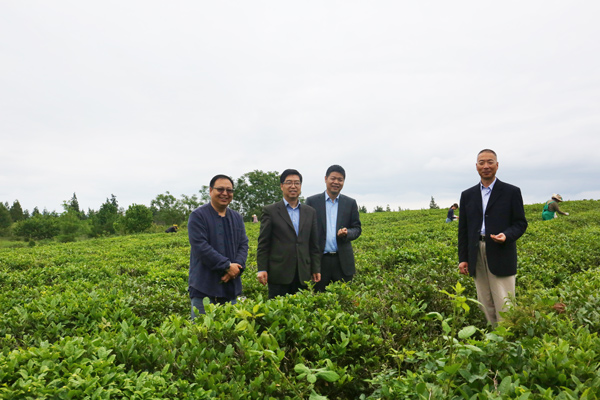
Hangzhou Wanhu Tea Co Ltd executives pay a visit to a tea farm in Georgia. [Photo provided to China Daily] |
In April last year, Wanhu Tea brought equipment and workers for the first time to Georgia. That was a throwback to a similar visit to Georgia by a Chinese man over 120 years ago.
In 1893, Liu Junzhou set forth from Ningbo of East China's Zhejiang province and brought tea seeds and workers to Georgia. He lived in the country for 21 years, during which he opened tea plantations and a tea school, and trained tea planters. Liu laid the foundation for Georgia's modern tea producers.
"When I first came here, the wild grass was taller than tea shrubs, but I could recognize that the tea here is of ancient Chinese strain," Zhang said.
In April this year, Zhang and his team of tea masters went to Georgia again to introduce advanced tea-making techniques.
On May 13, the Ministry of Commerce announced that China and Georgia have signed an FTA, which will see China exempt import duties on almost 94 percent of Georgian goods, and Georgia will reciprocate by doing away with import duties on 96.5 percent of Chinese products.
"We want to make a difference and achieve better results than our ancestors under the supportive policy of the Belt and Road Initiative. Wanhu Tea's best tea masters will teach local people in Georgia how to make high-quality tea."
Born in Shanxi province, Zhang knows that local tea merchants had developed the famous Sino-Russian Tea Road. The route enabled transport of Chinese tea from East China's Fujian province to Mongolia and Russia during the reigns of the Ming and Qing dynasties (1368-1911).
"China is the birthplace of tea, and it boasts excellent tea-making techniques and profound tea cultures. As a Chinese tea maker, I feel obliged to popularize Chinese tea products and cultures across the world," Zhang said.
Zou Shuo contributed to this story.