The Rules in the Digital Economy and Access to Justice
The Rules in the Digital Economy and Access to Justice
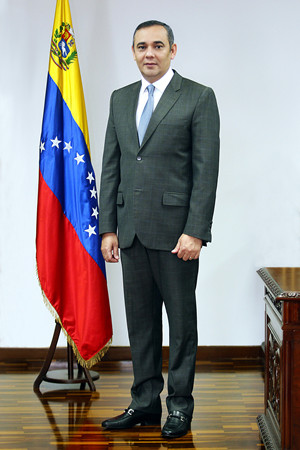
Maikel Jose Moreno Pérez,
Magistrate of the Criminal Cassation Chamber of the Supreme Court of Justice of Bolivarian Republic of the Venezuela
His Excellency Dr. Zhou Qiang, President of the Supreme People's Court of the People's Republic of China:
I would like to thank you for your kind invitation to this important academic space, which allows us to exchange experiences on the rule of law in the digital economy. I cordially and respectfully greet the high representatives of the judiciary attending this forum. It is an honor to present my talk before you.
Our societies evolve as the means of production, transportation and the essential tools for the development of trade and cooperation between cultures are perfected and massified. Commercial exchange is a requirement that allows and guarantees the subsistence and development of our civilization. We are moving at an accelerated pace towards the standardization and globalization of processes that promote the economy on a worldwide scale, based on a universal technological framework, where the access to the Internet, social networks and simplified interconnection have given way to the digital age.
And this period of our history represents a great challenge for those who dictate the laws, but above all for those of us who have the duty to make them effective. The rules of the law in the digital era must be frankly different from those commonly conceived by traditional juridical institutions, and this results in the adaptation of rules to computer, telematic and digital processes, which currently govern all commercial business. It is precisely because of this, the emergence of new technologies seems to have no limits, since they derive endless potentially juridical relations between individuals and between the economic sources of our countries. The digitization of information, the internet, electronic trade and the emergence of crypto-actives have made it possible to evade physical borders, thus achieving an uncontrolled expansion of commercial relations, which, in the best of cases, are usually lawful and rational. However, without an effective legal control, these could be used as means of new criminal trends that endanger the security of the parties and, on a global stage, the security of the states. At this point, we must ask ourselves: How to conceive, materialize and make viable an effective legal mechanism for control and access to justice? To answer this question, we must establish that this mechanism must be governed by the principles of haste, reliability, transparency, suitability, freedom of evidence, and simplicity.
The challenge for legal institutions and government entities is to create a rational, easily accessible, effective and direct legal framework to resolve conflicts that may arise in the digital age and based on this, conceive a regulatory system that is of easy understanding, differentiated in three fundamental phases or areas.
Firstly, the accessibility to the system and the filing of claims and demands online.
Secondly, the arbitration and conciliation of conflicts.
And thirdly, the judicialization of cases governed by a brief and expeditious process, which seeks the forced resolution and sanctioning of the infractions found under a consensual and pre-established legal framework.
It is our duty to promote an integral justice system for commerce and trade, creating clear rules, easily accessible systems to report any trade violation, promoting arbitration and fostering the creation of special economic jurisdictions where virtual or internet courts could be set up, with the capacity to apply to the parties to their jurisdiction and competence. I believe that, with the characteristics of these systems, the parties can feel protected and encourage greater use of electronic tools to favor commercial activity.
The Bolivarian Republic of Venezuela has implemented the "Virtual Dispatch" program (Despacho Virtual in spanish), where courts with jurisdiction in the civil area receive the lawsuit and subpoena by email and other vía digital, serving electronically the parties that submit to the process in order to generate an expeditious mechanism of resolution of conflicts in civil and commercial matters. We have seen the immense utility of the system, since greater transparency and objectivity have been achieved as an immediate result in the process; the parties are notified in real time and can have immediate access to their affairs from anywhere, via the Internet.
In short, Venezuela contributes with its experience to the law of the digital age, breaking down the limits that were imposed by formal legal institutions, which, far from prioritizing the speed and security of the parties, turned the civil trial into a complex instance where the acts were delayed due to the absence or inaction of the parties in conflict.
It is time to make technology friendly and to promote new and better tools that prioritize rational electronic commerce, as a sustainable and safe objective for our citizens.
Thank you very much.
 |
|
MAIKEL JOSé MORENO PéREZ |
Justice, Magistrate of the Criminal Cassation Chamber of the Supreme Court of Justice Bolivarian Republic of the Venezuela
ACADEMIC FORMATION
?Doctor in Criminal Sciences and Criminalistics at the Santa Rosa Catholic University in 2019.
?Doctor in Constitutional Law at the Santa María University in 2014.
?Lawyer graduated from Santa María University in 1995
TRAJECTORYPROFESSIONAL
?President of the Supreme Court of Justice from February 24, 2017 to April 2022.
?First Vice President of the Supreme Court of Justice from February 11, 2015 to February 24, 2017.
?President of the Criminal Cassation Chamber of the Supreme Court of Justice from February 11, 2015 to the present.
?Magistrate of the Criminal Cassation Chamber of the Supreme Court of Justice since December 28, 2014.
?Minister Counselor of the Embassy of the Bolivarian Republic of Venezuela in the Republic of Trinidad and Tobago (Charge d'Affaires), Ministry of People's Power for Foreign Relations, 2008-2010.
?Counselor of the Embassy of the Bolivarian Republic of Venezuela in the Italian Republic, Ministry of Popular Power for Foreign Relations, 2007-2008.
?Titular judge of the Court of Appeals of the Criminal Judicial Circuit of the Metropolitan Area of Caracas, Supreme Court of Justice.
?Provisional judge of the Court of Appeals of the Criminal Judicial Circuit of the Caracas Metropolitan Area, Supreme Court of Justice, 03/01/2005 - 12/07/2005.
?Provisional Judge of the Court of First Instance of the Criminal Judicial Circuit of the Metropolitan Area of Caracas, Supreme Court of Justice, 02/10/2002 -07/12/2005.
?Ad Honorem Advisor to the Permanent Sub-Commission on Drugs of the National Assembly, 01/15/2001 - 01/15/2002.
?Special substitute judge of the First Instance of the Delta Amacuro State Criminal Judicial Circuit, 10/15/2001.
?Advisory lawyer, Police of the Sucre Municipality, 02/01/2001.
?Consultant lawyer, National Electoral Council, 08/28/2000 - 11/27/2000.
?Legal Advisor, Aeropostal Alas de Venezuela, 02/1997 - 07/2000.
?Bailiff, Executive Directorate of the Magistracy, 02/28/1994 - 10/26/1994.