
Calls to revive intangible cultural heritage while there's still time
At the recently closed meetings of the nation's top legislators and political advisers, some delegates said many intangible cultural heritage items in China may soon face their final curtain due to the aging of their inheritors.
The government and experts called upon the young to learn the cultural traditions. One of the measures to better protect cultural assets is a nationwide pilot training program launched in 2015 by the Ministry of Culture.
Last year, the ministry organized 35 research and training sessions at 23 colleges in 12 regions across China, attracting about 1,800 artisans. Shanghai University, for example, welcomed nearly 60 artisans from Qinghai's Golog prefecture, aged from 16 to 70, in an exchange program.
Ma Shengde, deputy director of the ministry's intangible cultural heritage department, said all the colleges they chose have years of experience in teaching, researching and protecting intangible cultural heritage. Some have related museums and the others have established long-term partnerships with inheritors.
This year, the ministry expanded the program to 57 institutions, including Tsinghua University, the Central Academy of Fine Arts and Tongji University, which will involve nearly 20,000 participants.
Some programs involve not only traditional skills but also Western theories and techniques.
Wang Lingshan, a professor at Shanghai University's College of Fine Arts, said there is no reason to make the inheritance of centuries-old national craft in conflict with learning more about the outside world in modern society.
Innovative courses such as painting and embroidering traditional pictures on reusable cloth bags can help inheritors better integrate time-honored craftsmanship with modern life and promote the country's intangible cultural heritage to go global, experts said.
"The program does not aim to replace the traditional master-apprentice pedagogy, for people cannot finish comprehensive learning of a subject in a monthlong session," Ma told Xinhua News Agency. "We want to improve people's ability to understand old art forms and crafts and explore better ways to transmit that knowledge to today's youth."
"Intangible cultural heritage items should not be destined for the museums and archives. They need to live among the people," he said.
Cultural authorities in many provinces and regions have made efforts to keep intangible cultural heritage items alive across the generations.
In Shandong province, a training course on the classic Lyuju opera Zi Mei Yi Jia opened on March 14. The project will enroll 28 trainees after nationwide selection and last nearly six months.
Zhang Guilin, deputy head of the Shandong Provincial Department of Culture, told China Daily he hopes the project can strengthen the team of young Lyuju opera performers and promote development of the intangible cultural heritage.
Zhao Jing, a trainee and national-level performer of Lyuju opera, said she could systematically learn the artistic creation of the opera during the course and carry forward that knowledge to her troupe.
haonan@chinadaily.com.cn
 |
|
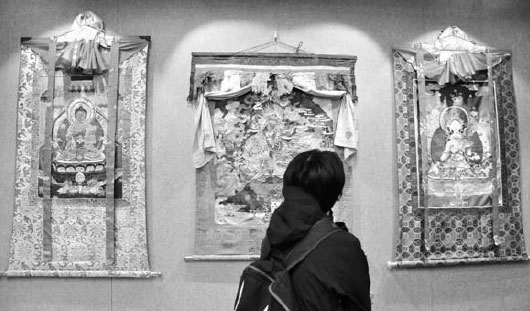
A visitor looks at Thang-ga paintings at an exhibition in Shanghai that showcases intangible cultural heritage items from Tibet. [Photo provided to chinadaily.com.cn] |
 Shandong: Where Excellence is made
 Building a Moderately Prosperous Society: The Tai'an Way
 Video: Jiunvfeng Park