Proper trash disposal can help us win fight against virus







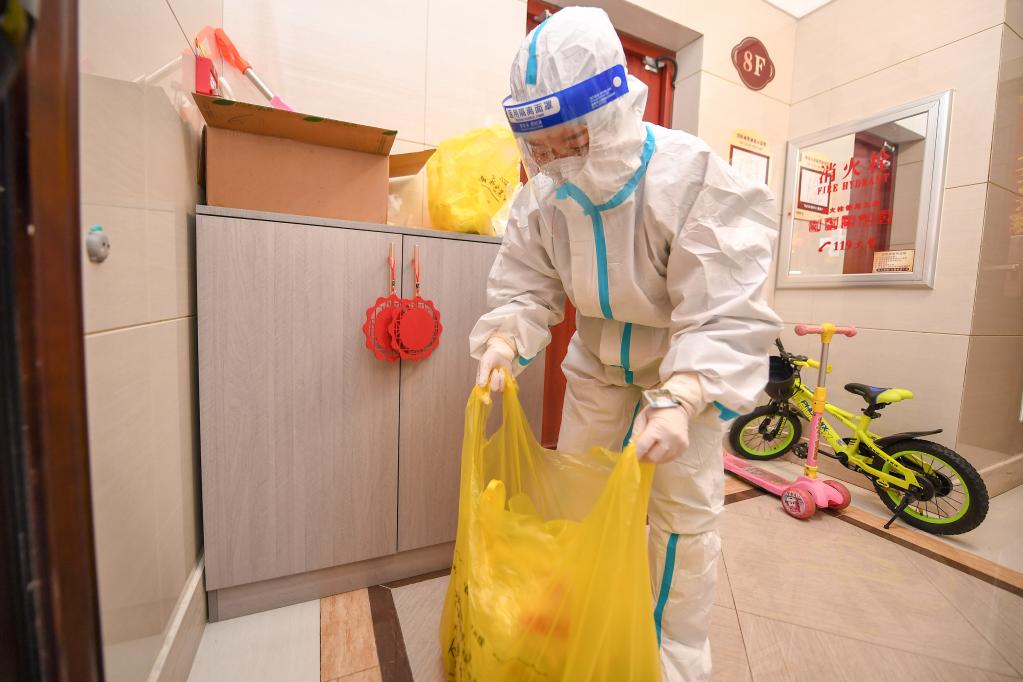
Several Chinese cities and provinces are facing a novel coronavirus resurgence, with strict pandemic prevention and control measures, even lockdowns if necessary, being implemented in places where infection rates are abnormally high. Against this background, proper disposal of waste can help prevent the spread of the virus and contribute to the success of the dynamic clearing policy.
At the beginning of the pandemic in 2020, proper disposal of used face masks was accorded high priority. According to the guideline of the State Council, China's Cabinet, face masks used by healthy people should be treated as household waste, while masks worn by people suspected of being infected and confirmed patients should be disposed of as medical waste.
As such, special trash cans have been placed in public places for the disposal of used masks. Many neighborhoods, too, have introduced such cans so the masks used by confirmed patients and those suspected of having contracted the virus can be separated and disinfected.
Although most parts of China are at low COVID-19 infection risk, measures still need to be taken against the possible spread of the virus. Since some people in Beijing have contracted the virus from imported goods, and media reports have been saying the virus has been detected on overseas mails and clothing, the Beijing Center for Disease Control and Prevention has recommended that people unpack their overseas deliveries outdoors and get them sterilized, instead of carrying them inside the house.
Cleaners, sanitation workers and people who work in waste treatment plants should take special care when disposing of packaging and other waste from imported goods, and the government must make arrangements for their regular nucleic acid tests.
In particular, the garbage disposal process should be strengthened in places such as hospitals, including makeshift hospitals, quarantine hotels and neighborhoods with confirmed cases.
The guideline for the classification and disposal of domestic waste during the pandemic (trial implementation) published by the China Association of Urban Environmental Sanitation says trash generated by medical isolation units should be treated as medical waste, which according to rules, should be sealed, labeled "infectious waste" and dumped only at designated places. Also, it is important to spray the waste with chlorinated disinfectant (1,000 milligram per liter) after dumping them in a trash can and before loading them on trucks for transportation.
As for trash at quarantine centers, Beijing requires them to be collected, transported and disposed of as medical waste rather than being mixed with household garbage. While some cities facing outbreaks, such as Shanghai and Harbin, capital of Heilongjiang province, are following similar rules, Shenzhen has improved the trash disposal process in areas where infections have broken out.
Unlike in no-infection and low-infection areas, in places under lockdown or stricter anti-pandemic restrictions, waste is collected by designated people wearing personal protective equipment. Residents in such places are required to put all the garbage including leftovers and masks into special garbage bags, tie them tightly and keep them outside their door for the cleaners to collect.
The cleaners in turn put those special garbage bags in trash cans whose inside is lined with huge plastic bags to avoid direct contact between the garbage bags and the trash cans, tie the big plastic bags and load them on trucks for transportation to incineration plants.
This process has been strictly followed by places where cluster infections have broken out including Dongcheng district of Beijing. With the expansion of quarantine areas in Shanghai, its waste output has increased and so has the need for waste disposal. According to reports, on March 16, Minhang district of Shanghai, where infections had broken out, generated more than 200 tons of garbage. But despite the generation of huge amounts of garbage, Shanghai has been disposing them properly.
Overall, given the highly contagious Omicron variant of the virus and sporadic outbreaks in China, there is a need to attach greater importance to garbage disposal in order to avoid cross infection and bring the pandemic under control as soon as possible.
The views don't necessarily represent those of China Daily.

If you have a specific expertise, or would like to share your thought about our stories, then send us your writings at opinion@chinadaily.com.cn, and comment@chinadaily.com.cn.