


Keeping tradition alive
Inheritors of intangible cultural heritage help ensure their art not only survives but thrives, Alexis Hooi and Wang Haoran report in Rizhao, Shandong.







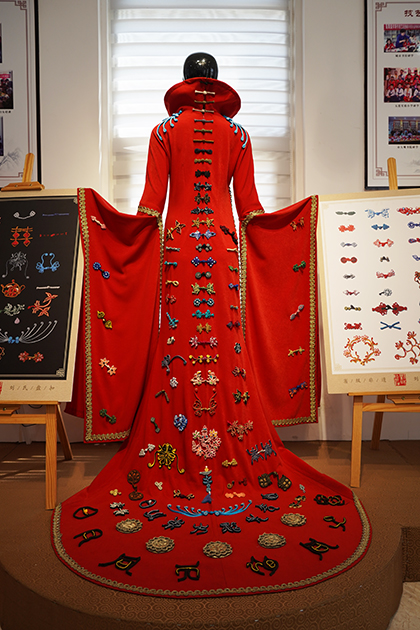
Liu Dongmei crafts intricate pankou, or traditional Chinese knotted buttons commonly used on qipao dresses. Ask the master artisan about the main factor behind her elaborate designs and the answer is surprisingly simple.
"First and foremost, you must have the passion for making them," she said.
Liu, 62, is a provincial-level intangible cultural heritage artisan in Wulian county of Rizhao, East China's Shandong province. Her award-winning pankou designs have adorned the dresses of luminaries in the public and private sector, appeared in national and other major ceremonies and events, and even emerged in modern, creative cultural items such as handbags and other fashion accessories.
The earliest written records of Chinese knot buttons can be traced to the Zhou Dynasty (c.11th century-256 BC).
Pankou artisans usually fashion thin strips of cloth before twisting them meticulously into different shapes and affixing them to the collars of the quintessential Chinese dresses. A traditional pankou combines an embossment with a circular piece of material, which are looped like a buckle to "tie" the button.
"I also conduct regular classes and training sessions for children and young women," Liu said.
She has been involved in about 1,600 pankou-making classes for students and conducted free training sessions for at least 660 women from local villages, as well as helped provide job opportunities related to the craft for more than 80 people.
"We must keep this Chinese tradition alive and constantly innovate to help it thrive," Liu said.