Power of Chinese innovation







CNNC-built Hualong One nuclear reactor technology reaches significant milestone
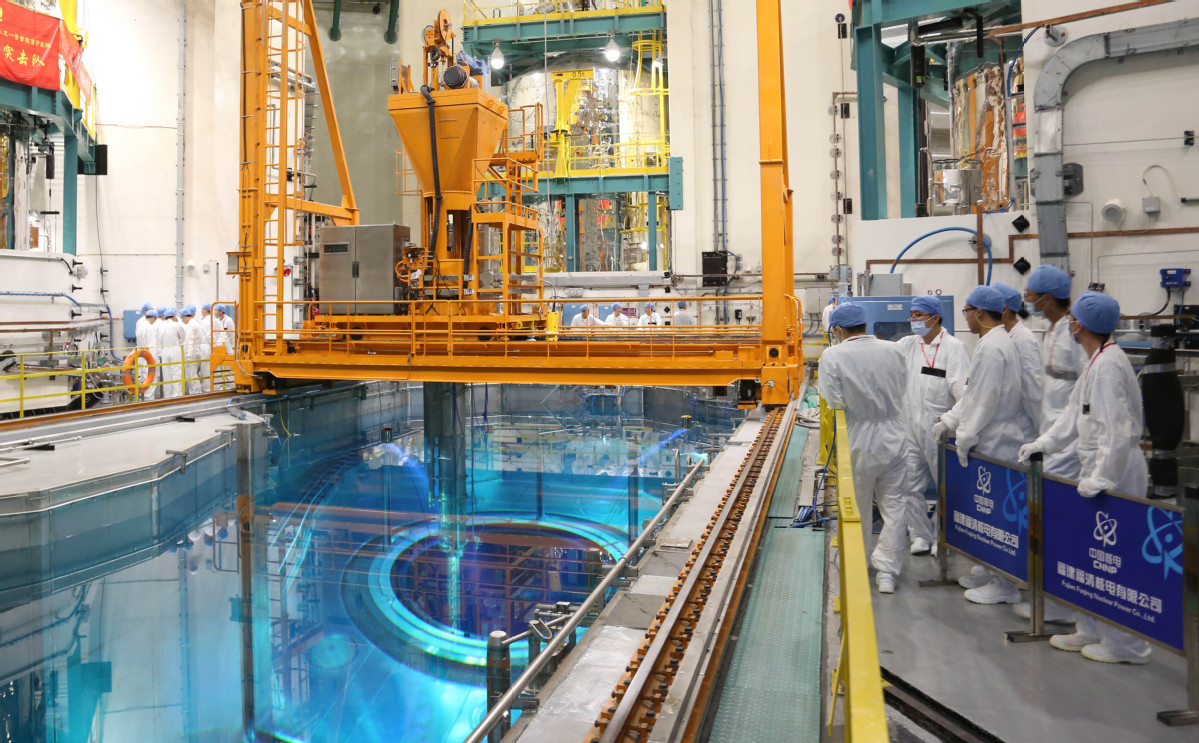
May 20 marked a big milestone for the Chinese nuclear power industry in general and China National Nuclear Corp in particular, when homegrown Hualong One technology completed the first ever 100 hours of continuous use.
The milestone was reached at the K2 unit of the Karachi nuclear power plant in Pakistan, the first overseas entity to use China's third-generation nuclear reactor technology for electricity generation. CNNC is the operator of the K2 unit.
The event signifies the commercial potential of the technology and will make it more competitive on the global stage, said experts.
Another reactor K3, which is under construction, will enter hot functional tests from August and be put into commercial operation in 2022.
Each unit is expected to generate about 9 billion kilowatt-hours of electricity annually. This should meet the demand of 4 million households, and would be equivalent of reductions in standard coal use by 3.12 million metric tons and carbon dioxide emissions by 8.16 million tons annually, CNNC said.
The success in construction and operation of the nuclear reactors in Pakistan will make the Hualong One technology better received in the global market, especially in countries and regions participating in the Belt and Road Initiative, it said.
With a design life of 60 years, Hualong One meets the highest global security standard. Jointly designed by CNNC and China General Nuclear Power Group (CGN), it is developed and designed on the basis of more than 30 years of nuclear power research, design, manufacturing, construction and operation.
There are eight nuclear reactors-six in China and two in Pakistan-currently under construction that will use Hualong One technology. China is hoping to further use its third-generation Hualong One design to boost its presence in the overseas nuclear power sector. It is already making further plans to build projects in Argentina and the United Kingdom.
In September 2016, CGN inked an agreement with France's EDF and the British government to develop a nuclear plant in Somerset, the UK.It was given the green light to enter Europe in November, which could advance a project in the UK with a certificate to show that it complies with the latest European Utility Requirements.
Argentina is also considering using the Chinese nuclear technology to build its fourth nuclear power plant.
Analysts believe China, once a novice that intends to build nuclear power plants based on designs from France, the United States and Russia, sees its own designs just as viable and can compete on safety and cost.
Wei Hanyang, a power market analyst at Bloomberg New Energy Finance, said there is a clear trend that China is moving away from imports of nuclear power technology to acceleration of local adoption, which in turn will help export Hualong One to more countries.
Li Xiaoming, assistant general manager of CNNC, said earlier that Hualong One is very competitive as a technology as it is just about the same as those of the United States, France and Russia, a foundation that will be relied on for future survival and international competitiveness.
China is among the few countries that have independently mastered third-generation nuclear power technology, with the comparative advantages to scale up and go into mass production, said Huang Feng, a member of the expert committee of the China Nuclear Energy Association.
According to Joseph Jacobelli, an energy analyst, author and senior adviser for Asia at Cenfura Ltd, a smart energy services company, the long-term prospects for China's new generation nuclear reactors going abroad are positive, as long as they build up strong operational track records and their cost per kilowatt-hour can compete with the local average power costs.
"The technology has been gradually developing over the past few years, with a particular acceleration during the period from 2016 to 2020," he said.
"Given the large amount of capacity to be built over the next few years, there is no reason for China's nuclear technology not to be one of the world's leading."
Despite a pause in the nuclear sector in many other countries, China's nuclear sector has been steadily moving forward with the country's independent research and manufacturing in the industry continuing to increase.
By the end of 2020, China had 49 operational nuclear power units. With 51.03 gigawatts of installed nuclear power capacity, it is the third-largest globally, said the CNEA.
The sector continues to develop even though it makes up just around 5 percent of the country's total generation, compared with 70 percent in France, 19 percent in the United States and 12 percent in Germany, said Bloomberg New Energy Finance.
The agency predicted that China will surpass France as the world's second-biggest nuclear power generator in 2022 and overtake the United States four years after that.
Zhao Lidong, general manager of Hualong One overseas project of China National Nuclear Corporation, said the K2 unit is of great significance as it optimizes Pakistan's energy structure, promotes the realization of the global targets of peaking carbon emissions and reaching carbon neutrality and jointly dealing with the global climate crisis.
"The construction of the Karachi nuclear power plant has helped promote the development of local economy and related industries," he said.
"We have directly provided over 10,000 jobs for Pakistanis and indirectly created more than 40,000 jobs through industrial chains, which has played a significant role in promoting the local people's livelihoods and economic growth in Pakistan."
Pakistan's Prime Minister Imran Khan said his country badly needs clean energy projects and the K2 will cater to the need.
The power plant will not only enable the transfer of technology from China but also equip local people with skills to use the state-of-the-art technology, he said.