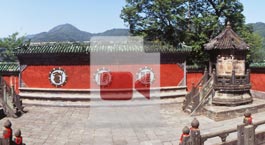
Zigui, hometown of Qu Yuan
( chinatravel.com, chinaculture.org )
Updated: 2011-12-01
Wang Zhaojun
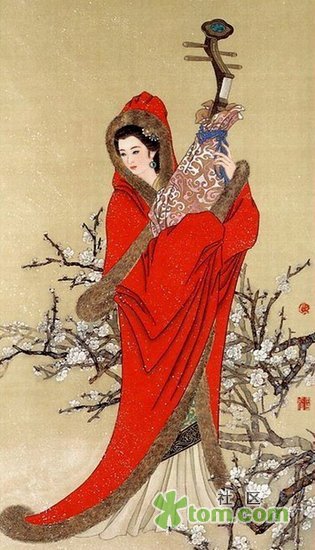 |
| Wang Zhaojun (photo from tom.com) |
Wang Zhaojun is perhaps the best known of China's "political brides". Wang Zhaojun was a real person, born in Zigui county (in current Hubei province) in the Western Han Dynasty (206 BC- AD 8). Her name was Wang Qiang, and Zhaojun was her style name. During the Jin Dynasty (265-420), she was referred to as Mingfei (Concubine Ming) as the name Zhao could not be used by ordinary folks since the King Sima Zhao had the same surname.
All this can be found in the official records, for in her teens she entered the palace as one of the numerous candidates from whom Emperor Yuan chose his concubines.
According to records, during the reign of Emperor Yuan (48-33 BC), Wang Zhaojun, a daring and determined young woman, entered the imperial harem willingly to save her father, a scholar-official, from persecution. She was beautiful, intelligent and well read.
At that time, the emperor chose concubines from his vast harem of maidens by looking at their portraits. As a result of this practice, it had become the custom for palace ladies to offer large bribes to court artists to ensure that they painted a flattering likeness. Wang Zhaojun, however, so sure of her beauty, refused to bribe the court painter Mao Yanshou. As a result Mao Yanshou painted an unflattering picture of her. From the finished portrait, she seemed to be the ugliest of all the palace ladies, and thus never received the emperor's favor. Wang Zhaojun did not like the thought of wasting her life in the imperial harem, and hoped that some day something would happen that would free her from it.
In the year 33 BC the Huns, a nomadic people of the north, wanted to establish friendly relations with the Han Dynasty through marriage. When Huhanxie, the Chanyu (Khan) of Hun, came to the Han capital to request a Han princess as a bride, Emperor Yuan agreed. Unwilling to pick out a real beauty, the emperor ordered that the plainest girl in the harem be selected for the marriage, and gave her away like his own daughter. He asked for volunteers. The idea of leaving their homeland and comfortable life at the court for the grasslands of the far and unknown north was abhorrent to most of the young women. But not to Wang Zhaojun: she saw it as a chance to leave the empty palace life and possibly play a more important role than she ever would. She applied. When the lady-in-charge of the harem sent the unflattering portrait of Wang Zhaojun to the emperor, he merely glanced at it and nodded his approval.
Only when Wang Zhaojun was on the point of departure did Emperor Yuan set eyes on her. Much to his dismay, he realized his terrible mistake that Wang Zhaojun was in fact the loveliest woman in his harem. He wanted to find a substitute for her; however, it was too late for the Emperor to change his decision. The fate of Wang Zhaojun had however been sealed. In anguish and sorrow, he parted with Wang Zhaojun. The court artist Mao Yanshou was subsequently put to death for deceiving the Emperor.
Emperor granted Wang a generous dowry and , specifically for this event, even changed the name of his reign to Jing Ning (peaceful boundary), implying that Zhaojun's departure for Hun way beyond the Great Wall would ensure everlasting peace and harmony between the Han and the Hun and a trouble-free border.
Under the escort of Han and Hun officials, Wang, in a beautiful red dress and with a pipa in her arms, set off from Chang'an on a white horse for her long journey to the distant land of the Huns. At the beginning, she found it hard to adapt to the way of life of the Hun. However, she was determined to overcome all difficulties and gradually became used to their habits and customs. Eventually Wang Zhaojun got on very good terms with the Huns and succeeded in spreading the Han culture and civilization among the Hun tribe. As she was loved and respected by the Huns, Chanyu (Khan) Huhanxie conferred on her the title of the First Lady of Hun Peace, eulogizing Zhaojun as a queen who had brought peach and security to the Hun tribe.
Wang Zhaojun lived in Hun for the rest of her life. Her children continued her work of forging a friendly and amicable relationship between the Han and the Hun. The story of Zhaojun's Settlement Way beyond the Great Wall has become a household tale in the history of the friendship and unity among Chinese nationalities as well as a popular subject in Chinese poetry, drama and novels. Today, her tomb at Hohhot in Inner Mongolia was one of the eight special scenery spots in present Inner Mongolia, which was built by the Huns of olden times in memory of this goodwill envoy from the Han.